Pomegra
Path Robotics raised a $300 million Series E at a $2.45 billion post-money valuation, led by Georgian, to push its welding AI into defense shipbuilding and other manufacturing tasks.
Key Takeaways
- Path Robotics closed a $300M Series E at a $2.45B post-money valuation, led by Georgian.
- Annual recurring revenue grew 17-fold in 18 months; total funding now tops $610M.
- Funds go to scaling welding, new manufacturing tasks, new robot form factors and model training.
Lead
Path Robotics, a Columbus, Ohio, startup that builds AI-driven autonomous welding systems, announced a $300 million Series E on November 10, 2026. The round values the company at $2.45 billion post-money. Georgian, a growth equity firm focused on AI, led it. Existing backers Tiger Global, Addition, Drive Capital, IronArc Ventures and Yamaha Motor Ventures also took part, and D. E. Shaw Ventures and NAVER Ventures joined as new investors.
Founded in 2018, Path has now raised more than $610 million. Georgian partner Emily Walsh is joining the board.
What Does Path Robotics Actually Sell?
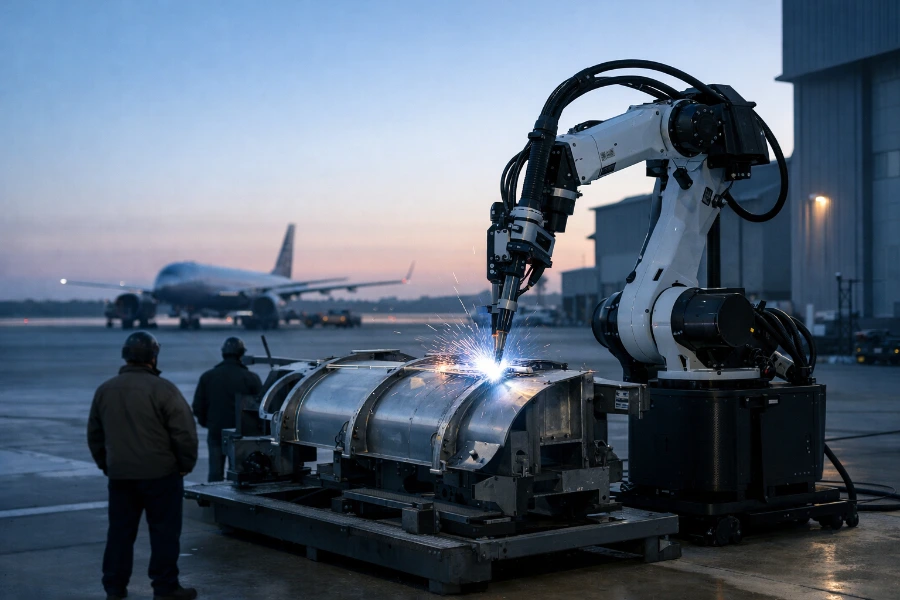
Path sells robotic welding cells driven by Obsidian, a model that combines machine learning and computer vision. The robot locates the weld joint, plans the weld and adjusts as conditions change, rather than running a fixed program written by an integrator for one part.
That matters because conventional welding robots need precisely fixtured, repeatable parts. Most fabrication shops, especially in shipbuilding and heavy equipment, do not have them. Path's pitch is that vision and learned control can handle variation that scripted automation cannot.
The company also launched Rove, a mobile welding system that pairs Obsidian with a quadruped robot platform. Path presents it as proof that the model can transfer across robot bodies. Preorders for Rove stand at 50 units, according to the company's own figures.
Why Did Investors Pay $2.45 Billion?
Investors paid for growth and a defense anchor customer. Path says its annual recurring revenue grew 17-fold over the past 18 months, though it has not disclosed the absolute figure. A multiple without a base is hard to price, and the starting point was presumably small.
The anchor is HII, the shipbuilder, which signed a $600 million performance-based production agreement with Path earlier this year to speed deployment across U.S. Navy shipbuilding programs. "Performance-based" means the full value depends on delivered results, so the headline figure is a ceiling rather than booked revenue. Lockheed Martin and Saronic, a maker of autonomous military vessels, are also customers, alongside mid-sized shops such as EK Machine, Millerbernd Manufacturing Company, TransAmerican Power Products and TYCROP.
The valuation also reflects a sharp step up from the prior round. Path did not disclose its Series D terms in the announcement, but the new figure is close to four times the previous mark, according to reports of the deal.
How Will the Money Be Spent?
Path plans to spend the capital on three things: scaling its welding business, building AI for manufacturing tasks beyond welding, and training larger models with more data and compute. It also intends to develop new robot form factors.
Headcount grew 97% over the past year, and the company is targeting 400 employees by the end of 2026. Expansion into defense and energy infrastructure is part of the stated plan.
The move beyond welding is the riskiest part of the thesis. Welding gave Path a narrow, measurable problem with a clear labor shortage behind it. Grinding, cutting or assembly will require new data and new customer validation, and each carries its own incumbents.
Competitive and Market Context
Path competes for the same pool of growth capital as other industrial robotics startups. Bedrock Robotics, which targets construction equipment, has reported a $600 million Series C at a $4.1 billion valuation, and Formic raised a $50 million Series B for factory robots. Investors are funding "physical AI" companies at valuations that assume software-like scaling in businesses that still ship hardware and install it on customer floors.
Path also argues its tools do not displace welders. The company states that none of its customers has ever fired a welder because of a task robot. That claim is Path's own, and it will be tested as deployments scale into the thousands of cells that a $2.45 billion valuation implies.
What Comes Next for Path Robotics?
The next test is whether revenue converts from the HII framework into recurring contracts. If the Navy program delivers on schedule, Path gains a reference customer that few competitors can match. If shipyard throughput gains fall short, the performance-based structure limits how much revenue the company can recognize.
A second question is capital intensity. Path has raised more than $610 million in eight years, and hardware deployment, field support and model training are all expensive. A public listing or a further private round would be the likely routes to fund that spending, though the company has announced neither.
Outlook
Path Robotics enters 2027 with $300 million in fresh capital, a defense anchor contract and a valuation that prices in rapid expansion. The evidence so far is a 17-fold ARR increase from an undisclosed base and a performance-based Navy agreement. Delivery on that agreement, and proof that Obsidian works outside welding, will determine whether the round looks conservative or early.