Pomegra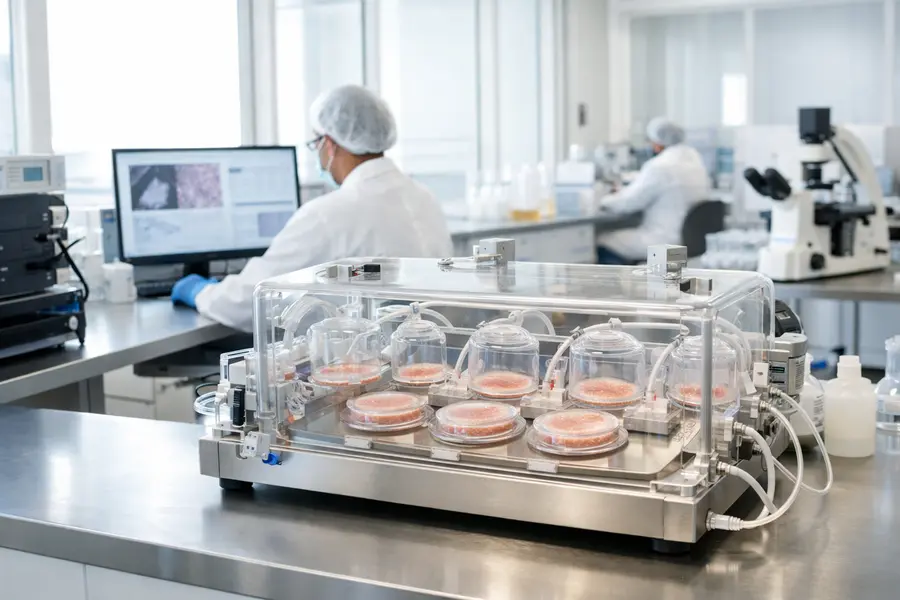
Outer Biosciences kept human skin tissue alive outside the body for a month to train an AI that finds new cosmetic and pharmaceutical ingredients - and just revealed a $23M funding haul after four years in stealth.
Key Takeaways:
- Outer Biosciences has raised $23M, backed by Wing Ventures, Initialized, and founder Michael Polansky's own firm Hawktail.
- The company keeps surgically discarded human skin viable for up to a month - roughly 5x the industry norm of a few days.
- Rather than seeking FDA approval, Outer Biosciences plans to license discovered ingredients to cosmetic and pharma companies.
Lead
Outer Biosciences emerged from four years of silence on August 21, 2026, revealing $23 million raised and a working system that keeps donated human skin alive for up to 30 days outside the body. The Cambridge, Massachusetts-area startup pairs that extended tissue viability with a proprietary AI model to identify new cosmetic ingredients - a loop in which the AI predicts promising compounds, living tissue tests them, and results feed back into the model regardless of outcome. The company was co-founded and is led by Michael Polansky, a Harvard-trained mathematician and former top deputy to Sean Parker.
What Does Outer Biosciences Actually Do?
The core technology solves a shelf-life problem that has quietly constrained cosmetic and pharmaceutical ingredient research for decades. Human skin tissue typically remains viable outside the body for only a few days. Outer Biosciences' platform extends that window to roughly a month by sourcing skin from cosmetic surgeries through biobanks and brokers operating under institutional review board oversight and documented donor consent.
That extended window matters because the AI needs time. The system flags candidate compounds, doses the living tissue, and captures what happens at a cellular level - gene expression, barrier function, inflammatory response. A result that falsifies the model's prediction is as valuable as one that confirms it. Over thousands of such cycles, the model sharpens its sense of which molecular structures are worth pursuing.
Outer Biosciences is not building drugs. The decision to focus on cosmetic ingredients sidesteps FDA approval timelines entirely. The company employs 19 people, all but Polansky based near Cambridge.
Who Backed It - and Why Does the Roster Matter?
Early investors include Wing Ventures, Initialized Capital, and Hawktail, the investment firm Polansky himself founded in 2021. Lady Gaga, Polansky's partner and fiancée, sits on the board. The $23 million figure - raised across rounds that were never publicly announced during the company's stealth period - represents a relatively modest burn for four years of wet-lab operations combined with AI development.
The investor list skews toward software-oriented venture funds rather than traditional biotech backers. Wing and Initialized have built their reputations on software and infrastructure bets. That choice reflects a thesis: Outer Biosciences sees itself primarily as a data and AI company that happens to run a biology lab, not a drug developer that has added machine learning as a secondary tool.
Is There a Real Revenue Model Here?
The company is already generating income. A pharmaceutical partner is paying for access to Outer Biosciences' tissue platform to study why certain cancer drugs trigger severe skin rashes - a side effect that causes treatment interruptions and, in serious cases, hospitalizations. Several consumer beauty brands are running pilots to test whether Outer Biosciences' compound predictions hold up against their own formulation and marketing benchmarks.
The longer-term plan is licensing. Rather than formulating its own products, Outer Biosciences intends to sell finished ingredients to beauty companies and pharma manufacturers who will bring them to market under their own brands. That keeps the company out of manufacturing and retail, where margins compress quickly, but it also means revenue scales slowly until a licensed ingredient reaches shelves.
What Comes Next for the Technology?
The company's stated next challenge is throughput. A platform that tests one compound at a time against living skin is scientifically valid but commercially limited. Expanding the number of concurrent experiments without degrading tissue quality is the core engineering problem on the biology side. On the AI side, the model's predictive value compounds with data volume - meaning early revenue from research partnerships feeds directly into the asset that underpins the licensing business.
Outer Biosciences faces no direct competitor doing exactly what it does at its claimed tissue-viability duration. Organoid platforms and synthetic skin models exist, but neither replicates the full complexity of primary human tissue over a month-long window. Whether that moat holds as synthetic biology and cell culture techniques improve is a legitimate open question.
Outlook
Outer Biosciences enters public view with a funded runway, early commercial contracts, and a technical claim - a month of viable human skin - that the industry has not matched on the record. The business model depends on licensed ingredients eventually reaching consumers, a path that runs through partners the company has not named and timelines that remain undisclosed. At $23 million in, the stealth period bought Polansky time to build a platform. What it still needs to prove is that the platform builds a company.