Pomegra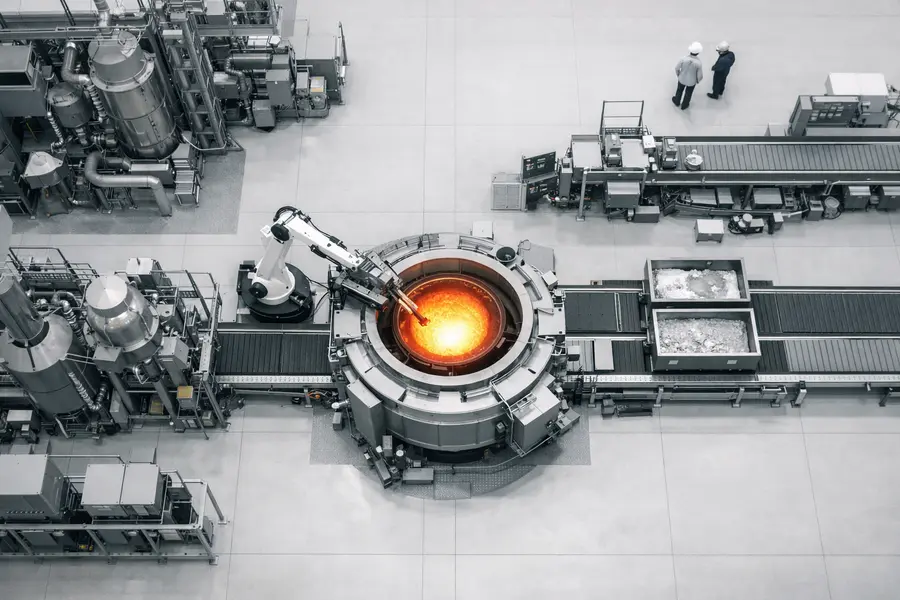
Hertha Metals closed a $133.65M Series A, co-led by Khosla and Doerr, with $65M of US government equity, to build a 10,000-tonne magnet-grade iron plant.
Key Takeaways
- Hertha Metals raised $133.65M in a Series A co-led by Khosla Ventures and Doerr Capital.
- The US government put in $65M of equity through the Pentagon's Industrial Base Analysis and Sustainment program.
- Proceeds fund Hertha Chalyx, a 10,000-tonne-a-year plant for steel-grade and magnet-grade iron.
Lead
Hertha Metals, a Texas startup founded in 2022, closed a $133.65M Series A announced in late September 2026. Khosla Ventures and Doerr Capital co-led the round, and $65M of it came as direct equity from the US government. The money will build Hertha Chalyx, a commercial plant planned to produce 10,000 tonnes a year of high-purity iron for rare-earth magnet makers. Valuation was not disclosed.
Who Else Is in the Round?
Seven other investors joined the two co-leads: CEV, Gates Frontier, Niterra SUISO no MORI Fund, Pear Ventures, Siemens Financial Services and Toyota Ventures. The government's stake came through the Department of Defense's Industrial Base Analysis and Sustainment (IBAS) program, with the Economic Defense Unit also named as a channel.
The government check is the notable line. At $65M, it makes up about 49% of the round, so private investors supplied roughly $68.65M. A Series A that is half public money is a bet on strategic supply, not on venture-style returns alone. Hertha has also said it has raised more than $150M since its founding, a figure that suggests earlier capital, though the breakdown by round was not published.
What Does Hertha Metals Actually Make?
Hertha makes high-purity iron and steel in a single continuous reactor, replacing the multi-step, coal-dependent blast furnace route. The process, called Flex-HERS, accepts any grade of iron ore. It uses natural gas or hydrogen as the reductant.
The company claims emissions cuts of 50% with natural gas and up to 98% with hydrogen. It also claims production costs about 25% below blast furnaces. Those figures are company claims, and they come from a demonstration facility of 360 tonnes a year in Conroe, Texas. Chalyx is a roughly 28-fold scale-up from that.
Why Does the US Government Want Magnet-Grade Iron?
Washington is paying because the US imports almost all of the high-purity iron used in neodymium-iron-boron magnets and has no domestic production capacity. Those magnets sit inside electric vehicle motors, wind turbines, drones, radar systems, satellites and submarines. Rare-earth elements get most of the attention in the magnet supply chain, but iron is the largest ingredient by weight.
CEO and founder Laureen Meroueh framed the plant as a supply gap to close, saying electric vehicles, aerospace platforms, radar systems and data centers all depend on domestic iron and magnet feedstock suppliers. The equity structure, rather than a grant or loan, gives the government a direct stake in the outcome.
What Are the Risks?
The main risk is scale-up. Moving from a 360-tonne pilot to 10,000 tonnes a year in a single reactor raises engineering questions that a demonstration plant does not answer, including throughput, ore variability and purity consistency at magnet grade. Hertha has not said where Chalyx will be built, and its completion date has not been published. Construction is expected to begin later in 2026.
Demand is a second question. Magnet manufacturers qualify new feedstock slowly, and offtake agreements were not part of the announcement. A 10,000-tonne plant is small against global steel output, so Hertha's commercial case depends on the premium that magnet-grade material commands over commodity iron.
What Comes Next for Hertha?
The next milestones are the Chalyx site, groundbreaking and customer commitments. If the plant meets its purity targets, Hertha would be among the first US producers of the material, which could pull in further defense and industrial funding. If it falls short, the government's equity stake means the shortfall will be a public matter as well as a private one.
For investors, the round also tests whether low-emission steelmaking can attract capital when sold as a security play rather than a climate play. Hydrogen-based reduction remains dependent on hydrogen supply that does not yet exist at scale, so natural gas is the realistic starting point.
Outlook
Hertha Metals has secured $133.65M, split almost evenly between private investors and the US government, to prove a single-step iron process at 10,000 tonnes a year. The funding addresses a clear import gap in magnet supply chains. The pilot-to-plant jump, an undisclosed valuation and the lack of announced customers keep the commercial outcome open.