Pomegra
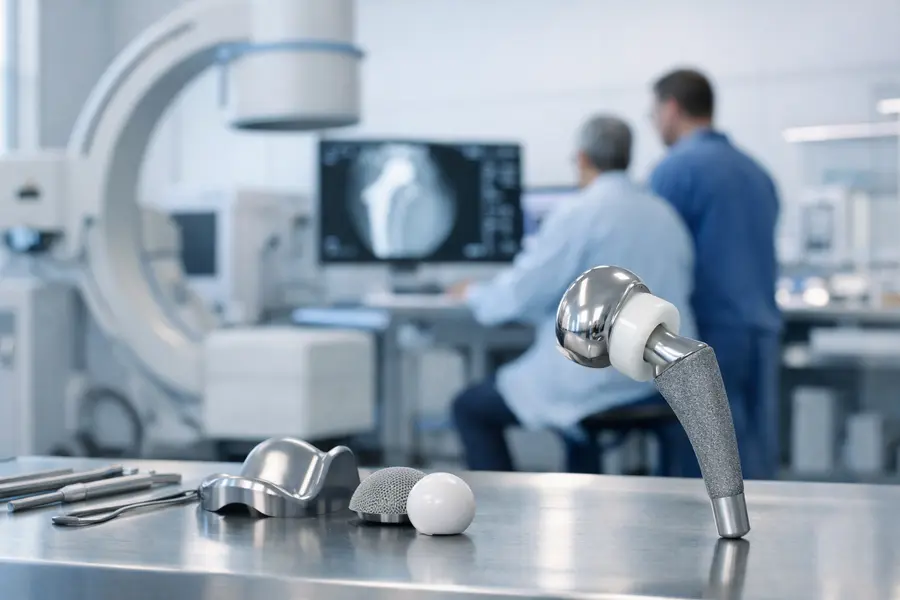
Imperial College spinout OSSTEC closed an $8 million round led by EMBRYO Ventures to take its 3D-printed ASCENT partial knee through FDA clearance and into first US cases.
Key Takeaways
- OSSTEC closed $8M led by EMBRYO Ventures; valuation and series label were not disclosed.
- ASCENT and CLARITY are not FDA-cleared; first US procedures are planned for H1 2027.
- The round follows a £2.5M raise in 2025 and a £1.2M seed in 2023.
Lead
OSSTEC, a London medical device company spun out of Imperial College London in 2021, announced on November 3, 2026 that it had closed $8 million to fund the US debut of its ASCENT cementless partial knee. EMBRYO Ventures led the round. Neovate Capital, New Wave Ventures, Oxford Technology Innovation Finance and Empirical Ventures also participated.
The money is earmarked for FDA clearance of ASCENT and its CLARITY instrumentation, then first-in-human surgical cases in the United States, which the company has scheduled for the first half of 2027. Neither product is cleared or available for sale in the US today.
What Does OSSTEC Actually Make?
OSSTEC makes ASCENT, a 3D-printed, fixed-bearing partial knee implant that bonds to bone without surgical cement. Its biomimetic fixation is designed to let bone grow into the implant, which targets loosening, a common reason partial knees are revised.
CLARITY is the matching instrument set used to implant it. The company says the platform can extend to other cementless joint replacements and that it is evaluating integration with robotic surgery systems. Those pipeline items carry no timelines.
The product displaces cemented partial knees from established orthopedic manufacturers. The pitch is a simpler operating room workflow, with no cement mixing or curing step.
How Big Is the Round, and What Does It Say About the Last One?
At $8 million (about £6 million), this is roughly double the £2.5 million raised in 2025, which was meant to support US market entry. The company's 2023 seed was £1.2 million, backed in part by the Imperial College Enterprise Fund. Three rounds in three years have grown by a factor of five.
The step up is meaningful but modest for a device company approaching a regulatory submission. Orthopedic implants usually need far more capital to reach commercial scale, so this round buys regulatory progress and a surgeon training base rather than a sales force. The next raise will likely depend on FDA clearance and early clinical performance.
OSSTEC did not disclose a valuation or label the round a Series A. The investor list leans toward UK and European venture and university-linked funds, with the lead from a medtech-focused firm. Those details are worth watching for how the company funds its post-clearance phase.
Why Do Surgeons Say Partial Knees Are Underused?
Partial knees are underused because many surgeons hesitate to offer them. Company figures put the share of knee replacement patients who qualify for a partial implant at about 50%, while only about 10% receive one.
CEO Max Munford said surgeons would offer a partial knee to more patients if they could use next-generation cementless technology. That claim is the commercial thesis, and it is untested in the US until ASCENT is cleared and used. Cemented partial knees have a long track record, and surgeons are slow to change established techniques.
Munford said the financing "moves our focus from preparation to patients." He founded OSSTEC from his PhD research in mechanical engineering at Imperial, and the company went through the university's Venture Catalyst Challenge, MedTech SuperConnector and mentoring programs.
What Could Slow the US Launch?
The main risk is regulatory timing. A first-in-human target in H1 2027 depends on FDA clearance arriving before then, and review schedules for orthopedic implants are not guaranteed. A delay would stretch the runway of an $8 million round.
Surgeon adoption is the second hurdle. OSSTEC plans to train and support a surgeon faculty at leading partial knee centers, a standard route for new implants, but one that takes time. US operations were established earlier in 2026 under OSSTEC Inc., giving the company a local base.
Outlook
OSSTEC now has funding to clear the FDA and perform its first US procedures in the first half of 2027. The round is larger than its predecessors yet still lean for orthopedics. The next milestones are clearance, early surgical results, and a follow-on raise to build commercial operations, with the broader cementless pipeline coming only after ASCENT proves itself.