Pomegra
Dutch metrology maker Nearfield Instruments closed a $380M Series D led by Fidelity at a $1.6B valuation, the largest deep-tech round in the Netherlands.
Key Takeaways
- Nearfield Instruments raised $380M in a Series D led by Fidelity, valuing the company at $1.6B.
- The round is the largest deep-tech financing in Dutch history and follows a $148M raise in July 2025.
- Proceeds go to production capacity, global support and joint R&D with chipmakers.
Lead
Nearfield Instruments, the Rotterdam-based maker of chip inspection tools, announced on June 22, 2026 that it closed a $380M Series D at a $1.6B valuation. Fidelity Management & Research Company led the round as a new investor. The company calls it the largest deep-tech funding round ever recorded in the Netherlands.
The raise arrives roughly 11 months after a $148M round in July 2025 backed by Temasek and Walden Catalyst Ventures. Raising more than two and a half times that amount in under a year is a steep step up, even for a sector where capital needs run high.
Who Invested in the Series D?
Fidelity led, with Temasek, Walden Catalyst Ventures, Innovation Industries, M&G Investments and Invest-NL, the Dutch national investor, also participating. The Qatar Investment Authority joined as a new backer. Existing investors TNO Ventures and ING took part as well.
The mix matters. A large US mutual fund manager taking the lead, alongside two sovereign-linked investors and a Dutch state vehicle, reads less like a venture bet and more like a crossover round positioned ahead of a possible listing. The company has not said anything about an IPO, and it has not disclosed revenue.
What Does Nearfield Instruments Actually Build?
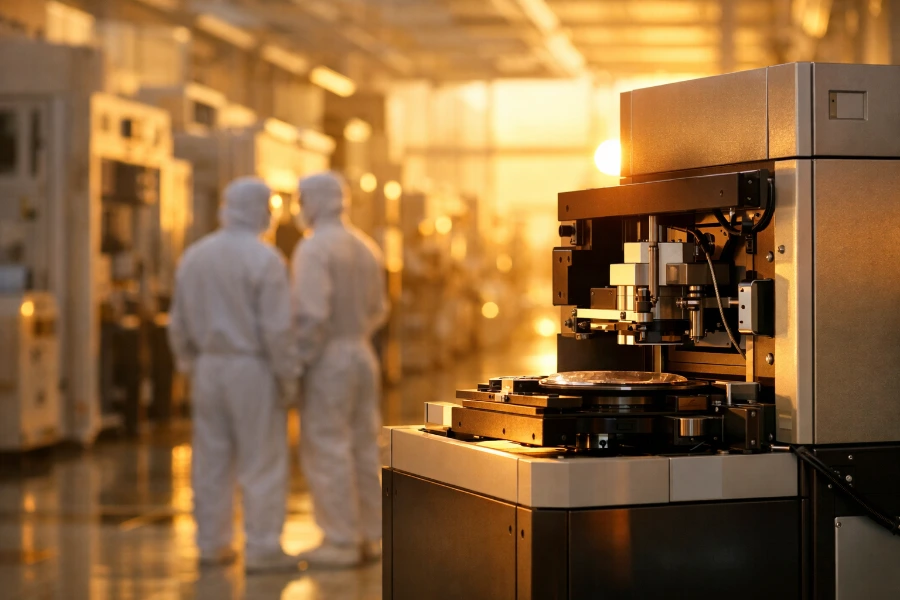
Nearfield builds tools that measure chip structures at nanometer scale after they leave the production line, without damaging the wafer. Its QUADRA platform is based on atomic force microscopy, a technique that probes a surface with a physical tip rather than light or electrons. The company spun out of the Dutch research institute TNO in 2016, and co-founder Hamed Sadeghian serves as CEO.
The company employs about 450 people across Taiwan, South Korea, Japan, Singapore, the United States and Belgium. That footprint tracks where leading-edge fabrication happens. Customer names remain undisclosed.
Why Is Metrology Attracting This Much Capital?
Chipmakers are stacking transistors and memory cells in three dimensions, and measuring features buried in those structures has become harder with conventional optical methods. As geometries shrink and layers multiply, yield losses from undetected defects get expensive. Demand for AI accelerators and high-bandwidth memory has raised the stakes further.
The semiconductor inspection market was valued at about $10.3B in 2025 and is projected to reach roughly $15B by 2031. KLA holds the dominant position today. A new entrant with a physically different measurement method can win only if a major fab qualifies its tools for production, a process that typically takes years and rarely ends in a large order unless the tool solves a problem incumbents cannot.
What Does the Valuation Imply?
At $1.6B, the valuation prices Nearfield as a company expected to convert pilot deployments into recurring tool sales. With revenue undisclosed, the multiple cannot be checked. The size of the round also suggests that capital is aimed at manufacturing and service infrastructure, not just research. Building and servicing precision instruments across six regions is capital intensive, and chipmakers expect fast field support before they commit volume.
The skeptical reading is that qualification risk remains. Fabs buy metrology tools slowly and standardize on a few suppliers. A $380M war chest buys time and production scale, but it does not shorten a customer's validation cycle.
Use of Funds and Strategic Context
Nearfield says it will put the money toward its innovation roadmap, expanded production capacity, a larger global customer support organization and deeper joint R&D with semiconductor manufacturers. The last item is the most telling. Co-development agreements with chipmakers are how a metrology vendor gets designed into a process node before it ships.
The round also lands in a European context where deep-tech companies have often moved to US investors or exchanges once they outgrow local capital. Here, Invest-NL, TNO Ventures and ING stayed in, which keeps some Dutch ownership in a company that sits in the supply chain around ASML's home market.
What Comes Next?
Three milestones will show whether the capital is working: named production customers, a visible ramp in tool shipments, and disclosure of financial results. If fabs adopt QUADRA in high-volume lines, a further round or public listing becomes plausible. If qualification drags, the company will have to carry a large cost base on a $1.6B mark that rivals and later investors may not match.
Outlook
Nearfield Instruments has gone from a $148M raise to a $380M Series D in under a year, led by Fidelity and backed by sovereign and Dutch state investors. The money funds capacity, support and co-development in a market where KLA dominates and qualification cycles are long. Customer wins and revenue disclosure are the next tests of the valuation.