 Pomegra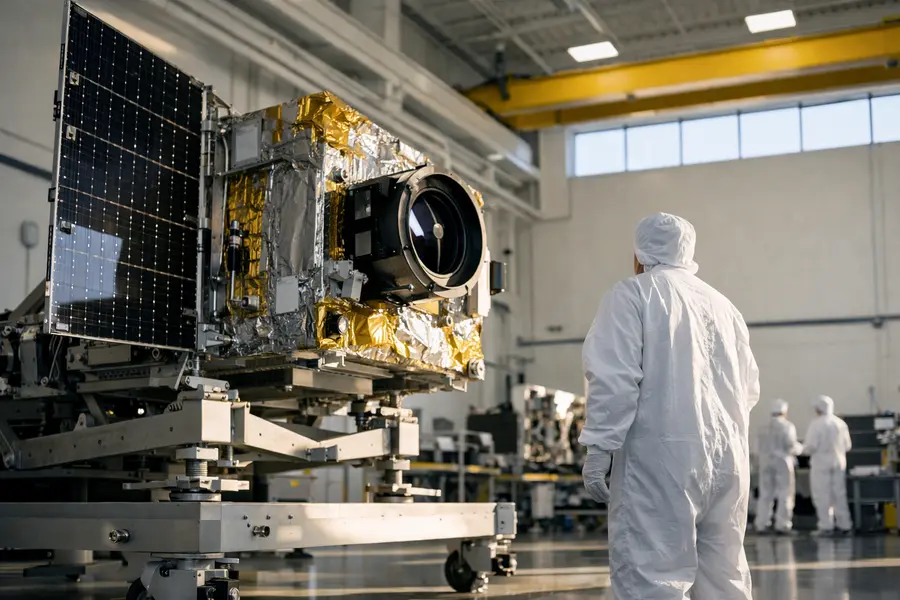
Eclipse Capital led a $250M Series C valuing Muon Space at $1.5B, backed by Google and Salesforce Ventures for satellite production and orbital AI compute.
Key Takeaways:
- Eclipse Capital led the $250M Series C; Google, Salesforce Ventures, Wellington Management, I Squared Capital, and others participated
- The $1.5B valuation brings total equity raised past $386M, nearly tripling Muon's pre-round funding base
- Capital targets satellite manufacturing scale to 500 per year by 2027, advanced payloads, and on-orbit AI computing nodes
Lead
Muon Space closed a $250 million Series C on August 20, 2026, at a $1.5 billion valuation. Eclipse Capital led the round; Google, Salesforce Ventures, Wellington Management, I Squared Capital, Woven Capital, and Galvanize came in as new investors, alongside existing backers including Radical Ventures, Congruent Ventures, Costanoa Ventures, and ACME Capital. The raise brings the Mountain View, California-based company's total equity to more than $386 million - well above the approximately $136 million accumulated before this round.
What Does Muon Space Actually Build?
Muon Space designs, manufactures, and operates satellites as a fully vertical stack: spacecraft hardware, instruments, software, and ground operations built in-house. The company was founded in 2021 by veterans of JPL, Skybox Imaging, Loft Orbital, Ball Aerospace, Apple, and Google, with several co-founders previously collaborating on the Environmental Defense Fund's MethaneSat project. The focus spans Earth observation, climate monitoring, and dual-use platforms for commercial and government customers. Muon opened a new manufacturing facility in San Jose in June 2026 and has deployed 11 satellites across six launches, with a reported 100% mission success rate.
How Does the Valuation Stack Up Against the Track Record?
A $1.5 billion valuation on $136 million in prior equity is a steep re-rating, and it prices in a manufacturing execution bet the company has not yet had to make at scale. The near-term pipeline provides some support: seven satellites launched in the first half of 2026, 13 more booked across the next 12 months, and over 50 in active development for customers. Dual-use positioning - commercial Earth observation alongside military space programs contracted through 2028 - offers revenue stability that pure commercial operators lack. Still, the gap between 11 deployed spacecraft and a target of 500 per year is significant, and satellite hardware companies have historically found manufacturing scale-up to be their most expensive lesson.
What Will the Capital Fund?
The manufacturing build-out takes the largest share, scaling the San Jose facility from current output toward the 500-per-year target by 2027. Advanced payload development for Earth observation and dual-use defense customers runs alongside that. Most ambitious is the on-orbit AI computing initiative, which aims to position Muon's satellites as distributed edge computing nodes rather than passive sensors. A real-time, high-bandwidth connectivity layer built through a SpaceX Starlink partnership would tie the network together. Combining sensing, compute, and connectivity from a single vertically integrated provider is more than most satellite manufacturers attempt at this stage of their development.
The Investor Mix Signals a Shift
Wellington Management, which oversees more than $1 trillion in assets, and I Squared Capital, an infrastructure-focused fund, are not venture-typical investors. Their presence in a Series C alongside traditional VC backers suggests that institutional capital is beginning to treat satellite infrastructure as an asset class with predictable characteristics rather than a venture-stage technology bet. That framing has precedents in fiber networks and data centers. Whether it holds for satellite constellations at this stage of the market depends on how consistently operators can deliver on contracted data pipelines - something Muon's 100% launch success rate makes a more credible argument for than it might be at a peer with failures on its record.
Is the Earth Observation Market Crowded?
Yes, but not uniformly. Planet Labs, Maxar, BlackSky, and a growing cohort of international operators compete for similar contracts. Muon's vertical integration differentiates it operationally - owning the full stack from fabrication to data delivery shortens lead times and tightens per-satellite cost control. The orbital AI compute angle is less contested territory, sitting adjacent to a commercial edge infrastructure market where demand has consistently outrun supply. Monetizing that compute capacity in orbit, rather than solely selling sensor data, is what distinguishes the $1.5 billion thesis from a straightforward satellite manufacturer valuation.
Outlook
Muon Space exits this round with a credible syndicate, an improving launch cadence, and a manufacturing ambition that will take at least 18 months to validate. The step-function move from 11 deployed satellites to 500-per-year production capacity is where the execution risk concentrates. On-orbit AI computing remains unproven at commercial scale. Upcoming satellite deliveries, defense contract renewals, and production throughput figures through 2027 will determine whether the $1.5 billion valuation was a fair read on trajectory or a number the company must now grow into.