Pomegra
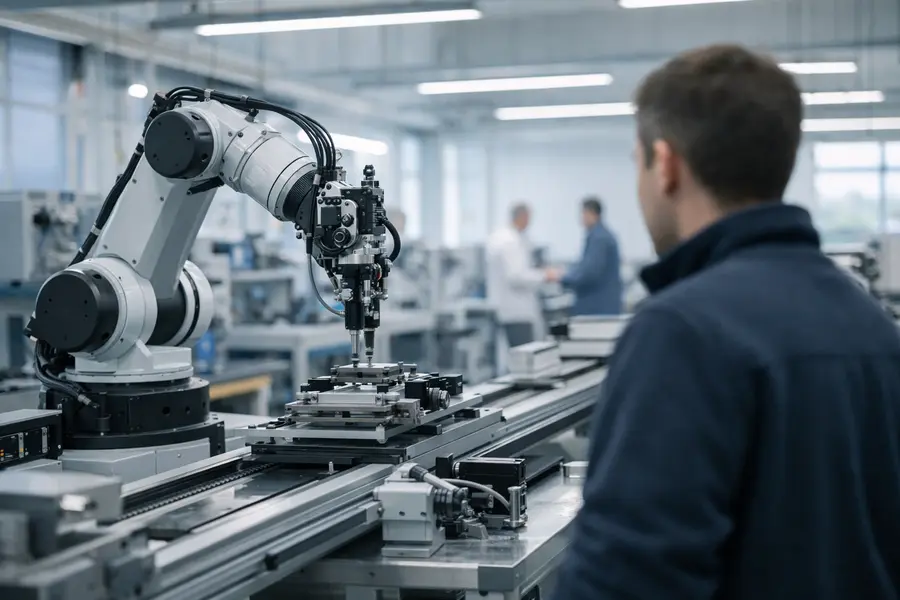
Machenta, a London robotics startup, raised a $40M seed round co-led by Creandum and Union Square Ventures to teach robots new tasks from one demonstration.
Key Takeaways
- Machenta raised $40M (about £30M) in a seed round announced October 27, 2026.
- Creandum and Union Square Ventures co-led; the valuation was not disclosed.
- Imperial College London calls it the largest seed round for a UK robotics startup.
Lead
Machenta, a London startup spun out of Imperial College London's robot learning research, announced a $40M seed round on October 27, 2026. Creandum and Union Square Ventures co-led the financing. The company is building a foundation model that lets robots pick up a new physical task after watching it performed once or twice. Its stated difference from rivals is that the model trained entirely in simulation, with no real-world footage.
Imperial describes the round, roughly £30M, as the largest seed ever raised by a UK robotics company. Machenta has not disclosed its valuation or any earlier funding.
What Does Machenta Actually Build?
Machenta builds a robot foundation model, a general-purpose AI system that controls robots across different tasks and hardware. The pitch is speed of learning: show the robot a task once, and it performs it. The company says the model works on different robot types, humanoids included.
The training method is the unusual part. Most robotics AI developers collect large volumes of real-world data, through teleoperation, video, or fleets of deployed machines. Machenta says it used none of that and generated its training data in simulated environments. That claim, along with the one-demonstration capability, has not been independently verified.
Who Is Behind the Company?
The company was founded in 2025 by Edward Johns, a professor at Imperial College London who serves as chief executive, and Vitalis Vosylius, a PhD student in his Robot Learning Lab. Colleagues from the lab joined them. The team numbers about 11 people.
Johns frames the premise in terms of learning speed. "Intelligence is not so much about what you can already do, it's about how quickly you can learn to do something new," he said. Creandum partner Kathi Wilhelm said the team has repeatedly changed what people thought was possible in robotics. USV managing partner Rebecca Kaden argued that the industry is pouring capital into real-world data collection while Machenta takes a different route.
Why Is a $40M Seed Round Notable?
A $40M seed is large by any standard, and it is exceptional for a company roughly a year old with 11 employees and, by its own account, no disclosed earlier financing. The size reflects the premium investors are placing on robot foundation model teams with academic pedigree. It also reflects how much compute and simulation work such a model needs before it can show commercial results.
The skeptical read is straightforward. The headline capability has no public benchmark, and no customer deployments have been announced. With the valuation withheld, outsiders cannot judge whether the price assumes a working product or only a promising research thesis. A seed at this size leaves little room for a modest Series A, so the next round will probably depend on demonstrable results with real hardware.
How Does Machenta Compare With Rivals?
Machenta enters a field that already includes Physical Intelligence, FieldAI, and Skild AI, all of which have raised substantially more capital. Those companies have leaned heavily on real-world or mixed data approaches. Machenta is betting that simulation-only training can match them on adaptability at far lower data-collection cost.
If that holds, the economics favor Machenta, since simulated data scales with compute rather than with physical robots and human operators. If it fails, the gap between simulated and real environments, which has troubled robotics researchers for years, becomes the central risk. The company's choice to publish the claim before extensive outside testing makes the next demonstrations important.
What Will the Money Fund?
The capital will go to hiring, additional computing power, and more simulated data generation. Machenta also plans to move into new office and laboratory space in King's Cross, London, giving it a physical site to test the model on real robots. The company said it will expand the model across more robot types, including humanoids.
Outlook
Machenta has secured one of the larger early-stage checks in European robotics on the strength of a research thesis and a small, academically rooted team. The round gives it room to build and test, but the proof points are still ahead: independent verification of one-shot learning, performance on physical hardware outside simulation, and a first commercial partner. Those milestones will determine whether the record seed is read as foresight or as an early signal of overheated robotics funding in the UK.