Pomegra
Leash Biosciences raised an $11M seed round led by Innovation Endeavors and Insight Partners to expand an automated lab that tests how well scientific AI performs against real experimental data.
Key Takeaways
- Leash Biosciences raised $11M in seed funding at a reported $30M post-money valuation, co-led by Innovation Endeavors and Insight Partners.
- The Salt Lake City lab holds 44 billion measurements from 6.3 million molecules tested against nearly 1,000 protein targets.
- Its Minos platform let AI agents run about 100,000 experimental campaigns in six weeks.
Lead
Leash Biosciences, a Salt Lake City company that runs an automated wet lab, announced an $11M seed round on November 25, 2026. Innovation Endeavors and Insight Partners co-led the financing, which reportedly values the company at $30M post-money. Leash will use the money to widen its experimental data production and extend its virtual research environments beyond protein-molecule binding into other biological experiments.
The company has not named the other participants in the round.
What Does Leash Biosciences Actually Sell?
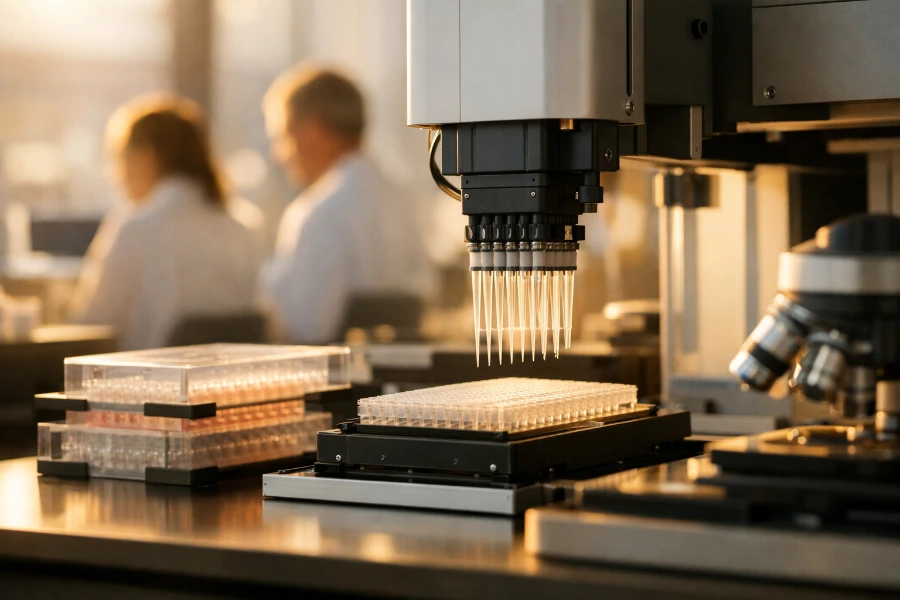
Leash sells measured experimental data and a testing ground for AI agents that claim to do science. Its lab has designed and physically tested 6.3 million molecules against nearly 1,000 protein targets, producing more than 44 billion measurements. The data is uniform and built for machine learning, unlike the fragmented literature most models train on.
On top of that sits Minos, a set of virtual research environments launched in October 2026. An AI agent picks experiments, receives results grounded in the lab's real measurements, revises its hypotheses and tries again. The setup scores how well a model makes scientific decisions, not whether it can recite a paper.
What Did Minos Show in Its First Six Weeks?
Minos recorded roughly 100,000 independent experimental campaigns by AI agents in its first six weeks, and it exposed consistent reasoning flaws in leading models. According to the company, the models struggled to abandon unproductive lines of inquiry. They also failed to change strategy when new evidence contradicted their assumptions.
Those are the failures a benchmark built on published text would not catch. Leash has not released model-by-model results, so the claim rests on the company's own account.
CEO and co-founder Ian Quigley framed the pitch as a curriculum problem. "Most companies developing AI for drug discovery rely on scientific data that was collected to find a drug, not to train models," he said. "We are creating a school for AI scientists by generating data for their curriculum."
Why Is the Valuation Worth Reading Closely?
The $30M post-money figure is modest for a company with this much proprietary data, and it implies the investors are paying for the lab and dataset, not for a finished product. Leash also announced a $9.3M seed financing in 2024, which would put cumulative funding near $20.3M. Another seed-stage round two years later signals that the company has yet to reach a priced Series A, or chose not to seek one.
Revenue and customer figures were not disclosed. Leash says it is pursuing partnerships with AI developers and pharmaceutical companies, but no named partners accompanied the announcement. That leaves the commercial model unproven, even if the technical premise is credible.
How Do Investors Frame the Bet?
The backers describe experimental data as the scarce input. Nick Olsen, a partner at Innovation Endeavors, said the most important axis for improvement is "high-quality experimental data, collected at scale for building performant AI systems."
Matias Porras Paniagua, a vice president at Insight Partners, tied the thesis to agents. "By building environments where AI agents improve against measured results, Leash is giving developers a way to train AI scientists against real experimental outcomes," he said.
The argument has a counterweight. Physical labs scale slower and cost more than software, and a dataset concentrated on protein-molecule binding covers one narrow slice of biology. Whether results from that slice transfer to other experiments is the open question the new round has to answer.
What Comes Next?
The funding goes to three things: more experimental throughput, new categories of biological experiments, and partnerships with AI developers and drugmakers. Success depends on whether model builders adopt Minos as a standard evaluation, and on whether pharma buyers pay for access to the data.
Competition is likely to come from both directions. Large AI labs are building their own science agents, and other lab-automation startups are producing proprietary data. Leash's advantage is a head start of 44 billion measurements and an evaluation product that already has usage.
Outlook
Leash Biosciences has raised $11M to turn an automated lab into a measuring stick for scientific AI. The data and early Minos results give it a credible technical story, while the small valuation, undisclosed customers and narrow experimental scope keep the commercial case unproven. The next signals to watch are named partners, published model comparisons and any experiments outside protein-molecule binding.