Pomegra
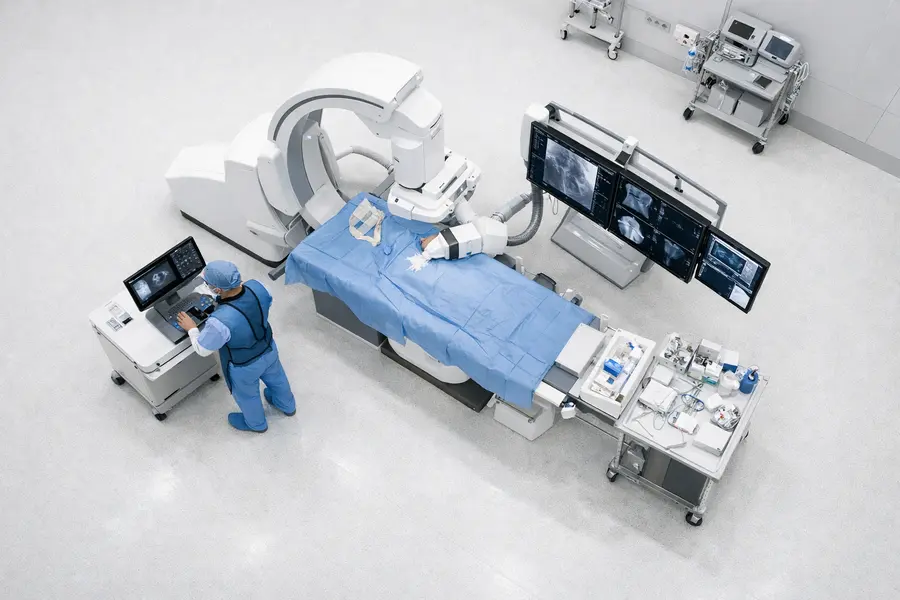
Laza Medical landed up to $160M in a Series B led by GE HealthCare for AI-guided robotic cath lab imaging, more than four times its 2023 $36M Series A.
Key Takeaways
- Laza Medical closed an up-to-$160M structured Series B led by GE HealthCare in early November 2026.
- The round is more than four times the company's $36M Series A from December 2023.
- The system is in development, has no commercial approval anywhere, and has completed a first-in-human study.
Lead
Laza Medical, a Shifamed portfolio company based in Los Gatos, California, announced in early November 2026 that it raised up to $160 million in a Series B financing led by GE HealthCare. The company is building an AI-enabled, robotically controlled imaging system for cardiac catheterization labs. Returning investors AMED, PA MedTech and Unorthodox Ventures also participated. Valuation was not disclosed.
The "up to" wording matters. The financing is structured, which usually means capital arrives in stages tied to milestones. Neither the company nor GE HealthCare has said how much is committed at close or what triggers the remainder.
What Does Laza Medical Actually Build?
Laza Medical is developing a system that pairs robotic probe control with AI to deliver consistent ultrasound guidance during heart procedures. The goal is to reduce the dependence on a skilled imaging operator inside the cath lab, where image quality can vary by user and by case.
The company has pointed to structural heart and electrophysiology as its initial targets. Both are growing interventional cardiology segments that depend on real-time ultrasound to guide catheters and devices. The Laza Medical System is not approved for commercial sale in any geography. Its first-in-human study was run at Oregon Health & Science University Hospital in Portland.
Why Did GE HealthCare Move From Participant to Lead?
GE HealthCare joined the Series A in 2023 as one of several investors and now anchors the Series B, which signals a deeper strategic interest in cath lab imaging. The company sells ultrasound and interventional imaging equipment, so a robotic, AI-driven layer on top of that hardware fits its portfolio logic.
Jyoti Gera, CEO of Cardiovascular and Interventional Solutions in GE HealthCare's Advanced Imaging Solutions business, said the future of cardiac intervention must be one where access, consistency and quality of care are no longer barriers to better outcomes. Amr Salahieh, Laza's founder and board chairman, said the cath lab is poised for a fundamental evolution, with intelligent imaging playing a defining role.
A lead position from a strategic investor carries trade-offs. It brings distribution, clinical relationships and technical credibility. It can also narrow the field of eventual acquirers or partners, since rivals in imaging may be wary of a company so closely tied to one vendor. GE HealthCare has not disclosed any option, acquisition right or commercial agreement attached to the round.
How Does the Round Compare With the Series A?
The Series B is roughly 4.4 times the size of the $36M Series A, if the full amount is drawn. That Series A, closed in December 2023, was led by The Capital Partnership, with GE HealthCare, PA MedTech, Unorthodox Ventures and Dara Holdings also taking part.
A jump of that scale for a pre-approval medical device company is notable. Robotics hardware, AI software and regulatory work are all expensive, and a milestone-based structure allows investors to commit a large headline figure while limiting early exposure. The headline number therefore says less about capital in the bank than a conventional priced round would.
Laza Medical has not stated total funding raised to date or a specific allocation. The company said proceeds will support its mission to transform cardiac catheterization labs through intelligent imaging, including continued development and operational expansion.
What Are the Hurdles Ahead?
Regulatory clearance is the main one. The system needs approval in each market before sale, and a robotic device that manipulates an imaging probe inside a patient will face scrutiny on both safety and the performance of its AI guidance.
Adoption is the second. Cath labs already run on established workflows, and hospitals will want evidence that robotic imaging shortens procedures, reduces staffing demands or improves outcomes before paying for new capital equipment. Early data from a single-site first-in-human study will not settle that question.
Competition is the third. Robotics and AI guidance are drawing attention across interventional cardiology, and large imaging vendors are developing their own tools. Laza's advantage is its focus and its strategic backer, but neither guarantees a place in hospital purchasing plans.
Outlook
Laza Medical now has a well-capitalized path, at least on paper, to move from first-in-human work toward larger clinical studies and regulatory submissions. The milestone structure of the financing will likely shape how quickly it can scale. The next markers to watch are disclosure of trial results, a regulatory filing timeline, and any commercial arrangement with GE HealthCare.