Pomegra
UK chip startup Fractile raised a $720M Series C at a $7B valuation, a sevenfold jump in six months, for memory-first AI inference hardware due in 2027.
Key Takeaways
- Fractile raised $720M in a Series C at a $7B post-money valuation, up from about $1B in May 2026.
- Thrive Capital, Founders Fund, Lightspeed and Redpoint led the round, with UK state-linked funds taking part.
- No commercial chip has shipped; the first product is planned for 2027.
Lead
Fractile, a London-based designer of AI inference chips, closed a $720M Series C in November 2026 at a post-money valuation of $7B. Thrive Capital, Founders Fund, Lightspeed and Redpoint led the round. The company has no commercial product on the market, and its first chip is planned for 2027.
The round arrives six months after Fractile's roughly $220M Series B, which was co-led by Founders Fund and Accel and valued the company near $1B. Founded about four years ago by Walter Goodwin, the company is building hardware to run trained models faster and with less energy than GPU-based systems.
Who Backed the Round?
Beyond the four lead investors, the cap table includes CapitalG, DST Global, BlackRock, Dragoneer, T. Rowe Price, Bain Capital Ventures, Balderton, Shopify Ventures and Elad Gil. Returning backers include Accel, Conviction and Felicis.
Two public-sector names stand out: the UK Sovereign AI fund and the British Business Bank. Goodwin credited the sovereign fund as a driving force behind frontier AI hardware development in London. Reports also cite a government commitment of £100M over three years tied to UK expansion, including a hardware facility in Bristol.
What Does Fractile Actually Build?
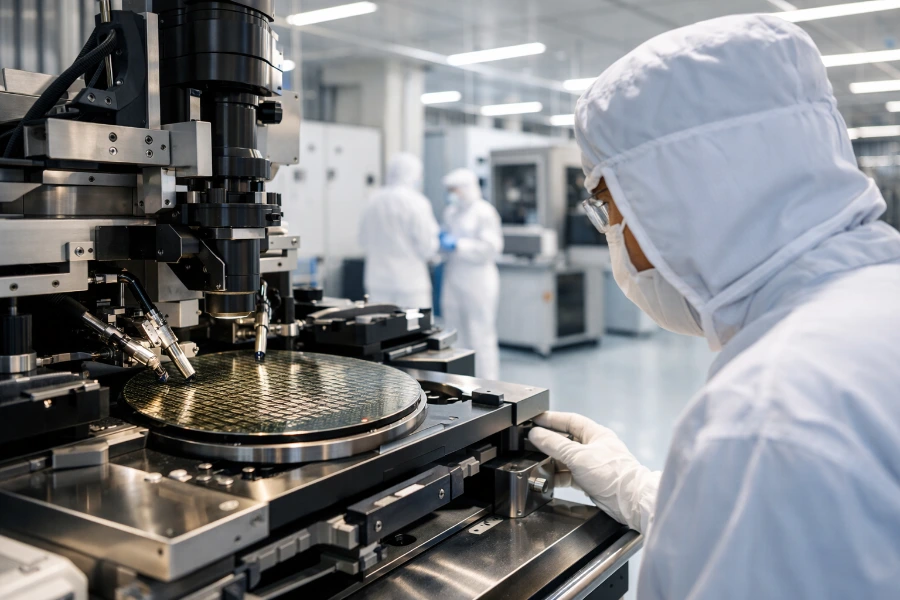
Fractile builds inference chips that stack custom DRAM directly onto logic, in a three-dimensional design aimed at memory bandwidth rather than raw compute. The company argues that memory, not arithmetic, now limits how fast large models can generate output.
Goodwin has described frontier models as "drinking through a straw," pointing to a 25,000-fold gap over 25 years between gains in compute power and growth in memory bandwidth. The pitch is bandwidth beyond high-bandwidth memory (HBM) and capacity beyond SRAM-heavy designs. Fractile claims the architecture could make inference up to 10 times faster, though no independent benchmark exists because no silicon has shipped.
Why Did the Valuation Jump Sevenfold in Six Months?
The jump reflects demand for inference capacity and a reported anchor customer rather than product traction. Bloomberg reported that Fractile reached an initial deal to sell about $250M of chips to Anthropic, for deployment in 2027. Other coverage describes the arrangement as interest in becoming an early customer, so the terms are not final in public.
Valuing a pre-revenue hardware company at $7B assumes it will tape out, manufacture and deliver chips on schedule. That is a demanding sequence: custom 3D memory stacking depends on advanced packaging capacity and foundry access, both tightly constrained. Compared with the Series B, the Series C prices in much of that execution before any of it has been demonstrated.
How Does Fractile Compare With Its Rivals?
Fractile competes against Nvidia, which dominates both training and inference, and a field of inference specialists including Groq, Cerebras and SambaNova. Each has taken a different route around the memory problem, from SRAM-heavy wafer-scale designs to deterministic dataflow architectures.
Fractile's stacked-DRAM approach sits between those camps. It is a bet that capacity and bandwidth can be had together without the cost of HBM supply, which is concentrated among a handful of manufacturers. The risk is that incumbents close the gap with their own memory roadmaps before Fractile's 2027 chip arrives.
What Will the Money Fund?
The company plans to expand hiring across London, Bristol, Palo Alto and Taipei. Fractile had roughly 80 staff in February 2026, so a $720M balance sheet implies a large increase in engineering, packaging and software teams. Taipei matters for proximity to the semiconductor supply chain, while Bristol anchors UK manufacturing and test ambitions.
What Comes Next for Fractile?
The next milestones are first silicon, validation of the bandwidth claims and a confirmed customer contract. Delays at any of these stages would put pressure on a valuation that rose faster than the company's engineering timeline. A successful 2027 launch would make Fractile the most prominent European challenger in AI accelerators and a test case for UK sovereign-backed deep tech.
Outlook
Fractile has moved from a roughly $1B startup to a $7B one in six months on the strength of a memory-first architecture, top-tier investors and a reported Anthropic order. The thesis is credible on paper, and the proof remains two product cycles away. Delivery of working chips in 2027 will determine whether the round looks prescient or early.