Pomegra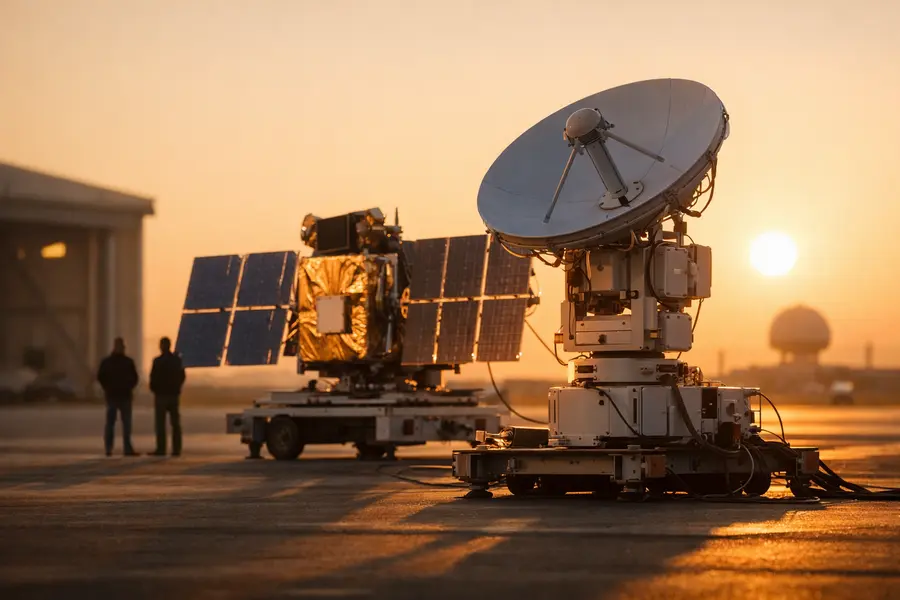
London startup Foundational exits stealth with a €9.6M pre-Seed round to bring millimetre-level laser tracking of satellites and orbital debris to commercial buyers.
Key Takeaways
- Foundational raised £8.2M (about €9.6M, $10.8M) in pre-Seed funding, led by Inflection, and left stealth on 1 October 2026.
- The company says it is Europe's largest space-tech pre-Seed to date; valuation is undisclosed.
- Its stations are about 30 times cheaper than legacy laser-ranging sites, according to the company.
Lead
Foundational, a London space-infrastructure startup founded in 2025, emerged from stealth on 1 October 2026 with a £8.2M pre-Seed round, roughly €9.6M. The round was led by early-stage fund Inflection, with BACKED, Final Frontier, Adjacent and Type One Ventures also participating. The company did not disclose a valuation.
The money will fund ground station expansion, in-house manufacturing of space hardware, retroreflector production and development of its data platform. The startup says its aim is to turn Satellite Laser Ranging, a technique long confined to scientific and government networks, into a commercial service.
What Does Foundational Actually Sell?
Foundational sells a vertically integrated Satellite Laser Ranging (SLR) system made of three parts: retroreflectors that fly on satellites, automated ground-based laser stations, and a software platform called Origin. SLR works by firing a laser pulse at a spacecraft and timing how long the reflected light takes to return, which fixes position to millimetre-level precision.
The company offers three passive retroreflector models, which need no electronics or pointing mechanism on board. Its ground stations track objects from up to 2,000 km, run day and night, and use eye-safe lasers. Foundational says the network is already operational and tracking objects.
Customers named by the company include commercial constellations, the European Space Agency, the UK government, aerospace manufacturers and research institutes. It also lists insurers among target buyers.
Who Is Behind It?
CEO Hira Virdee holds a PhD in astrodynamics from University College London, funded by the US Air Force Research Laboratory. He set up Lumi Space in 2018 with backing from the European Space Agency and the UK Space Agency. Foundational builds on the laser-ranging work developed there.
Co-founder and CTO Dave Gooding has co-authored laser-ranging research with Virdee since 2022. He holds a DPhil in astrophysics and is listed as chief operating officer at Lumi Space. The relationship between the two companies, including any shared ownership or licensing, has not been detailed publicly.
Why Does Precise Orbit Data Matter Now?
Low Earth orbit is getting crowded, and operators need better positions and trajectories for satellites and debris to avoid collisions. "The technology we use to track exactly where satellites are hasn't kept up" with the growth of the space economy, the company says. Virdee frames the product as a collision-avoidance tool: "By automating and scaling Satellite Laser Ranging, Foundational helps operators identify collision risks, plan safer manoeuvres and make better use of spacecraft."
The same data has uses beyond traffic management. Foundational points to navigation and positioning, Earth observation and surveying, and maritime and aviation applications. Market estimates put space situational awareness at $1.73B in 2025, rising to $2.79B by 2030.
How Does It Compare With Rivals?
Foundational's closest competitor in scale terms is LeoLabs, which tracks objects by radar and has raised more than $120M. Smaller laser-focused players include Finland's Aavuus, which runs a laser network, and London's Space DOTS, which has raised $1.5M in seed funding.
Radar covers wide areas and works on uncooperative debris, while laser ranging is far more precise but, for most targets, needs a retroreflector fitted on the spacecraft. That limits the pitch to operators willing to add hardware at the design stage. Foundational's cost claim for its stations, 30 times below legacy facilities, is a company figure that has not been independently verified.
What Does the Round Say About the Market?
A £8.2M pre-Seed is large for the stage, and the "largest in European space tech" label is the company's own. The size reflects the founders' track record and an operating network rather than a prototype. Investors are paying for a team that has already built SLR hardware once, which lowers technical risk but raises a question about how the new company differs from Lumi Space.
Commercial demand is the harder test. Government and agency contracts can anchor early revenue, but constellation operators will only adopt retroreflectors if the data changes their collision-avoidance decisions or insurance costs.
Outlook
Foundational enters the market with an operating network, a founding team with prior SLR experience and £8.2M to scale stations and retroreflector production. Its next milestones are likely to be station count, commercial contracts and retroreflector adoption on new satellite designs. A seed round would come after those proof points, and competition from radar-based trackers and other laser networks will shape how quickly it gets there.