Pomegra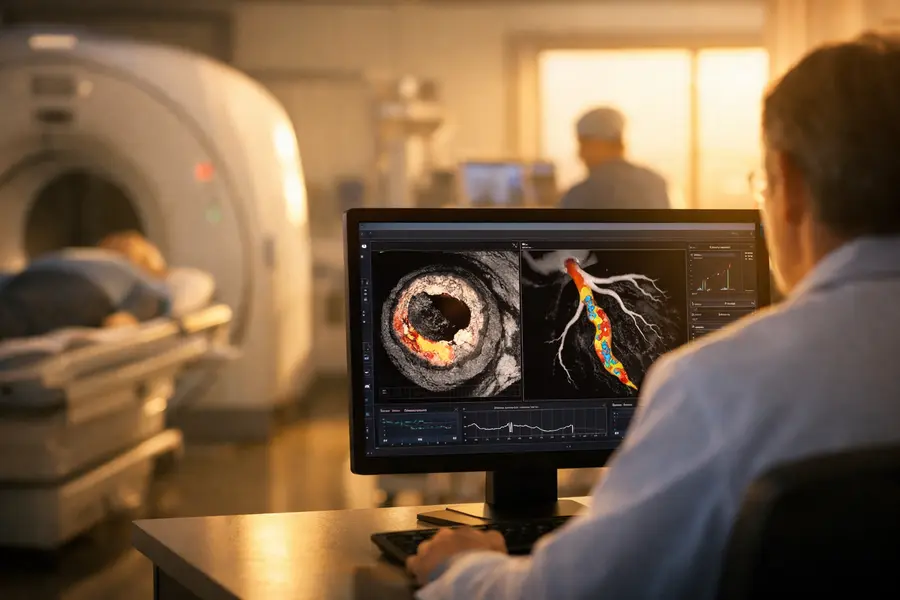
Elucid's oversubscribed $55M Series D will fund commercial expansion of its FDA-cleared plaque AI platform, now backed by a fresh Medicare reimbursement code.
- Elucid raised $55M in an oversubscribed Series D, bringing total funding to approximately $185M since founding.
- Plaque-IQ secured FDA clearance in October 2024; its BioIntegrated FFR-CT companion tool is currently under FDA 510(k) review.
- AMA CPT code 75577, active since January 2026, pays a national average of $1,012 per plaque analysis in imaging centers.
Lead
Boston cardiovascular AI company Elucid closed a $55 million oversubscribed Series D on September 2, 2026, drawing participation from a new, unnamed publicly traded medical device firm alongside existing backers IAG Capital Partners and Elevage Medical Technologies, a Patient Square Capital platform. The round marks Elucid's fourth publicly traded strategic investor and brings cumulative financing to approximately $185 million. Proceeds target full commercial launch of the company's AI-driven coronary plaque assessment suite, timed to coincide with fresh Medicare reimbursement coverage that took effect at the start of the year.
What Does Elucid Actually Build?
Elucid's core product is Plaque-IQ, an AI software tool that analyzes standard cardiac CT scans to quantify the composition and severity of coronary artery plaque without surgery or catheterization. The FDA cleared Plaque-IQ in October 2024, making it the first and only non-invasive method cleared to characterize high-risk plaque types against histopathology-validated benchmarks. A companion product, BioIntegrated FFR-CT, estimates coronary blood flow restriction from the same imaging data. That tool's 510(k) submission is currently under FDA review. Together, the two products are designed to form a single clinical decision platform, giving cardiologists plaque morphology data alongside hemodynamic assessment in one workflow.
The clinical gap Elucid is filling is real. Coronary artery disease remains the leading cause of death in the United States, and the standard diagnostic pathway still relies heavily on either stress testing - which often misses non-obstructive high-risk plaque - or invasive catheterization. A software layer that extracts more information from CT data already being ordered represents a meaningful shift in diagnostic yield, not a new imaging modality.
Why Did This Round Come Together Now?
Timing matters here. The American Medical Association activated Category I CPT code 75577 in January 2026, establishing a dedicated reimbursement path for coronary plaque analysis with a national average payment of $1,012 in imaging centers and physician offices, and $951 in hospital outpatient settings. That billing code removes the single largest friction point in scaling an AI diagnostic: hospitals and radiology groups now have a clear revenue line to attach to Plaque-IQ deployments.
For investors, a cleared product with an active CPT code is a materially different risk profile than a pre-clearance AI platform. The oversubscribed character of the round reflects that shift. The inclusion of a fourth publicly traded strategic medtech backer - identity withheld - signals that at least one large device company views Elucid's platform as either a distribution asset, a future acquisition target, or both.
What Does $185M in Total Funding Imply About Valuation?
Elucid has not disclosed its current valuation, and the company offered no post-money figure alongside the Series D announcement. The cumulative $185M raised across four rounds is a significant capital base for a software-only cardiovascular diagnostics firm. At typical medtech Series D multiples, the implied valuation is likely several hundred million dollars, though without disclosed terms that figure remains speculative. The oversubscription at this stage suggests the company did not need to accept a down round from its prior financing, but confirmation would require public disclosure.
Clinical and Commercial Road Ahead
The immediate commercial priority is converting existing CT scanner installations into Plaque-IQ clients, leveraging the CPT code to make the economic case to radiology and cardiology departments. BioIntegrated FFR-CT clearance, if granted, adds a hemodynamic layer that could make the platform stickier and harder to displace by single-function competitors.
Elucid also cited continued investment in landmark clinical studies as a use of proceeds. Prospective outcomes data remains the long-term credentialing tool for AI diagnostics: payers and health systems want evidence that plaque characterization translates into fewer cardiac events, not just more detailed reports.
Outlook
Elucid enters its post-Series D phase with cleared technology, active reimbursement, and a diversified strategic investor base. The near-term test is commercial velocity: how quickly the company can convert the CPT code into signed deployment agreements across health systems. BioIntegrated FFR-CT clearance would accelerate that case considerably. The $185M in total funding gives Elucid runway to absorb a slow FDA timeline if one materializes. The broader question - whether AI-derived plaque data changes clinical outcomes at scale - will take years and prospective trial data to answer definitively.