Pomegra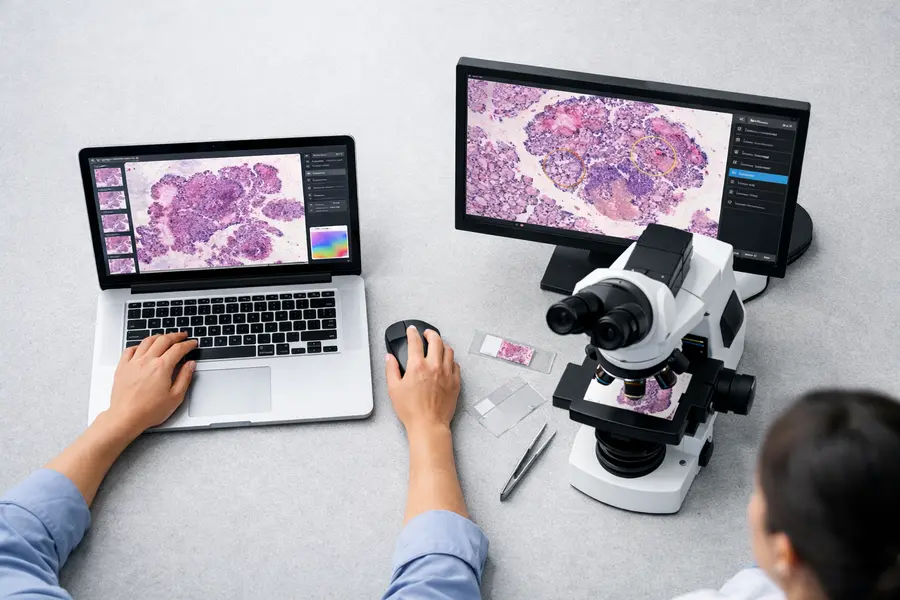
Agilent will pay $240M upfront plus up to $30M in milestones for Proscia, adding pathology software to its Dako stain business ahead of a fiscal 2027 close.
Key Takeaways
- Agilent will pay $240M in cash at closing, plus up to $30M tied to future performance milestones.
- Proscia reported trailing twelve-month revenue above $18M, with growth over 20%.
- The deal is expected to close early in Agilent's fiscal 2027, which begins November 1, 2026.
Lead
Agilent Technologies agreed on October 14, 2026 to acquire Proscia, a Philadelphia-based digital pathology software company, for $240M in cash at closing and up to $30M more if performance milestones are met. The maximum price of $270M is roughly 15 times Proscia's trailing twelve-month revenue of more than $18M. The upfront payment alone is about 13 times that figure. It is a strategic purchase of a software product line, not an acquihire: Proscia arrives with a commercial platform, a customer base and an existing sales relationship with the buyer.
What Is Agilent Getting for $240M?
Agilent is getting an enterprise software platform that connects slide scanners, laboratory information systems, image-analysis applications and AI tools. Proscia's Concentriq serves more than 4,000 laboratories, hospitals and clinics in the U.S. and Europe. It also counts 16 of the top 20 pharmaceutical companies as customers.
Revenue growth exceeds 20%, and as a software business it carries gross margins well above those of Agilent's instrument and consumables lines. Agilent CEO Padraig McDonnell described the deal as building a platform for scientific intelligence in tissue-based precision medicine. In practice, that means pairing the data Agilent's assays generate with software that interprets pathology images.
Why Did Agilent Choose Proscia?
Agilent already knew the product. The two companies signed a multi-year distribution agreement in September 2022 to offer a digital diagnostic pathology system, so this is a conversion of a four-year commercial relationship into ownership.
Agilent's pathology business, built around the Dako brand of stains, antibodies and companion diagnostics, sells into the same laboratories that run Proscia's software. Owning the software layer lets Agilent cross-sell to those Dako customers directly. It also gives Agilent a place to attach AI-based tools, a segment of a pathology market that Agilent sizes at roughly $5B.
How Does the Price Compare With Rival Deals?
The price is far below the most visible recent comparable. Roche's acquisition of AI pathology developer PathAI was valued at up to $1.05B. That deal bought algorithm development, while Agilent is buying workflow software and distribution, which accounts for part of the gap.
The difference also shows how the sector has settled. Large diagnostics and life-sciences companies have decided that the slide-management layer, where scanners and algorithms plug in, is worth owning. Agilent is paying a lower multiple than headline AI valuations suggested a year ago.
What Does This Say About Proscia's Funding Path?
Proscia raised more than $100M across seven rounds since 2016. Its most recent round was a $50M Series D in March 2025, led by Triangle Peak Partners with Insight Partners, Alpha Intelligence Capital, Razor's Edge Ventures, Interwoven Ventures and GPG Healthcare participating. Earlier backers included Scale Venture Partners, which led the $23M Series B in 2020, along with Hitachi Ventures and Robin Hood Ventures.
The valuation from the Series D was not disclosed, so a direct step-up or step-down against the exit cannot be calculated. The sale came about 19 months after that round, which suggests the company chose a strategic exit over a further independent raise. With total proceeds capped at $270M against capital raised in excess of $100M, investors are likely to see a positive but moderate return rather than a breakout one.
What Comes Next for the Deal?
Agilent expects the transaction to close early in its fiscal 2027, subject to customary conditions. The milestone payment of up to $30M, about 11% of the maximum price, ties part of the founders' and investors' payout to Proscia's performance under Agilent ownership. The milestone metrics were not disclosed.
Integration risk centers on neutrality. Proscia's platform works with scanners from multiple manufacturers, and customers who use competing hardware or competing stain suppliers may question whether the software will stay vendor-agnostic under a Dako owner. How Agilent handles that question will shape whether the 20% growth rate holds after closing.
Outlook
Agilent is paying a double-digit revenue multiple for a profitable-margin software asset it has sold alongside its own products since 2022. The price sits well below the PathAI benchmark, and the structure puts $30M at risk against performance. The result of the deal will depend on retaining Proscia's multi-vendor customers while moving Dako accounts onto the platform, with the first read likely in Agilent's fiscal 2027 results.