 Pomegra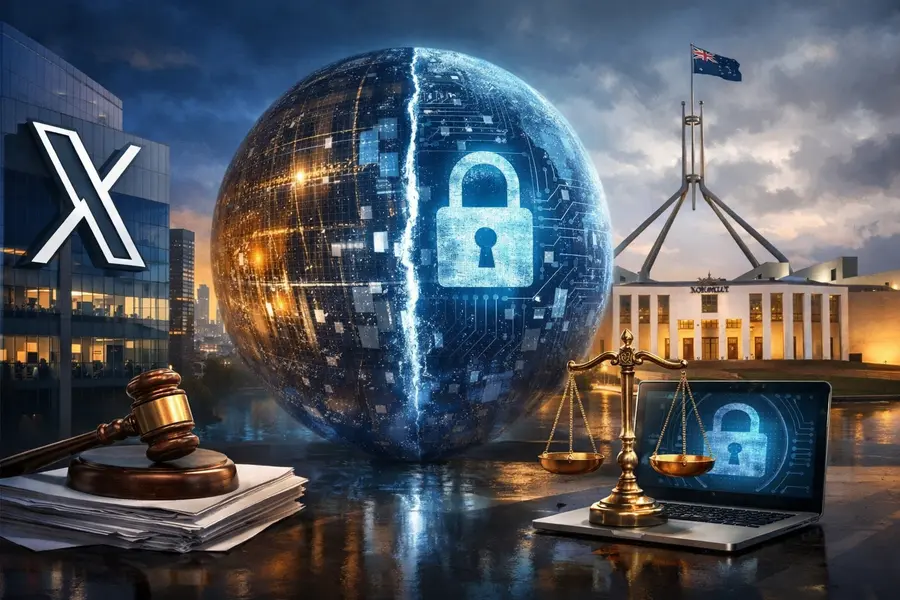
Lead
X Corp challenged Australian authorities before a Senate committee in late July 2026, arguing that Canberra's planned expansion of the eSafety Commissioner's enforcement powers failed to give "due regard to procedural fairness, privacy, the broader impacts on online services, and Australia's digital economy." The submission marked the latest confrontation between the platform owned by Elon Musk and Australian Parliament, which enacted the world's first ban on social media for users under 16 when the law took effect on December 10, 2025.What Happened
The Australian government, under Prime Minister Anthony Albanese, announced in June 2026 a package of amendments designed to strengthen enforcement of the under-16 social media prohibition. The package includes plans to double the maximum civil penalty for non-compliant platforms from A$49.5 million to A$99 million (approximately $69 million), and to grant the eSafety Commissioner, Julie Inman Grant, wider rights of document discovery — the ability to compel platforms to hand over internal records during investigations.
- Australia proposes doubling platform fines to A$99 million and expanding eSafety Commissioner's document-discovery powers.
- X Corp argues the changes violate procedural fairness, privacy rights, and international law.
- A separate Federal Court judgment, finalized in May 2026, ordered X to pay $750,000 for child-safety compliance failures.
Regulatory History
The confrontation between X and Australian regulators did not begin with the social media age ban. In February 2023, the eSafety Commissioner issued a transparency notice to the entity then known as Twitter, requiring a detailed report on its handling of child sexual exploitation and abuse material under Australia's Online Safety Act. When the platform, by then rebranded under the X Corp corporate structure, failed to respond fully, the Commissioner initiated civil penalty proceedings.
The case wound through the Federal Court for three years. The Full Federal Court rejected X Corp's appeal in July 2025 — the company had argued it bore no obligation to respond to a notice served on its predecessor entity — and a Federal Court judgment finalized in May 2026 ordered X Corp to pay $650,000 in civil penalties plus $100,000 in legal costs, close to the maximum fine available under existing law.
Government Position
Albanese pledged to arm the regulator with the tools necessary to enforce the under-16 ban after early evidence suggested compliance was limited. A study published by the British Medical Journal found that 85% of Australians aged 12 to 15 continued to access social media platforms after the law took effect, with most bypassing age checks by falsely claiming to be over 16 or exploiting gaps in facial-recognition verification. The eSafety Commissioner has stated it is preparing potential enforcement action against five major platforms.
Alongside X, platforms including TikTok, Instagram, YouTube, Snapchat, and Facebook fall within the ban's scope, each facing fines under the current A$49.5 million ceiling — a threshold the government argues is insufficient deterrence for platforms generating billions in global revenue.
Geopolitical Dimension
The dispute has acquired a transatlantic dimension. A U.S. congressional committee asked eSafety Commissioner Inman Grant to testify before it, with members accusing her of "imperiling American free speech." The intervention reflects a broader pattern in which Washington has pushed back against digital regulatory frameworks enacted by allied governments — particularly where those frameworks create compliance obligations for American technology companies.
X Corp's claim that Australian regulatory expansion "undermines international law" is a significant escalation, signaling the company may pursue avenues beyond domestic litigation. The argument frames platform governance not as a national policy prerogative but as a matter subject to international trade and communications norms, a position likely to resonate with U.S. officials who have long resisted extraterritorial digital regulation.For Australian Parliament, the external pressure tests the political durability of what Canberra has positioned as a child-safety milestone.
Outlook
Australia shows no signs of retreating. The government is pressing forward with fine-doubling legislation and enhanced discovery powers despite industry objections, and the eSafety Commissioner is preparing enforcement proceedings against multiple platforms. X Corp, meanwhile, faces both ongoing compliance obligations and a separate unresolved court application over the Relevant Electronic Services Standard governing child sexual exploitation content.
The outcome of that unresolved case — combined with legislative progress on the A$99 million penalty regime — will determine how much practical leverage Canberra can bring to bear. If the fine ceiling rises and discovery powers are confirmed, Australian regulators will hold materially stronger tools than they possessed when the $750,000 child-safety judgment was handed down, setting a precedent that other jurisdictions are watching closely.


