Pomegra
US envoys Witkoff and Kushner pressed Putin to admit Europe to Ukraine talks as Russia and Kyiv agreed a prisoner swap, with no ceasefire and Ust-Luga hit.
- Putin agreed to let European representatives join the next round of Ukraine talks, according to Witkoff.
- Russia and Ukraine agreed a prisoner swap in Abu Dhabi that Kushner called potentially the largest of the war.
- Ukrainian drones set fire to oil tanks at Ust-Luga on November 11, and Brent settled at $95.82 on November 12.
Lead
US special envoy Steve Witkoff and Jared Kushner met Russian President Vladimir Putin in Moscow on Thursday, November 12. They pressed him to let European representatives take part in negotiations over the war in Ukraine. The meeting followed two days of US-mediated talks in Abu Dhabi, the first in nine months, where Russian and Ukrainian delegations agreed a large prisoner exchange but no ceasefire. The diplomacy ran alongside a Ukrainian drone strike on the Baltic port of Ust-Luga, one of Russia's main oil export outlets.
What Did Witkoff and Kushner Achieve in Moscow?
The envoys secured Putin's agreement that European representatives can join the next round of talks. Witkoff said the Russian president accepted a wider format. Putin also urged Washington to establish whether European governments want peace or war in Ukraine, a signal that Moscow will test European intentions before committing to a broader table.
European governments have so far been consulted but not seated. National security advisers from Ukraine, Germany, Italy, France, Poland and the EU have been in contact with the US side. Ukrainian President Volodymyr Zelensky welcomed the European role and said he hoped the discussions would address ceasefire arrangements.
The negotiating tracks, schedule and venue for the expanded round have not been announced. US officials said nothing is final until a comprehensive agreement is reached, and that the security questions are linked: territory, postwar European security and guarantees will be handled in parallel.
What Was Agreed in Abu Dhabi?
Russia and Ukraine agreed a prisoner swap that Kushner said Washington is working to make the largest exchange of the war. He said it could reunite thousands of people with their families. The number of detainees and the date of the exchange have not been published.
The humanitarian step did not close the gap on core issues. Russia holds roughly one-fifth of Ukrainian territory, and Ukraine refuses to give up the part of the eastern Donbas region it still controls. That dispute, rather than the format of the talks, remains the main obstacle to a ceasefire. Prisoner exchanges have been one of the few areas of consistent cooperation between the two sides since the full-scale invasion began in February 2022.
What Happened at Ust-Luga?
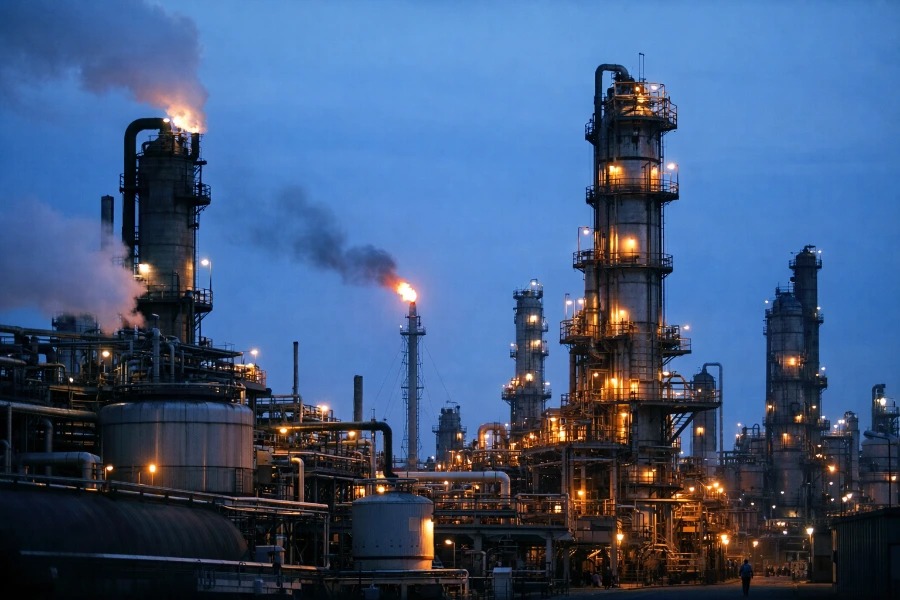
Ukrainian drones struck the Ust-Luga port complex in Russia's Leningrad region on November 11, causing a large fire visible from neighboring Estonia. Ukraine's General Staff said five petroleum-product tanks with a combined capacity of 150,000 cubic meters were destroyed. It also reported damage to a hydrocracking unit, an air cooling unit and a pumping station. Three workers were injured, and a transformer substation was shut down in an emergency.
Ukraine's security service said the same operation hit the Naro-Fominsk, a Buyan-M class missile boat carrying Onyx and Kalibr missiles. Fires were also reported at the Novatek (NVTK) terminal, at the Factor terminal and at a nearby railway station.
Ust-Luga handles crude oil, refined products, gas condensate, coal and grain. It has been sanctioned by the EU, the UK, the US, Canada and Switzerland for its role in moving Russian cargoes. Ukrainian forces last struck the port on September 1, 2026. Kyiv's General Staff said each damaged tank or pier reduces oil revenue to the Russian budget.
How Did the Ust-Luga Strike Affect the Crude Oil Price?
Brent futures settled at $95.82 a barrel on November 12, up $3.06 or 3.3%, but the Ust-Luga strike was only one of several drivers. The larger factors were attacks on Saudi energy sites and shipping disruptions in the Strait of Hormuz. The Russia-Ukraine exchange of strikes on energy infrastructure added to the supply-risk premium, though the Baltic fire did not by itself reset the market.
The strike mattered more for Russian logistics than for the global balance. Damaged storage and processing units limit how quickly cargoes can be assembled for loading, and repair timelines for tanks and secondary-processing units run to weeks or months. Russian export flows from the Baltic have been exposed to repeated disruption since late summer, which raises costs for insurers and shippers even when loadings resume quickly. Traders in the Moscow-listed market and in Brent are watching whether Ust-Luga loadings fall in the coming days.
Geopolitical Dimension
The two tracks pull in opposite directions. Washington is trying to widen the diplomatic format to include Europe, which would bring in the governments that would underwrite any postwar security arrangement and hold the frozen Russian central bank assets. Moscow's demand that the US test European intentions suggests it intends to bargain over the role of European forces and sanctions relief as part of any territorial settlement.
Kyiv, meanwhile, continues to use long-range drones to press on Russia's energy revenue while talks proceed. The Ust-Luga target sits close to the borders of Estonia and Finland, which raises the profile of Baltic security for NATO members even as the alliance is being brought into the negotiation.
What Comes Next for the Ukraine Talks?
The next round is expected to include European participants, but no date has been set. The near-term indicators are the timing and size of the prisoner exchange, the confirmation of European delegations, and whether Russia and Ukraine reopen the question of limited ceasefires, including on energy infrastructure. A pause on strikes against oil facilities would be the most direct way for the diplomacy to reach energy markets.
Outlook
Putin's consent to a European presence is the main diplomatic gain from the Moscow visit, and the prisoner swap is the main concrete result from Abu Dhabi. Neither alters the underlying dispute over Donbas, and no ceasefire is in place. Over the next three to twelve months, the oil price and Russian export reliability are likely to track both the talks and the pace of Ukrainian strikes on Baltic and Black Sea terminals.
Mentioned tickers: NVTK