Pomegra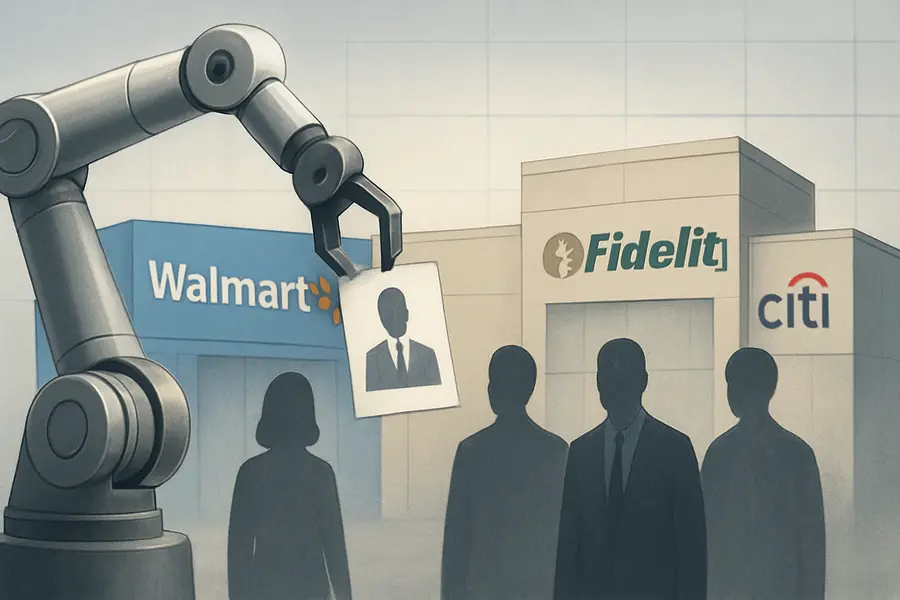
Walmart, Fidelity, and Citigroup each cut corporate roles in May 2026 as automation-led restructuring redraws the white-collar workforce across retail and finance.
- Walmart layoffs reached roughly 1,000 corporate technology and product roles in May 2026 as the retailer consolidated its global tech platforms.
- Fidelity eliminated approximately 800 positions — about 1% of its 80,000-person workforce — while planning to hire 3,300 staff skewed toward junior engineering talent.
- Citigroup's AI-enabled overhaul has reduced headcount by approximately 20,000, or 10% of its workforce, as its Q1 2026 efficiency ratio improved to 58%.
Lead
Three of the largest employers in U.S. retail and financial services — Walmart Inc., Fidelity Investments, and Citigroup Inc. — each moved to reduce corporate headcount during a concentrated window in May 2026, as organizations across the economy consolidate technology infrastructure and reassign back-office labor to AI-augmented systems. Together the three employers are cutting or reallocating more than 21,000 roles, part of a broader wave of restructuring that finance and banking firms alone extended to more than 65,500 positions this year across 16 major companies.
What Happened
Walmart layoffs became public on May 12, 2026, when an internal memo from Global CTO Suresh Kumar and EVP Daniel Danker disclosed that roughly 1,000 corporate employees across product, design, and digital-technology teams were being cut or offered relocation to Bentonville, Arkansas, or Northern California. The reorganization merged the technology and product-design divisions of Walmart, Sam's Club, and the company's international markets into a single shared platform — eliminating overlapping roles that arose when AI-focused product units were integrated across divisions. Walmart framed the action as a platform-consolidation cleanup rather than an AI-driven workforce reduction, even as the affected functions sit at the core of its competitive response to Amazon, Costco, and Aldi. Total corporate roles affected in 2026 reached roughly 1,100. Warehouse and store-level hiring continued uninterrupted.The fidelity layoff arrived days earlier, on May 7, when Bloomberg reported that the Boston-based asset manager was dismissing about 800 staffers — approximately 1% of its global headcount — as it overhauled technology and product-delivery teams. Fidelity is abandoning an agile, squad-based operating model in favor of larger centralized units, trimming senior management layers while creating capacity for hands-on engineering roles. A company spokesperson declined to attribute the cuts to AI, characterizing them instead as an effort to field "the right combination of skills" for trading and household-planning platforms the firm is developing. Fidelity simultaneously disclosed plans to hire approximately 3,300 employees in 2026, with roughly 1,650 positions in technology and product and nearly 2,000 early-career recruits across the firm. The restructuring coincides with a directive for about 25,000 employees in Boston and other locations to return to five-day in-office work starting in September.
The citi layoff is further advanced and more explicitly AI-linked. Citigroup's CEO Jane Fraser launched a multi-year transformation plan in early 2024 that targets the elimination of approximately 20,000 roles — around 10% of the firm's global workforce — by replacing functions across operations, compliance, and middle-office with automation and AI-enabled monitoring systems. By mid-2026, that plan is substantially complete. Fraser is simultaneously requiring all 175,000 Citigroup employees across 80 locations to complete AI training, characterizing mandatory instruction as a way to "remove the myths of intimidation" around the technology. The bank's Q1 2026 results demonstrated early returns: net income reached $5.8 billion, the efficiency ratio improved to 58%, and 2025 full-year revenue of approximately $85 billion represented roughly 6% growth year-over-year.
Strategic Context
The three employers have arrived at nearly identical strategic logic through different vocabularies. Walmart avoids attributing reductions to AI while restructuring the teams that build and deploy it. Fidelity describes an engineering retooling that elevates junior practitioners over layers of management — the precise workforce profile that automation creates room for. Citigroup is the most candid: its 20,000-person reduction was executed methodically, with AI-enabled systems designed to absorb operational and compliance workflows that previously required large human teams.
The pattern reflects what is becoming the standard restructuring playbook in both sectors: centralize technology functions, mandate return-to-office, execute headline cuts concentrated in senior and mid-level professional roles, and offset reductions with hiring of lower-cost, technically oriented early-career employees. The maneuver reconfigures the internal labor pyramid without reducing nominal headcount claims — Walmart, for instance, emphasized that overall headcount should remain roughly flat.
Industry-wide data underscores the pace. Across all sectors in 2026, 56% of disclosed layoff events have cited AI, automation, or machine learning as a contributing force, affecting more than 156,000 workers across approximately 150 companies. In financial services alone, the scale of workforce reduction tied to AI is reaching systemic dimensions: Citigroup and HSBC together have eliminated roughly 40,000 positions explicitly citing the technology.
AI and Technology Angle
The distinction between Citigroup's transparency and Walmart's framing is partly legal and partly competitive. Citigroup benefits from linking job reductions to a credible productivity narrative for investors. Walmart, operating in a politically sensitive consumer-retail environment, has more incentive to decouple workforce changes from automation messaging. Fidelity, as a privately held firm, faces neither shareholder-communication pressure nor the same public-relations exposure that publicly traded retailers navigate.
What the three cases share is infrastructure: all three are collapsing previously siloed technology teams into unified platforms, and all three are directing investment toward AI-native tooling. The immediate human consequence in each case is the same — experienced middle-layer employees in product, technology, and operations are being displaced faster than equivalent roles are created.
Outlook
The pace of corporate restructuring in retail and financial services is unlikely to moderate through the remainder of 2026. Organizations that completed platform consolidations early — Citigroup being the clearest example — are already reporting improved efficiency ratios and are positioned to redeploy capital toward further automation investment. Walmart and Fidelity are at earlier stages of the same transition, suggesting additional workforce adjustments are probable as technology integrations mature. The structural shift in demand — away from senior generalist roles and toward technically specialized, early-career practitioners — is accelerating, with wage and organizational implications that extend well beyond the companies currently making headlines.
Mentioned tickers: WMT, C