 Pomegra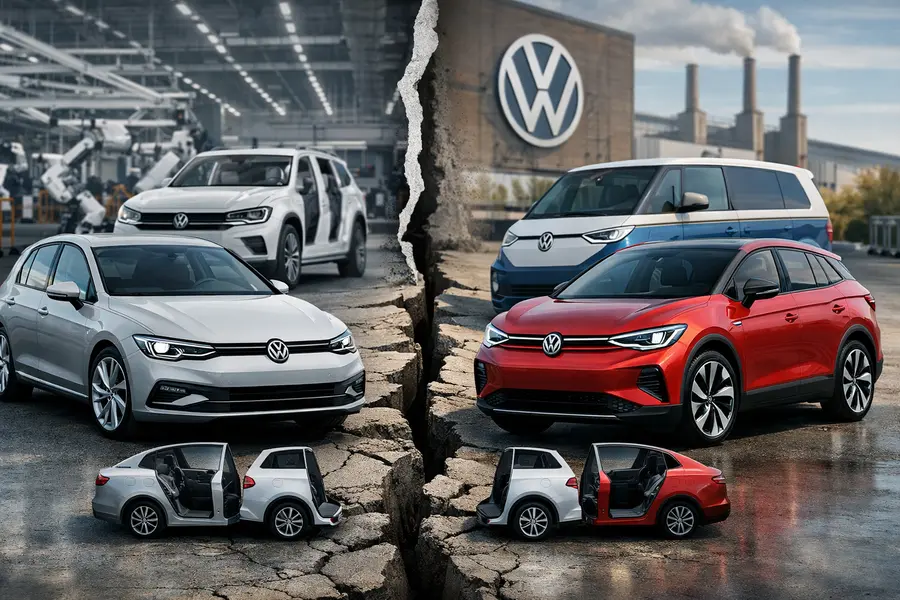
Volkswagen plans to cut its global model lineup by up to half and reduce annual production capacity to 9 million vehicles as China demand collapses and costs spiral.
- VW will cut its model lineup by up to half and trim equipment variants 75%, targeting 9 million units of annual production capacity.
- Q2 2026 global deliveries fell 8.6%—the worst in four years—as China sales collapsed 36.6% year-on-year amid fading subsidies and fierce local competition.
- VOW3 shares have shed more than 31% in 2026, trading 22% below their 200-day moving average as investors price in a prolonged transition.
Lead
Volkswagen Group presented one of the most sweeping overhauls in its eight-decade history on July 9, 2026, when CEO Oliver Blume unveiled a 12-initiative restructuring program at the company's supervisory board meeting in Wolfsburg. The plan calls for halving the group's global model lineup, cutting equipment options by 75%, and reducing annual global car production capacity to 9 million vehicles—a direct response to collapsing demand in China, mounting U.S. tariffs, and structurally high domestic costs that have eroded the carmaker's competitive position across every major market.What Happened
The planned Volkswagen model lineup cut is the most aggressive product rationalization in the group's history. Across brands including VW, Audi, Skoda, SEAT, and Porsche, up to half of current nameplates would be gradually discontinued, with resources redirected toward a smaller number of higher-margin, higher-specification models. Equipment variants—the configurations that drive factory complexity and development cost—will be reduced by as much as 75%.
Production capacity will fall further to 9 million units per year, down from approximately 10 million, calibrated to a demand environment that has deteriorated significantly from post-pandemic expectations. Volkswagen delivered 8.6% fewer vehicles to customers worldwide in the second quarter of 2026—the worst quarterly decline in four years. In China, the group's historically most profitable market, deliveries collapsed 36.6% year-on-year as domestic electric-vehicle rivals continued to hold structural share advantages in the lower and mid segments, even as Beijing's EV subsidies faded.
Financial Deterioration
The automotive industry restructuring at Volkswagen is a direct response to financial results that have alarmed investors and the supervisory board alike. In the first quarter of 2026, group net profit fell 28% to €1.56 billion while revenue declined 2% to €75.7 billion. The combination of high fixed costs and falling volumes has compressed margins across virtually every brand in the portfolio.
Capital expenditure commitments are being cut to €130 billion over the multi-year plan horizon, freeing resources previously earmarked for models now slated for discontinuation. A separate €7.4 billion divestiture of powertrain-related assets is under discussion, designed to generate near-term liquidity and sharpen focus on the group's core vehicle business.
The restructuring blueprint also calls for up to 100,000 job cuts—equivalent to roughly one in four of Volkswagen's global workforce—and the closure of four German factories: three Volkswagen brand plants in Hanover, Zwickau, and Emden, and Audi's facility in Neckarsulm, which together employ more than 45,000 workers. Management stopped short of formally ratifying those closures at Thursday's supervisory board session, reflecting the legal and political complexity that governs any such decision in Germany.
VOW Stock and Market Reaction
VOW stock registered a further 3.9% decline to €72.82 on the day of the announcement, extending a year-to-date loss of more than 31%. The preferred shares have fallen from a December 2025 high of €109.10 and now trade 22% below their 200-day moving average of €93.96—a level that reflects deep investor skepticism about both the pace of restructuring and the group's capacity to execute under political and labor constraints.Broader automotive industry equities in Europe have de-rated significantly as the Chinese competitive threat has intensified. Investors are applying higher structural-discount rates to legacy carmakers with large fixed-cost bases in high-wage markets, a dynamic that has hit Volkswagen harder than most given its German manufacturing concentration and dependence on China for a disproportionate share of group earnings.
Strategic Rationale
Volkswagen's leadership is attempting a simultaneous contraction and quality upgrade—fewer models, sharply reduced complexity, and a narrower but more profitable product architecture. The logic mirrors restructuring approaches that U.S. and Japanese competitors began executing years earlier: a smaller lineup reduces engineering overhead, simplifies the supply chain, and concentrates brand equity on vehicles that command stronger pricing.Plans to structurally separate the VW brand from the broader group are also advancing, an organizational move designed to impose greater financial accountability on each nameplate and potentially surface valuation that consolidated group reporting obscures. Such a separation would also give each division clearer mandates as the group navigates the uneven transition to electric vehicles.
Political and Labor Resistance
The pace of automotive industry restructuring at Volkswagen will be determined as much by politics and labor law as by market economics. Lower Saxony holds a 20% voting stake in the group under the Volkswagen Law, conferring an effective veto over major strategic decisions including plant closures. IG Metall, Germany's largest industrial union, and the company's General Works Council have publicly pledged nationwide protests and vowed to resist any closures or headcount reductions beyond those already agreed in prior rounds of negotiation. Worker demonstrations erupted across Volkswagen's German sites following reports of the scope of the proposed cuts.
The combination of union opposition, state shareholder leverage, and German employment law means that even decisions ratified by the supervisory board could take years to implement fully—a timeline that may not align with the pace at which demand and competitive pressures are moving against the group.
Outlook
Volkswagen's path forward requires compressing decades of accumulated model proliferation and factory investment into a structurally leaner organization while navigating the most consequential labor standoff in the group's recent history. The financial logic of the plan—fewer products, lower costs, higher margins per unit—is straightforward; the execution is not. With VOW3 shares near multi-year lows and China volumes still under pressure from both local competition and macroeconomic softness, the window for a managed transition is narrowing. Whether Thursday's supervisory board framework translates into binding operational decisions—and on what timeline—remains the defining question for the group heading into the second half of 2026.