Pomegra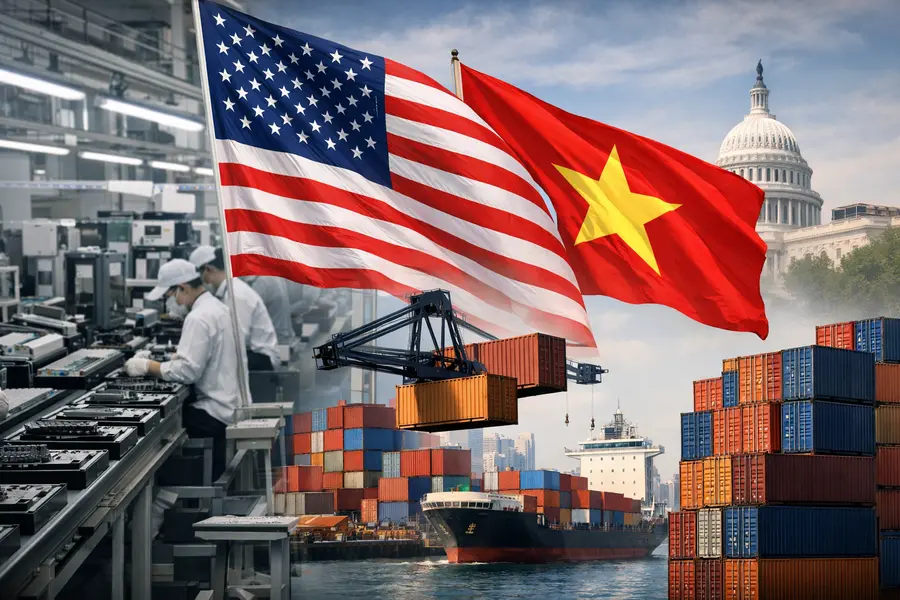
US customs officials have conducted spot inspections at China-linked Vietnam factories, raising fears of broader tariffs as bilateral trade negotiations stall over transshipment enforcement.
- US Customs inspectors examined raw material sourcing, production processes, and software IP compliance at China-linked Vietnam factories.
- Vietnam faces three simultaneous Section 301 investigations covering excess manufacturing capacity, forced labor, and intellectual property.
- The US-Vietnam goods trade deficit surged 44.3% to $178.2 billion in 2025, intensifying White House scrutiny of the corridor.
Lead
US Customs and Border Protection officers conducted spot inspections at China-linked manufacturing facilities across Vietnam in late July 2026, scrutinizing supply chains for evidence that Chinese goods are being rerouted through the Southeast Asian nation to circumvent US tariffs. The sweep arrives as bilateral trade talks between Washington and Hanoi have entered what officials describe as a decisive phase, with unresolved disagreements over transshipment rules and non-tariff barriers threatening to stall a framework trade agreement reached in October 2025.
What Happened
American customs officers examined documents, raw material sources, and production processes at targeted facilities to determine how much value was added within Vietnam before goods were exported to the United States. Inspectors also reviewed potential software intellectual property violations at select sites.
The reviews center on a persistent concern: whether containers of nominally Vietnamese goods contain Chinese-manufactured products relabeled to claim Vietnamese origin — and thereby avoid the substantially higher duties applied to Chinese imports. Under US trade rules, goods claiming Vietnamese origin must meet substantive value-addition thresholds. A retrospective CBP determination that a shipment contains predominantly Chinese-origin content can result in full Chinese-rate tariffs being applied retroactively to goods already cleared through US ports.
The inspections did not surface conclusive evidence of large-scale illicit transshipment, though officials have indicated the compliance reviews are ongoing.
Three Investigations, One Country
Vietnam stands as the only country currently facing three simultaneous Section 301 trade actions initiated by the Office of the United States Trade Representative. The first, launched in March 2026, targets excess manufacturing capacity across electronics, steel, aluminum, batteries, semiconductors, and solar equipment. A second, opened the same month, examines forced-labor compliance and placed Vietnam in a higher-risk tier carrying a proposed additional tariff of 12.5%, with direct exposure across textiles, apparel, footwear, furniture, and wood products. A third investigation, opened in May 2026 following USTR's Special 301 Report, targets Vietnam's intellectual property enforcement regime.On-the-ground vietnam factory inspections by customs officers — running parallel to the three formal investigations — signal a posture that extends well beyond routine compliance monitoring.
Trade Flows at Stake
The scale of US-Vietnam commerce amplifies the risk. US goods imports from Vietnam totaled $193.8 billion in 2025, a 42.0% increase from 2024, while American exports to Vietnam reached $15.7 billion, leaving a bilateral goods trade deficit of $178.2 billion — up 44.3% year-over-year.
That surge coincides with a broad redirection of Chinese manufacturing. Over $8 billion of Chinese exports were rerouted through Vietnam to the United States in the first three quarters of 2025 alone, as producers sought to preserve US market access under escalating tariff pressure. Vietnam accounted for approximately 80% of shipments from companies with full Chinese ownership that were redirected through Southeast Asia. US-China transpacific container bookings ran roughly 30% below year-earlier levels in early 2026 — underscoring how dramatically supply chains have shifted and why Washington treats the Vietnam manufacturing corridor as a critical enforcement front.
Negotiations Under Strain
Under the October 2025 framework, US goods enter Vietnam duty-free while the US applies a 20% tariff on Vietnamese imports, down sharply from the 46% rate announced in April 2025. A transshipment clause in the draft agreement would levy a 40% tariff on third-country goods passing through Vietnam to the United States — a provision explicitly targeting Chinese producers using the corridor.
Finalizing that framework has been difficult. The current negotiating round is tense, with the two sides unable to agree on transshipment enforcement mechanisms and a range of non-tariff barriers. Washington is pressing Hanoi to tighten rules of origin, crack down on software IP violations, and align on export controls. Until those demands are resolved, the risk of additional tariff actions against Vietnam's export base remains open.
Geopolitical Dimension
Vietnam occupies a strategically delicate position. It has deepened security and economic ties with the United States while remaining heavily dependent on Chinese inputs across its manufacturing base. A typical vietnam factory producing electronics or furniture sources significant shares of components from Chinese suppliers, making a clean domestic-origin determination complex for producers and regulators alike.
US pressure for stricter origin controls, backed by customs inspections, forces both Vietnamese authorities and multinational supply chain operators to recalibrate sourcing strategies. Companies that shifted production to Vietnam to avoid earlier tariff rounds now face the prospect of retroactive reclassification if their containers are found to contain predominantly Chinese-origin content — a compliance risk that extends to the full chain of logistics, documentation, and factory auditing.
Outlook
The July inspections mark an escalation in US enforcement that raises the probability of additional tariff action against Vietnam, independent of whether large-scale transshipment fraud is confirmed. The outcome of three concurrent Section 301 investigations — and whether Hanoi satisfies Washington's demands on transshipment rules, IP protection, and non-tariff barriers — will determine whether Vietnam's current preferential tariff position holds or narrows materially. Supply chain operators with significant Vietnam exposure face heightened documentation, sourcing, and compliance requirements as enforcement pressure deepens.
Mentioned tickers: VNM