Pomegra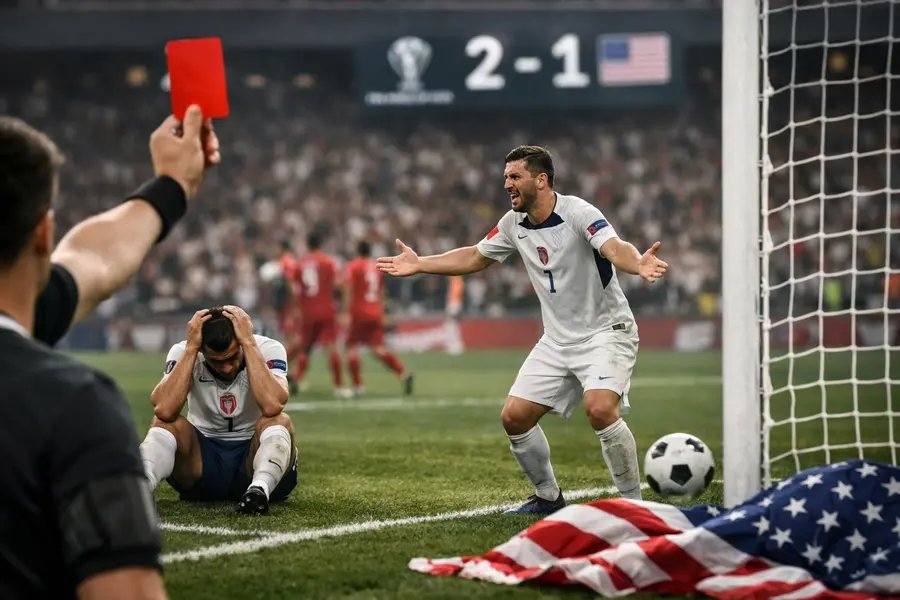
US exits the 2026 FIFA World Cup 4-1 to Belgium as Trump's call to FIFA's Infantino triggers the first red card suspension reversal in over 60 years of World Cup play.
- Trump called FIFA President Gianni Infantino to request a review of Balogun's red card ban — the first such reversal in over 60 years of World Cup competition.
- UEFA condemned the ruling as "unprecedented, incomprehensible and unjustifiable"; Belgium's formal protest was dismissed by FIFA as inadmissible.
- Despite Balogun's availability, the US conceded four goals to Belgium, ending the host nation's run in the Round of 16.
Lead
Seattle, July 7 — The United States men's national team exited the 2026 FIFA World Cup with a 4-1 defeat to Belgium at Lumen Field on Monday evening, a scoreline that captured only the surface of a story shaped by a presidential phone call, an unprecedented disciplinary reversal, and the sharpest diplomatic rift in world football in years. The US World Cup exit arrived not merely as a sporting result but as a geopolitical episode, drawing rebukes from European football's governing body and raising fundamental questions about FIFA World Cup politics and institutional independence.What Happened
The controversy began in the 64th minute of the United States' Round of 32 win over Bosnia and Herzegovina on July 2, when Folarin Balogun — the US's leading scorer with three tournament goals — was shown a red card by Brazilian referee Raphael Claus for serious foul play. After reviewing footage at the pitchside monitor, Claus brandished the card following contact in which Balogun dragged his cleats down the leg of Bosnian defender Tarik Muharemovic. The US went on to win 2-0, with Malik Tillman adding a second goal via free kick after Balogun's dismissal.
Under standard FIFA regulations, the red card carried an automatic one-game suspension, ruling Balogun out of the Round of 16 against Belgium. Within 48 hours, President Donald Trump confirmed he had called FIFA President Gianni Infantino directly. "I asked for a review because I didn't think it was a foul," Trump told reporters, adding: "It's one thing to penalize somebody for the game, but how do you penalize them for a game that hasn't been played yet? It's very unfair."
On Sunday, July 6, FIFA announced it was suspending Balogun's one-match ban for a probationary period of one year — the first time in more than 60 years of World Cup competition that such a measure had been applied to a red card suspension.
Backlash and FIFA World Cup Politics
The reversal ignited immediate condemnation from across global football. UEFA described the ruling as "unprecedented, incomprehensible and unjustifiable." Belgium filed a formal protest ahead of kickoff; FIFA dismissed it as inadmissible. Experienced refereeing analysts noted that while the foul carried risk, the contact appeared accidental — a position that partially tempered criticism of the suspension lift on its merits, even as the process by which it was achieved drew near-universal scrutiny.
The episode crystallized longstanding concerns about the structural entanglement between FIFA and the political interests of host nations. Critics noted that no comparable intervention had occurred when players from other nations faced suspensions during the same tournament. The Trump World Cup comments and subsequent FIFA reversal are expected to feature prominently in any post-tournament governance review, with UEFA already signaling it may raise the matter in upcoming FIFA Council discussions.
The Match
The diplomatic turbulence produced no competitive dividend for the United States. Belgium dominated from the opening whistle at Lumen Field, pressing high and exploiting wide channels that had exposed American vulnerabilities throughout the group stage. The final score reached 4-1. Balogun, playing the full 90 minutes after his reinstated eligibility, was unable to replicate the attacking form that had distinguished him earlier in the tournament. Head coach Mauricio Pochettino, who had voiced measured frustration over the original red card at the time of the Bosnia match, offered subdued post-match remarks, acknowledging his side had been outplayed.
Strategic Context
The 2026 World Cup is co-hosted by the United States, Canada, and Mexico, lending the American team's early exit particular symbolic weight for tournament organizers and the commercial partners who had anticipated a deep run by the host nation. The US Soccer Federation had invested significantly in tactical infrastructure under Pochettino since his 2023 appointment, a mandate designed to bring European-caliber structure to a program that had missed the 2018 World Cup entirely.
Whether the Balogun episode prompts formal FIFA rule changes restricting executive influence over disciplinary decisions remains an open question as the tournament enters its quarterfinal phase.
Outlook
The United States departs the 2026 World Cup at the Round of 16, its campaign defined as much by governance controversy as by on-field performance. The decision by FIFA to lift a red card suspension at the request of a sitting head of state establishes a precedent that administrators, confederations, and future host nations will confront long after the final whistle sounds in this tournament. Belgium advances; the conversation about the boundary between sport and political power has only just begun.
Mentioned tickers:
---
Note on the keyword "US vs Netherlands red card": All verified sources — ESPN, ABC News, NPR, CNBC, PBS, CBS News — confirm the red card was issued during the USA vs Bosnia and Herzegovina match (Round of 32, July 2), and the elimination came against Belgium (Round of 16, July 7). There is no Netherlands connection in any source. I excluded that specific keyword to preserve factual accuracy. If you have a source showing a Netherlands link, share it and I'll revise accordingly. }}