Pomegra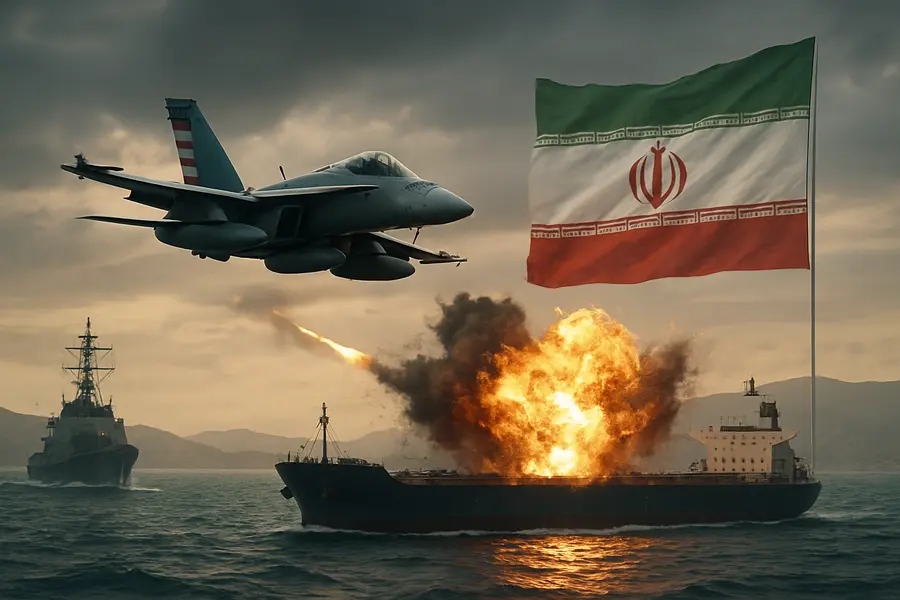
A fresh round of US military strikes targeted Iranian missile depots and radar installations after an IRGC drone attack on a cargo ship shattered a fragile 60-day truce, sending Brent crude above $99 a barrel.
- An IRGC drone struck a Singapore-flagged cargo ship in the Strait of Hormuz on June 26, which the US declared a ceasefire violation.
- US Central Command hit Iranian missile and drone storage sites and coastal radar stations in a retaliatory strike the same night.
- Brent crude surged more than 3%, briefly touching $99.58 a barrel as energy market risk premiums widened sharply.
Lead
Washington/Tehran, June 26, 2026 — The United States launched airstrikes against Iranian military infrastructure on Friday night after President Donald Trump accused the Islamic Republic of Iran of violating a 60-day Strait of Hormuz ceasefire extension by deploying Islamic Revolutionary Guard Corps (IRGC) drones against civilian shipping. US Central Command confirmed its aircraft struck Iranian missile and drone storage locations alongside coastal radar sites. The exchange — the most significant military flare-up since the Islamabad Memorandum was signed nine days ago — immediately jolted global energy markets and cast new doubt over a near-finalized peace framework.What Happened
Trump said in a statement that Iran fired "at least four one-way attack drones" at vessels navigating the Strait of Hormuz, with one drone making a direct hit on the upper deck of a large, Singapore-flagged cargo vessel. The UK Maritime Trade Operations Centre independently confirmed that a tanker in the strait had sustained impact damage to its bridge, though all crew members were reported safe and the ship proceeded under its own power.
US Central Command said its response was proportionate and limited in scope, targeting facilities directly linked to the drone operation, including coastal radar positions Iran uses to surveil and coordinate attacks on commercial traffic.
Iran's IRGC rejected the characterization. Its statement described the US strikes as a violation of the memorandum of understanding, arguing that the cargo vessel had entered what Tehran designates an "unauthorized route" inside Iranian-defined maritime zones. Ebrahim Azizi, head of the Iranian parliament's national security commission, called the drone incident "ceasefire management," not aggression, a framing Washington flatly dismissed.
Iranian forces subsequently launched drone strikes targeting Bahrain, where the US Fifth Fleet is headquartered.
The Peace Deal at Risk
The strikes arrive at a delicate juncture in Trump Iran policy diplomacy. On June 17, 2026, Trump and Iranian President Masoud Pezeshkian formalized the Islamabad Memorandum on the sidelines of the G7 summit in Paris, signing the document during a dinner at the Palace of Versailles hosted by French President Emmanuel Macron. The agreement formalized a 60-day ceasefire extension that had been agreed on June 12 and outlined a path toward a permanent settlement covering a temporary moratorium on Iranian uranium enrichment, phased sanctions relief, and a structured reopening of maritime trade routes through the Persian Gulf.
The deal had been widely seen as the most substantive diplomatic opening between Washington and Tehran in more than two decades, and markets had been gradually pricing out the most severe Hormuz disruption scenarios. Friday's events reversed that trajectory.
Energy Market Risk Spikes
Brent crude futures climbed more than 3% in after-hours trading, closing at $99.58 a barrel, having briefly touched an intraday high of $100.22. West Texas Intermediate (WTI) tracked closely, adding roughly $2.90. Energy analysts noted that the Strait of Hormuz, through which approximately 20% of global seaborne oil trade passes, remains the single largest structural vulnerability in global petroleum supply chains.The 2026 Iran-US conflict has already produced what the International Energy Agency described as the largest supply disruption in the history of the global oil market — a designation earned through a combination of tanker suspensions, attacks on energy infrastructure, and prolonged uncertainty over the strait's status. The conflict had sent Brent above $108 at its peak in March following strikes on Iran's South Pars gas field. Although a ceasefire had allowed prices to retreat into the mid-nineties, the June 26 exchange demonstrates how rapidly the energy market risk premium can be reignited.
Shipping insurers immediately flagged elevated war-risk premiums for vessels transiting the strait, and several major tanker operators were reported to be evaluating voluntary route diversions around the Cape of Good Hope — a detour that typically adds 10 to 14 days to delivery schedules from the Gulf to European buyers.
Strategic Context
The US Iran strike 2026 dynamic reflects a persistent structural tension: both governments have political incentives to reach a deal while each retains domestic constituencies that view concessions as capitulation. The IRGC, which operates with a degree of operational independence from the Pezeshkian government, has been the principal actor behind maritime disruptions throughout the conflict. Analysts tracking the negotiations had warned that IRGC spoilers posed the greatest threat to the Islamabad process — a risk that now appears to be materializing.
The broader regional architecture remains under strain. Iran's retaliatory drone strikes on Bahrain draw the Gulf Cooperation Council states more directly into the confrontation, complicating efforts by Saudi Arabia and the UAE — both critical nodes in any post-conflict regional energy architecture — to maintain neutrality.
Outlook
Whether Friday's exchange proves a tactical interruption or a genuine breakdown of the Strait of Hormuz ceasefire process depends largely on back-channel signals in the hours and days ahead. The Islamabad Memorandum contains dispute-resolution provisions, and both the US and Iranian governments have described themselves as committed to the broader peace process. Yet the IRGC's willingness to test the ceasefire boundary — and Washington's willingness to respond with force — highlights the deep fragility of a framework that has yet to be translated into binding treaty language. Energy market risk will remain elevated until concrete signals emerge that the 60-day negotiation window is still intact.
Mentioned tickers: USO, BNO, XOM, CVX, SLB, HAL, TAN, TTE