Pomegra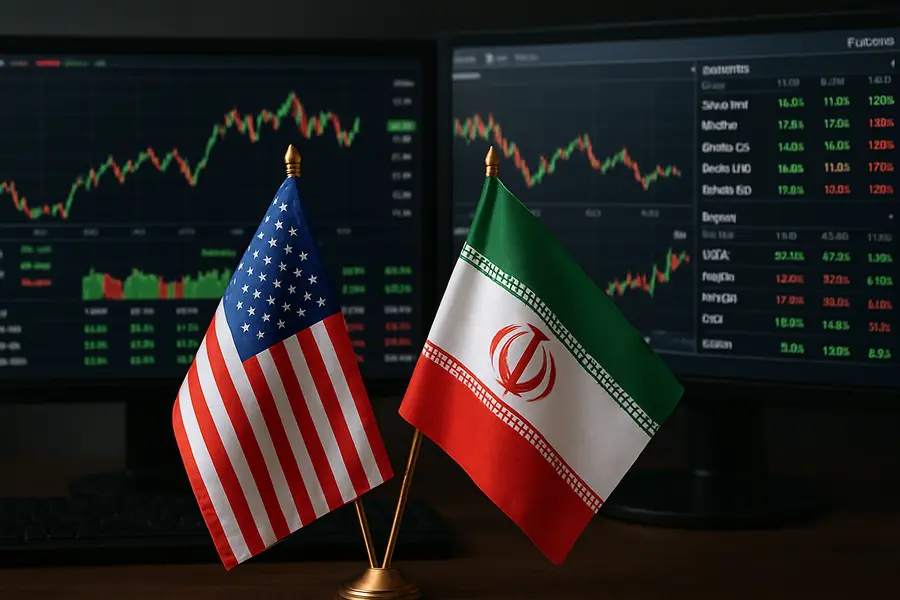
Wall Street futures drifted lower in premarket trading Monday as the U.S. and Iran agreed on a 60-day roadmap toward a final deal after the first round of Switzerland talks concluded over the weekend.
- S&P 500 E-minis fell 0.16% and Dow E-minis dropped 0.09% in premarket as investors weighed the U.S.-Iran 60-day deal roadmap.
- Brent crude slipped as much as 2% after the first round of talks concluded, with Tehran agreeing to readmit IAEA nuclear inspectors.
- Two-year Treasury yields hit 4.230%, their highest since early 2025, with markets pricing a 25-basis-point Fed rate hike in September.
Lead
U.S. stock market futures pointed to a cautious open Monday, June 22, as Wall Street parsed "encouraging progress" from the inaugural round of U.S.-Iran peace talks in Switzerland — a diplomatic milestone that pulled Brent crude down as much as 2% but left equity indices in a holding pattern ahead of a pivotal week of inflation data and corporate earnings.By 4:53 a.m. ET, S&P 500 futures had slipped 12 points, or 0.16%, while Dow E-minis shed 49 points, or 0.09%. Nasdaq 100 E-minis were effectively flat, up just 2.5 points. The muted moves followed a week in which the Nasdaq gained 2.4%, driven by technology and semiconductor names, leaving markets with limited near-term directional catalyst until diplomacy or domestic data provided one.
What Happened
Negotiations at the Bürgenstock resort outside Geneva concluded their first session Sunday night with Washington and Tehran announcing agreement on a roadmap toward a final deal within 60 days. Both governments described the session as producing "encouraging progress," though core disagreements — principally Iran's right to enrich uranium and the disposition of its highly enriched uranium stockpile — remain unresolved.
A significant diplomatic concession emerged: Tehran agreed to readmit inspectors from the International Atomic Energy Agency, with technical discussions with IAEA representatives beginning as early as Monday. Vice President JD Vance framed the access agreement as "the first step in permanently denuclearizing Iran's nuclear program" and said U.S. negotiators were focused on making it "effectively impossible" for Tehran to reconstitute a weapons-capable nuclear capability. Working groups covering nuclear issues, sanctions relief, and monitoring are expected to convene at the resort through the week.
The two sides also agreed to establish a de-confliction cell to oversee the cessation of military operations in Lebanon, addressing one of the session's most contested secondary disputes.
Market Reaction
Brent crude led asset-class moves, declining as much as 2% Monday morning and trading near $80 per barrel. The benchmark had already shed approximately $17 per barrel over the four preceding sessions as market participants grew more confident that the worst of the Strait of Hormuz disruption was receding. Iranian forces have refrained from targeting commercial vessels in the strait for several consecutive nights, a development U.S. officials have cited as compliance with the June 17 memorandum of understanding.Equity stock market futures today reflected more measured optimism. When cash trading resumed, seven of eleven S&P 500 sectors advanced. The Dow Jones Industrial Average added 261 points, or 0.51%, to 51,826. The S&P 500 gained 0.32% to 7,524. The Nasdaq Composite was essentially unchanged, with communication services declining 2.3% and partly offsetting gains elsewhere.
Semiconductor stocks outperformed the broader tape. Micron Technology and Sandisk each climbed roughly 3.5%, and Intel rose 4.1%, as investors bet on continued enterprise AI infrastructure buildout. Apogee Therapeutics surged 53% after reports surfaced of acquisition discussions with AbbVie in a deal valued at approximately $10.9 billion.
Fixed-income markets struck a divergent note. The two-year Treasury yield touched 4.230%, its highest level since early 2025, signaling that bond traders expect the Federal Reserve to raise its benchmark rate by 25 basis points in September. The move underscored persistent domestic inflation concerns even as geopolitical risk appeared to recede at the margin.
Geopolitical Dimension
The U.S.-Iran peace talks roadmap represents the most substantive diplomatic engagement between Washington and Tehran since the collapse of the 2015 Joint Comprehensive Plan of Action. The framework signed June 17 established a ceasefire, outlined the prospect of sanctions relief tied to Iranian compliance, and pointed to the conditional release of up to $25 billion in frozen Iranian assets.
The path to a final agreement, however, remains narrow. Iranian President Masoud Pezeshkian has publicly insisted that Tehran will not relinquish its right to enrich uranium — a position that sits in direct tension with U.S. negotiating priorities. The scope of IAEA inspection access, the sequencing of sanctions relief, and the fate of Iran's existing highly enriched uranium stockpile are expected to dominate the working-group sessions convening this week.
Lebanon represents the secondary front. The de-confliction mechanism agreed in Switzerland is designed to enforce the halt in military operations between Israel and Hezbollah, though no formal ceasefire document has been signed as part of the current framework.
The Strait of Hormuz remains the most consequential near-term variable for global energy markets. Through it passes roughly 20% of the world's traded oil, and normalization of maritime traffic would compress the geopolitical risk premium embedded in energy prices — a process already visibly underway in crude futures.
What's Next
Market outlook June 2026 is shaped by two converging calendars. Micron Technology reports quarterly earnings Wednesday, providing a real-time read on enterprise AI infrastructure demand — the sector that has been the principal engine of equity market strength. Personal consumption expenditure inflation data follows Thursday, and as the Federal Reserve's preferred price gauge, it could decisively shift rate expectations heading into the second half of the year.On the diplomatic front, technical teams at Bürgenstock are expected to deliver substantive progress before a High Level Committee reconvenes. Any signal that Iran is prepared to cap uranium enrichment or expand IAEA access would represent a material catalyst for energy markets. A breakdown in talks, or renewed activity in the Strait of Hormuz, would reverse recent oil-price declines sharply and likely push equity futures lower.