Pomegra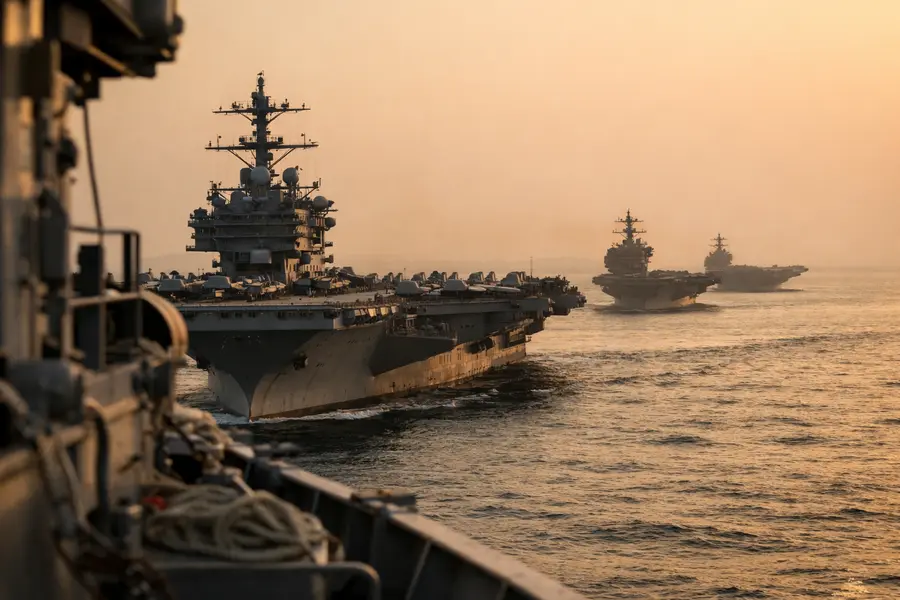
The Pentagon is sending the USS Theodore Roosevelt and 10,000 sailors and Marines to the Gulf as Trump rejects Iran's ceasefire offer and Brent holds near $107.
- The USS Theodore Roosevelt left San Diego on Sunday, and 2,200 Marines aboard USS Makin Island followed on Monday.
- Trump rejected Iran's offer to reopen the Strait of Hormuz in exchange for sanctions relief and an end to the naval blockade.
- Brent crude gained 2.89% to $107.34 a barrel after the rejection, with strikes expected to resume after November's midterms.
Lead
The Pentagon is deploying an additional aircraft carrier and about 10,000 sailors and Marines to the Persian Gulf region. The move gives US commanders more options if President Donald Trump chooses to escalate against Iran. The USS Theodore Roosevelt carrier strike group left its San Diego home port on Sunday. The USS Makin Island amphibious ready group, with an assault ship, aircraft and 2,200 Marines, sailed on Monday.
The deployment follows Trump's rejection of a conditional Iranian proposal to reopen the Strait of Hormuz. He has signaled that renewed strikes are likely after the November midterm elections. The war is now in its eighth month, and diplomacy has stalled over Tehran's control of the waterway.
What Is the Pentagon Sending to the Middle East?
The Pentagon is sending a third carrier strike group, a second amphibious ready group and roughly 10,000 personnel. Once the Theodore Roosevelt arrives, the region could again host three carriers at once. That last happened in April 2026, and before that during the 2003 invasion of Iraq.
The USS George Washington is already on station. The USS George H.W. Bush has temporarily left the region. The USS Boxer amphibious group is operating near the Strait of Hormuz. In recent weeks the Pentagon also sent two additional missile defense batteries to Qatar and Saudi Arabia.
US Central Command has declined to discuss timelines, saying it does not discuss unit schedules for operational security reasons.
What Did Trump Reject, and What Did Iran Offer?
Trump rejected an Iranian proposal, announced at the United Nations General Assembly, that would have reopened the Strait of Hormuz. The offer set a seven-day timeline. Washington would release frozen Iranian funds, lift sanctions and end its naval blockade of Iranian ports. In return, Iran would reopen the strait and return to talks on its nuclear program.
Trump called the package not good enough. He said that things he would not have approved a year ago he would not approve today. He singled out the offer to open the strait as insufficient on its own. He has also told advisers he expects US strikes to resume after the midterms, which fall in early November.
Why Did Oil Prices React This Way?
Brent crude rose 2.89% to $107.34 a barrel after the rejection, trading near $108 in Asian hours on Monday. The crude oil price reflects a market that sees a growing chance of renewed US-Iran hostilities once the election is over.
The Strait of Hormuz carried about one-fifth of global oil supply before the war began in February. Commercial traffic has since fallen sharply because of attacks on vessels, mostly attributed to Iran or allied groups. Shipping data show 132 transits across the week of September 21 to 27, against a pre-war baseline of roughly 130 crossings a day.
Regional equities were mixed on the news. South Korea's Kospi fell 2.70% and Japan's Nikkei lost 0.73%. Hong Kong's Hang Seng gained 0.54%. Importers of Gulf crude in North Asia carry the most exposure to a prolonged disruption.
Strategic Context
The deployment serves two purposes. It adds strike capacity if talks stay frozen, and it adds force protection for shipping and Gulf partners. A third carrier increases the number of aircraft available for sustained operations. The amphibious groups add the ability to seize or secure coastal and island positions.
The timing around the midterms limits Trump's options. A major escalation before the vote would risk higher fuel prices at the pump. Waiting leaves forces in place while the blockade and sanctions continue to pressure Tehran. For Iran, the offer to reopen Hormuz was its main bargaining asset, and Washington has declined to treat it as sufficient on its own.
What Comes Next for Oil and Gulf Security?
Oil is likely to stay sensitive to each Hormuz incident and each carrier movement through the election. Near-term outcomes fall into three broad cases:
- Stalemate: the blockade and attacks on shipping continue, and Brent stays above $100.
- Back-channel talks: a revised offer from Tehran revives negotiations before the vote, and risk premiums ease.
- Post-midterm strikes: with three carriers on station, the US has the capacity to resume operations soon after the election, and energy prices could rise sharply.
Gulf producers and Asian refiners are exposed in all three cases. The extra missile batteries in Qatar and Saudi Arabia indicate that Washington expects retaliation against partner infrastructure if strikes resume.
Outlook
The Pentagon is building a force posture that supports renewed strikes, while Trump has closed the diplomatic route Iran offered at the UN. Brent near $107 prices in that risk. The arrival of the Theodore Roosevelt, the November midterms and the next shipping data from Hormuz are the markers for the next phase of the conflict.
Mentioned tickers: None