Pomegra
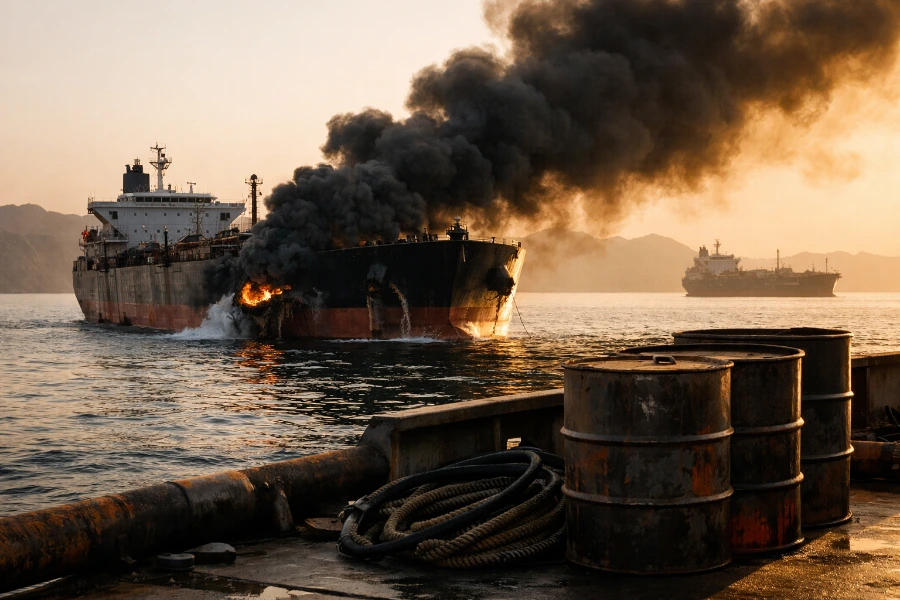
Iran's army says three oil tankers hit naval mines east of the Strait of Hormuz, yet Brent held near $92 as a supply surplus capped the crude oil price.
- Iran's army says three tankers hit naval mines and caught fire east of Hormuz after switching off navigation systems.
- Brent traded near $92.12 and WTI near $83.17 on November 19, little changed on the day.
- A US crude stock build of 3.4 million barrels and an IEA-projected surplus outweighed the shipping risk.
Lead
Three oil tankers struck naval mines and caught fire east of the Strait of Hormuz on November 18, according to a statement from Iran's army. The army said the vessels had switched off their navigation systems before entering an area it described as off-limits to shipping, and that all three were disabled. Brent crude futures traded at $92.12 a barrel in Asian hours on Thursday, up 17 cents, or 0.18 percent. WTI stood at $83.17, down 0.11 percent.
What Did Iran's Army Say Happened to the Tankers?
Iran's army said three tankers were disabled by mine blasts in the eastern approaches to the strait, and that they had been operating dark inside a restricted zone. The statement gave no vessel names, flags, ownership details or casualty figures.
By early Thursday, shipowners, flag states, the UK Maritime Trade Operations (UKMTO) and US Central Command had not corroborated the mine strikes. Iran has previously reported mine incidents, while the US military has said the waterway was cleared of mines.
A separate incident was logged by UKMTO. A tanker was struck by a projectile about six nautical miles north of Khasab, Oman, at 1645 GMT on November 18. The projectile hit the engine room, and the crew were reported safe. The origin of the projectile was not stated.
The incidents follow an attack on a vessel operated by ADNOC, the Abu Dhabi state energy company, on November 17, which left 11 crew injured and one missing. They also coincide with Iranian drone strikes on US positions in Kuwait.
Why Did the Crude Oil Price Barely React?
Oil barely moved because physical supply is ample and Gulf exports are flowing near pre-war levels. The conflict between the United States, Israel and Iran is now in its ninth month, and traders have priced in a recurring pattern of maritime incidents without a sustained loss of barrels.
Inventory data added to the bearish tone. US crude stocks rose by 3.4 million barrels to 417.8 million in the latest weekly report, against a forecast build of only 58,000 barrels. Gasoline and distillate stocks also exceeded expectations. Brent fell 1.3 percent on Wednesday after the release.
The International Energy Agency projects a fourth-quarter surplus of 1.7 million barrels per day, with supply of about 105 million against demand of 102.3 million. Brent and WTI are on course for a monthly decline of roughly 20 percent in November.
Geopolitical Dimension
The Strait of Hormuz is the only seaward exit for most Gulf crude, and mine warfare is a low-cost way to raise insurance premiums and delay sailings without a formal blockade. Tanker rates remain elevated because reduced fleet capacity has complicated offshore transfers, even as volumes have recovered.
Iran's claim that the ships ran without transponders places responsibility on the shipping side and signals that it intends to enforce exclusion zones east of the strait. That is a different pressure point from the narrow channel itself, and it widens the area where commercial operators face risk. Shipping through the strait carries war-risk premiums that have not fully normalized.
What Comes Next for Hormuz Shipping and Oil?
The next signals are independent confirmation of the three vessels' identities and condition, and any US naval response on mine clearance. If the incidents are verified and repeat, the effect would fall first on freight and insurance costs rather than on benchmark crude, given current surplus conditions.
OPEC+ ministers meet on November 29 to review production policy, and the surplus outlook will shape that decision. Goldman Sachs (GS) forecasts Brent averaging $88 in 2027 and easing to $78 by the end of that year on a return to surplus supply. Those projections assume Gulf exports remain intact.
Outlook
The mine claims add to a run of Hormuz incidents that have so far failed to lift the crude oil price, which is anchored by rising inventories and a projected fourth-quarter surplus. Near-term direction depends on whether verified losses of tanker capacity emerge, and on the OPEC+ meeting on November 29. Without either, shipping costs, not crude benchmarks, carry most of the risk.
Mentioned tickers: GS