 Pomegra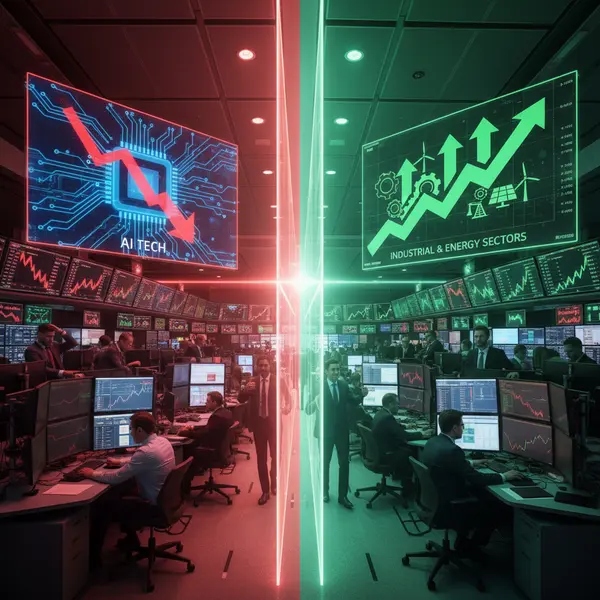
The AI Trade Hits a Wall
The anything-AI playbook that powered two consecutive years of double-digit Nasdaq gains has entered a period of sharp reassessment. What strategists are now calling the "AI Funk" — a sustained derating of artificial intelligence-exposed equities amid mounting questions over return on investment — has reshaped equity market leadership in the first five months of 2026. The S&P 500 Information Technology sector stands as the index's single worst performer year to date, shedding 0.40%, a jarring reversal after finishing 2025 as the second-best sector on the back of the AI infrastructure boom.
- Tech is 2026's worst-performing S&P 500 sector, down 0.40% YTD while basic materials, industrials, and energy lead all gains
- AI agents erased roughly $2 trillion in SaaS market cap between January and February 2026, coining the term "SaaSpocalypse"
- Small-cap stocks are outpacing large caps +5.57% vs. +0.56% YTD, driven by earnings broadening beyond the Magnificent Seven
The broader market, however, has not collapsed — it has rotated. Basic materials now lead all U.S. equity sectors, up 9.05% for the year. Industrials and energy follow close behind. Small-cap companies have surged 5.57% year to date against a meager 0.56% gain for large caps. The divergence is the clearest signal in years that capital is fleeing concentration risk and seeking earnings broadening in corners of the market long left behind by the Magnificent Seven's gravitational pull.
The SaaSpocalypse: $2 Trillion Gone in 30 Days
The rupture was sudden and structural. Between January 15 and February 14, 2026, approximately $2 trillion in market capitalization evaporated from the software sector — not from a recession, not from a rate shock, but from AI agents themselves. The iShares Expanded Tech-Software ETF (IGV) plunged 22% year to date, its steepest decline since the 2022 rate-hike cycle, but with an entirely different underlying cause.
Autonomous AI agents have begun performing — and replacing — the workflows that powered the SaaS subscription economy for two decades. Project management, CRM logging, customer support triage, HR scheduling, and report generation are now being executed by agent-based systems that don't require a dedicated software interface, let alone per-seat licensing. The per-seat pricing model, the cornerstone of SaaS revenue growth, is structurally threatened when a single agent can displace five human operators.Individual stock damage was severe. Atlassian (TEAM) dropped 35% after reporting the first-ever quarterly decline in enterprise seat count in the company's history. Salesforce (CRM) fell 28% despite revenue growth, as investors pivoted focus from top-line numbers to decelerating net-new customer acquisition — a forward-looking signal that markets treated as existential. ServiceNow (NOW) lost 22%, Workday (WDAY) slid 20%, and HubSpot (HUBS) declined 25%, as AI agents began handling more than 80% of tier-1 support tickets and core CRM data-entry functions. Analysts at Morgan Stanley and Bank of America issued cautious notes on Salesforce following its Q1 2026 earnings, calling growth momentum "largely uninspiring" and flagging "deceleration to mid-single-digit booking growth" as a persistent headwind.
The Earnings Broadening Story
The most constructive counternarrative to the AI Funk is the closing of the earnings gap between Big Tech and the rest of the market. Michael Arone, chief investment strategist at State Street Global Advisors, frames the shift as a "powerful one-two punch": an economy performing above expectations, backed by fiscal stimulus and lower interest rates, combined with genuinely broadening profits across small-cap and non-tech sectors.
In the Morningstar growth index, small-cap companies are up 6.02% year to date versus just 0.13% for large caps. In the value index, small caps gained 5.94% against 2.80% for large caps. The Russell 2000 has outperformed the S&P 500 year to date, and Wolfe Research's technical team noted in late May that the small-cap index is not yet overbought — flagging a potential run toward the 3,000 level. Real assets are performing "outstandingly," with gold, metals, and mining companies commanding investor attention as the dollar diversification trade gains momentum amid geopolitical uncertainty.
AI Capex vs. ROI: The Core Tension
Beneath the sector rotation lies a deeper ideological confrontation on Wall Street: Big Tech is spending more than ever on AI infrastructure, but the revenue payoff remains elusive for the broader software ecosystem. S&P 500 companies' capital expenditure expectations for 2026 have risen more than 5%, with Alphabet, Amazon, Meta, and Microsoft projected to collectively deploy hundreds of billions on AI buildout. Nvidia (NVDA) — having crossed a $5 trillion market valuation in 2025 — remains a beneficiary of the infrastructure wave, as does AMD, which surged 16% in a single session in early May on robust AI demand signals.
Yet the St. Louis Federal Reserve's Alberto Musalem articulated the market's central tension in a late-May speech, expressing skepticism that AI will prove disinflationary in the near term — a direct counter to the productivity-boom thesis advanced by new Fed Chair Kevin Warsh. With PCE inflation holding at 3.8% annually and core PCE at 3.3% — both well above the Fed's 2% target — monetary policy remains in holding mode, straining rate-sensitive growth multiples even as AI narratives struggle to convert spending into demonstrable corporate earnings.
Old Economy's Comeback and the Road Ahead
The "Great Rotation" now dominating market commentary is not a single event but a confluence of forces: AI ROI disappointment pressuring software multiples, geopolitical instability boosting real-asset demand, small-cap earnings recovery drawing capital away from mega-cap concentration, and an emerging class of agent-native startups threatening incumbents from below.
Snowflake (SNOW) delivered a rare bright spot for the AI-adjacent software trade in late May, surging 36.5% on a single session — its best day on record — after issuing a rosy fiscal Q2 outlook and lifting full-year product revenue guidance to $5.84 billion. The move temporarily revived enthusiasm across enterprise software, lifting the IGV ETF 2.8% on the session and pulling Qualcomm and AMD higher. But even that surge unfolded against a backdrop of CEO confidence falling from 59 to 47 in Q2 per The Conference Board, with business leaders citing geopolitical risks, AI uncertainty, and deteriorating economic expectations as leading concerns.
The market heading into June 2026 is one defined by selective AI winners, surging old-economy sectors, and a structural repricing of the SaaS business model. The S&P 500 and Nasdaq have posted new record closes even through the volatility, reaching 7,563.63 and 26,917.47 respectively in late May — testament to the underlying resilience of the bull market. But the composition of that rally has fundamentally changed. Tech still participates; it no longer leads unconditionally.
Mentioned Tickers: NVDA, MSFT, AAPL, AMZN, GOOGL, META, TSLA, CRM, NOW, TEAM, WDAY, HUBS, SNOW, AMD, QCOM, SNDK, MRVL, IGV, BBY, KSS, DLTR, NIO, DTE