Pomegra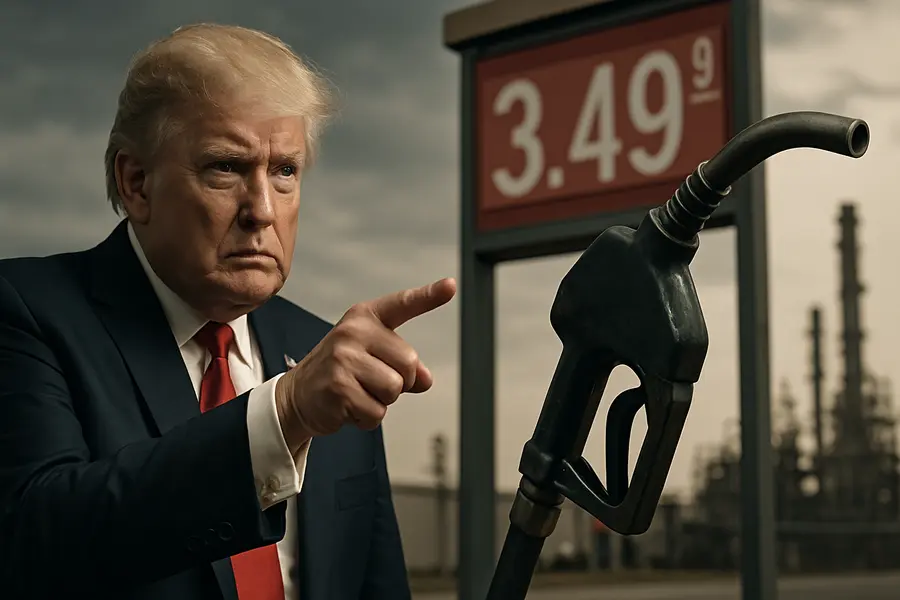
Trump directed the DOJ to investigate big oil companies including Exxon and Chevron after crude oil prices fell 27% but pump prices dropped only half as much.
- Crude oil fell ~27% in six weeks to near $76/barrel; national average gasoline slipped just 13% to $3.93/gallon.
- Trump named Exxon Mobil, Chevron, Shell, and BP by name, accusing the industry of "gouging" consumers.
- The DOJ pledged to begin looking into fuel affordability "immediately"; no formal enforcement action has been announced.
Lead
President Donald Trump on June 24, 2026 ordered the Department of Justice to open an investigation into big oil companies, alleging that Exxon Mobil, Chevron, Shell, and BP are failing to pass along a sharp decline in crude costs to drivers at the pump. In a post on Truth Social, Trump accused the industry of "gouging" consumers and warned that gasoline prices "better start going down a lot faster."
What Happened
Trump's directive came after U.S. benchmark crude fell roughly 27% over six weeks — from a peak near $112 per barrel in mid-May to approximately $76 per barrel on June 24 — while the national average retail gasoline price declined a comparatively modest 13%, from about $4.52 per gallon in late May to $3.93 per gallon, according to AAA data. GasBuddy placed the average slightly lower at $3.85.
"Oil prices have come down so much and we are not seeing anything at the pump," Trump wrote, adding that customers are being charged prices inconsistent with the underlying cost of crude. He set an informal target of $2.25 per gallon.
The DOJ responded with a statement committing to ensure "affordability in this nation," describing fuel cost as both a national security issue and a kitchen-table concern. No specific investigation mechanics, subpoenas, or timelines were disclosed as of June 25.
Industry Response
Chevron offered the most direct public reply. CFO Eimear Bonner acknowledged the lag, stating "it's going to take time" for lower crude costs to flow through to retail and that the company is "doing everything we can" to help resolve the situation. Chevron cited annual production growth of 7–10% as part of its supply response.The American Petroleum Institute pushed back on the "gouging" characterization, arguing that gasoline prices "don't move in lockstep with crude oil, especially during a major global disruption that is still affecting supply, refining and inventories." Exxon Mobil, Shell, and BP had not responded to media requests for comment by the time of publication.
Structural Context
The divergence between crude and retail prices reflects well-documented features of fuel supply chains rather than an anomaly. Crude oil accounts for roughly 50% of a gallon's retail price; the remainder covers refining margins, distribution, taxes, and station overhead — costs that move more slowly or not at all with crude benchmarks. Economists estimate a long-run pass-through rate of roughly 50%, with only about 37% of a crude price move reflected at the pump within three months.
Compounding the lag: U.S. refineries are still working through higher-cost crude purchased during a period of elevated prices tied to disruptions in the Strait of Hormuz earlier this year. For the week ending June 19, refineries operated at 96.1% capacity utilization, processing 17.1 million barrels per day, while commercial crude inventories of 412.1 million barrels stood 7% below the five-year seasonal average. Gasoline inventories were similarly tight, running 5% below the five-year norm — a factor that mechanically supports retail prices even as crude falls.
Market Reaction
Shares of Chevron, Exxon Mobil, and ConocoPhillips moved lower following the announcement. The broader energy sector came under pressure as investors assessed the political and regulatory risk to refining margins.
Treasury Secretary Scott Bessent framed the situation as a supply-chain normalization issue, expecting prices to decline further as Middle East tensions ease and higher-cost inventory clears the system.
Outlook
Whether the DOJ inquiry produces a formal antitrust investigation or enforcement action remains unclear. Price-gouging cases in the oil sector have historically faced a high legal bar: prosecutors must demonstrate coordinated conduct or market manipulation rather than the ordinary inventory and margin dynamics that underlie most crude-to-pump price lags. The more immediate lever is crude supply itself — if oil prices remain near current levels, retail prices are widely projected by the EIA to continue declining into the second half of 2026, potentially narrowing the political pressure on the industry.