Pomegra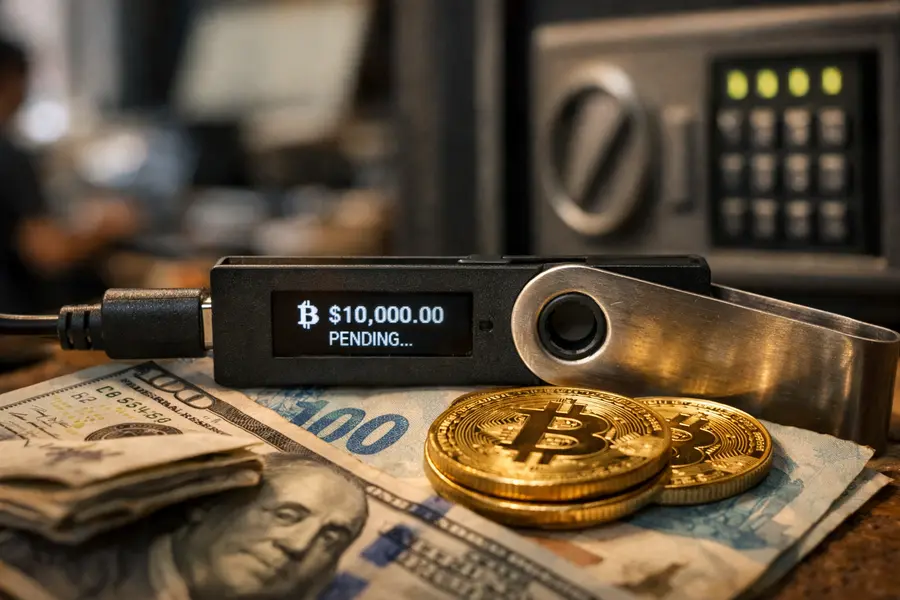
Brazil's central bank mandates a 24-hour delay on crypto transfers above $10,000 to foreign platforms or self-custody wallets, targeting stablecoin fraud, effective January 2027.
- Resolution BCB No. 584/2026, published August 7, requires a 24-hour hold on crypto transfers above $10,000 sent to overseas exchanges or self-custody wallets, taking effect January 1, 2027.
- The Brazil rules close an enforcement gap where stablecoin fraud proceeds cleared foreign platforms faster than victims or institutions could initiate recovery.
- Providers may release funds early after completing satisfactory risk assessments; customers must receive real-time notifications throughout the review.
Lead
Brazil's Banco Central do Brasil (BCB) published Resolution No. 584/2026 on August 7, 2026, directing all virtual asset service providers (VASPs) operating in the country to impose a mandatory transfer delay of up to 24 hours on crypto transfers exceeding the equivalent of $10,000 destined for foreign exchanges or self-custody wallets. Effective January 1, 2027, the rule covers both single transactions and cumulative daily volumes above the threshold. The BCB identified stablecoins — dollar-pegged digital assets — as a primary instrument used to move funds obtained through financial fraud before victims or financial institutions can intervene, describing the hold as a recovery window designed to match what traditional banking rails already provide for wire transfers.What the Rule Does
Any outbound transfer above $10,000 — whether in a single transaction or accumulated across multiple transfers on the same calendar day — triggers the 24-hour hold before execution. The pause applies specifically to transfers directed to overseas VASPs or to self-custody wallets, both of which have historically provided rapid exit routes for illicit crypto flows.
Providers are not required to hold transfers for the full period if their internal risk systems clear the transaction earlier. The BCB permits early release once a satisfactory review has been completed under parameters the regulator will prescribe. At every stage, VASPs must keep customers informed of the status of their funds in real time — a transparency obligation that runs alongside the hold itself.
VASPs must also maintain daily logs documenting occurrences of fraud and attempted fraud in both payment services and virtual asset operations, including the corrective measures applied. The BCB can draw on that data during supervisory examinations.
Stablecoin Fraud: The Regulatory Driver
Stablecoin fraud forms the explicit policy rationale for the new rules. Stablecoins have become a preferred vehicle for moving criminal proceeds internationally at speed, exploiting the near-instantaneous settlement that crypto rails provide. Criminals have combined phishing, social engineering, and unauthorized account access to generate victim losses, then immediately bridged proceeds through stablecoins to foreign wallets — a sequence that standard bank-clearing timelines of 24 to 48 hours would ordinarily disrupt. Crypto transfers carried no equivalent delay, creating an asymmetric enforcement gap that Resolution No. 584/2026 closes with the mandatory 24-hour transfer delay.The BCB noted a sharp recent rise in fraud cases using this channel, underscoring the urgency behind the accelerated rulemaking.
Broader Regulatory Architecture
The transfer delay sits atop a multi-layer framework the BCB has been assembling since late 2025. Resolutions 519, 520, and 521, published November 2025 and operative from February 2026, established mandatory BCB authorization for every exchange, custodian, and intermediary in Brazil, with capital requirements of between R$10.8 million and R$37.2 million — roughly $2 million to $7 million — calibrated by business model. VASPs must reach the more demanding Segment 4 prudential tier by June 30, 2028.
In May 2026, the BCB separately barred the use of stablecoins and other cryptocurrencies to settle transactions within Brazil's regulated electronic foreign exchange system, the framework governing digital international remittances. That rule, Resolution No. 561, takes effect October 1, 2026. The August measure adds a fraud-prevention layer targeting outbound flows, complementing the cross-border settlement restriction rather than duplicating it.
Market and Operational Impact
The 24-hour transfer delay will affect retail and institutional users who move significant volumes across borders, particularly those relying on stablecoins for cross-border liquidity management. Commercial flows above $10,000 — a threshold that captures a meaningful share of professional crypto activity — will face extended settlement timelines from January 2027 onward.
Smaller VASPs carry the heaviest compliance burden. Building or integrating real-time risk-assessment systems capable of clearing transactions within the hold window, alongside mandatory fraud logging and customer-notification protocols, raises the operational cost floor materially. Larger, capitalized exchanges with established compliance teams are better positioned to absorb these requirements, an asymmetry that is expected to accelerate market consolidation already under way following the 2026 licensing regime.
Outlook
With Resolution BCB No. 584/2026 taking effect January 1, 2027, Brazilian VASPs face a five-month window to build the risk-assessment, logging, and notification infrastructure the Brazil rules require. The BCB's decision to apply a concrete hold mechanism specifically to stablecoin fraud channels — rather than a broader transaction ban — signals a calibrated, enforcement-first approach that other major emerging-market regulators are likely to monitor. As compliance costs consolidate Brazil's crypto market around larger incumbents, the country's regulatory framework is set to become one of the most operationally detailed in Latin America.