Pomegra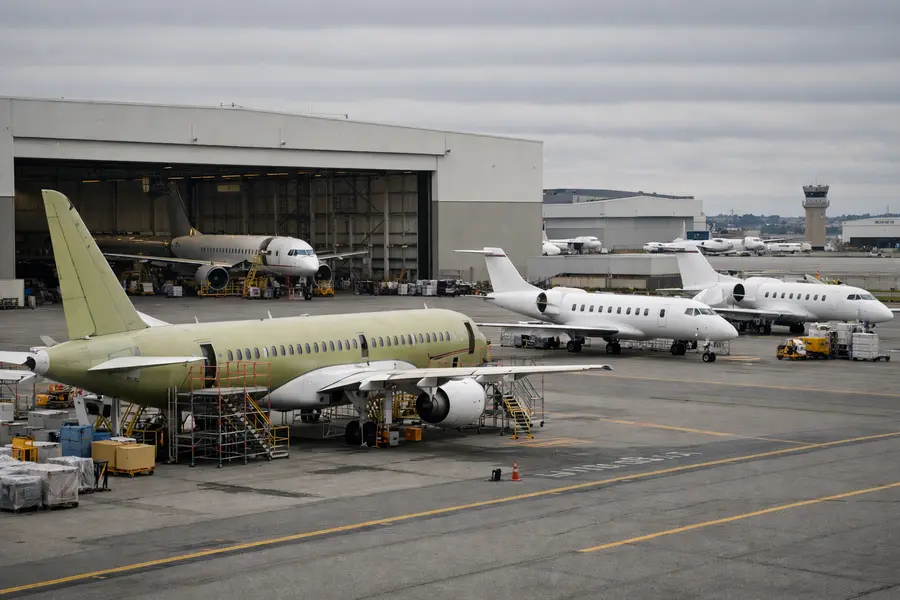
Trump's threat to bar Canada's Bombardier from US aviation markets widens the US-Canada trade confrontation beyond goods tariffs into aircraft certification, drawing rare Republican dissent from Kansas lawmakers protecting more than 1,200 constituent jobs.
- Trump declared Bombardier must manufacture aircraft in the US or lose access to the American market, its largest by revenue.
- Bombardier shares fell as much as 7% on the Toronto Stock Exchange before recovering; the company employs 3,500 Americans, including 1,200-plus in Wichita.
- Kansas Republican senators Roger Marshall and Jerry Moran publicly broke with the White House, with Marshall saying he had already carried the concern into the Oval Office.
Lead
President Donald Trump declared on September 7, 2026, that Bombardier should no longer be permitted to sell aircraft in the United States, demanding the Montreal-based manufacturer shift production to American soil or face a full ban on its business-jet lineup. The proclamation - "NO MORE SELLING BOMBARDIER IN THE UNITED STATES!" - escalated a dispute that has periodically disrupted North American aviation since January 2026, when Trump first threatened to revoke FAA certification for Bombardier's Global Express family and impose a 50% tariff on Canadian aircraft. Bombardier shares shed as much as 7%, falling to C$293.49 on the Toronto Stock Exchange, before clawing back a portion of those losses as investors weighed the legal and political obstacles to enforcement.
What Is the Gulfstream Certification Dispute?
The immediate trigger is a bilateral aviation-certification standoff rooted in Trump's January 2026 charge that Transport Canada was deliberately delaying approval of Gulfstream - owned by General Dynamics (GD) - jets to shield Bombardier from US competition. Trump threatened to decertify Bombardier's Global Express in retaliation and demanded Canada fast-track the Gulfstream G500, G600, G700, and G800. Transport Canada approved the G500 and G600 on February 15 and the G700 and G800 on February 23, formally closing the certification gap. Despite that resolution, Trump re-opened hostilities in September, shifting his stated demand from certification parity to domestic-manufacture requirements - a condition that goes well beyond the original dispute.
Why Can't the FAA Simply Revoke Bombardier's Type Certificate?
The FAA lacks legal authority to withdraw a type certificate for economic or political reasons; revocation requires a documented safety finding and formal rulemaking subject to judicial review. When Trump issued the January decertification order, the agency declined to act, and the threat was never formally implemented. The September escalation is structured differently - framed as a market-access ban rather than an airworthiness revocation - but enforcement would still require the FAA, the Commerce Department, or Congress to act through established legal channels, each of which carries its own procedural and political friction.
Republican Dissent in Kansas
The most consequential political development is the open resistance from within Trump's own party. Sen. Roger Marshall, a Kansas Republican facing re-election, said he would fight to preserve Bombardier's jobs and confirmed he had already raised the matter directly with the president. Sen. Jerry Moran, also a Kansas Republican, reached out to the Trump administration to underscore Bombardier's contributions to the state economy. Bombardier employs more than 1,200 workers at its Wichita, Kansas facilities - which serve as the company's US headquarters and a hub for service and completion work - within a total US workforce of 3,500. The public rebuke is significant: Republican senators openly challenging a Trump trade action are rare, and the pushback reflects how directly the aviation-manufacturing workforce in swing-state industrial districts can complicate White House trade strategy in a midterm election environment.
How Does This Fit the Broader US-Canada Trade War?
The aviation standoff is one front in a broader escalation that has seen Canada introduce counter-tariffs covering $20 billion worth of US goods. The aviation sector is particularly sensitive because Bombardier's Global Express series - including the Global 6500 and Global 7500 - is a dominant product in the ultra-long-range business-jet segment heavily consumed by US corporations and high-net-worth buyers. A blanket sales ban would not merely affect Bombardier; it would constrain US buyers and the American maintenance, repair, and overhaul ecosystem that services those aircraft. The US Army's fleet also includes Bombardier-derived platforms, a detail that adds a defense-industrial dimension to the dispute, with Tech Times reporting the army spy-plane connection on September 8.
Outlook
The September escalation converts what appeared to be a resolved certification dispute into a broader test of whether the administration can impose de-facto industrial policy on a treaty ally without triggering legal challenges or congressional resistance. The FAA's structural inability to revoke type certificates on non-safety grounds, combined with open Republican opposition from Kansas, narrows the practical enforcement pathways available to the White House. Bombardier has countered by publicly touting its US employment footprint, a standard playbook for foreign manufacturers navigating US political pressure. Near-term, the dispute is likely to remain in the declaratory phase unless the administration identifies a regulatory mechanism to convert presidential statements into actionable market-access restrictions - a process that would face both legal and political headwinds.
Mentioned tickers: GD, BBD.B