Pomegra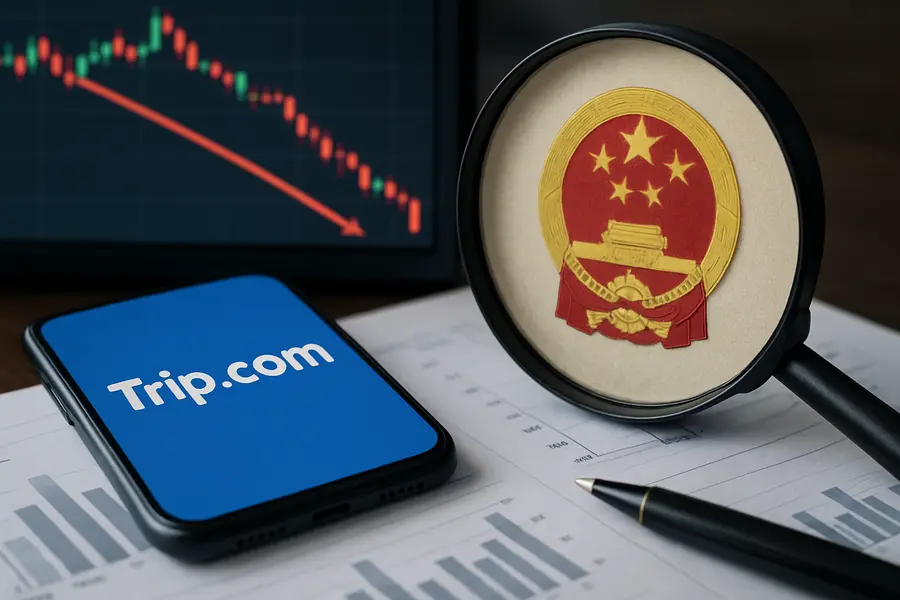
Trip.com slid in Hong Kong after Q1 net income dropped 42% and China's SAMR antitrust probe into alleged monopolistic practices dimmed its Q2 revenue outlook.
- Trip.com (9961.HK) fell approximately 9.6% in Hong Kong on June 25, 2026, after Q1 net income dropped to RMB 2.5B from RMB 4.3B a year earlier.
- China's SAMR opened a formal Anti-Monopoly Law investigation into Trip.com on January 14, 2026, targeting an AI-powered hotel pricing tool.
- At the statutory maximum, fines could reach 10% of annual revenue — approximately US$860 million based on full-year 2025 results.
Lead
Hong Kong, June 25, 2026 — Trip.com Group Limited (Nasdaq: TCOM; HKEX: 9961) fell approximately 9.6% in Hong Kong trading Wednesday, closing at HK$315.00 against a prior close of HK$353.60, as investors absorbed a steep year-on-year profit decline and reduced second-quarter guidance while China's ongoing antitrust investigation cast a lengthening shadow over the company's domestic business. The session made Trip.com among the largest single-stock drags on the Hang Seng Index.What Happened
Trip.com reported Q1 2026 net revenues of RMB 16.2 billion (US$2.4 billion), a 17% increase year-on-year — a continuation of solid top-line growth. However, net income attributable to shareholders fell sharply to RMB 2.5 billion, from RMB 4.3 billion in Q1 2025, a 42% decline that reflected higher compliance costs and structural adjustments to commercial arrangements with hotel partners. For Q2 2026, the company guided net revenue growth of just 3% to 8% year-on-year, a pronounced deceleration from the 16%–21% growth rates recorded across full-year 2025. Trip.com cited macroeconomic headwinds, elevated energy prices, geopolitical volatility, and operational changes to its hotel merchant model as contributing factors.The SAMR Antitrust Investigation
The regulatory backdrop framing both the margin pressure and the subdued guidance is China's State Administration for Market Regulation probe disclosed on January 14, 2026. SAMR opened a formal investigation under the Anti-Monopoly Law, citing suspicion that Trip.com has abused a dominant market position — the most serious category of platform misconduct in Chinese competition law.
The probe centers on an AI-driven automatic price-adjustment tool that hotel partners alleged allowed the platform to lower listed room rates without merchant consent. Hotels that refused to match discounts on rival platforms faced reduced search visibility or potential delisting. The complaints surfaced publicly in late November 2025. In March 2025, three Beijing government agencies jointly summoned 12 online platforms to publicly criticize Trip.com's automatic price-matching mechanism for undermining hotels' independent pricing authority. The company subsequently shut down the AI pricing system.
The initial probe announcement on January 14 sent TCOM's U.S.-listed American depositary shares down 17%, erasing more than US$8 billion in market capitalization in a single session; Hong Kong-listed shares tumbled approximately 19% the following day — the steepest single-day loss since the company's Hong Kong listing in April 2021, on volume that surged to roughly 34 million shares against a daily average near 1.8 million.
Strategic Context
Trip.com and domestic rival Tongcheng Travel together hold more than 70% of China's online travel agency market by booking volume. That combined dominance — built through a decade of consolidation including the 2016 merger of Ctrip.com and Qunar — placed the company firmly within SAMR's enforcement mandate for major digital platforms.The current case is the most significant Anti-Monopoly Law action against a large platform operator since SAMR's 2021 enforcement wave, which produced a RMB 18.2 billion fine against Alibaba and a RMB 3.44 billion fine against Meituan for exclusivity-driven conduct. Under the Anti-Monopoly Law, penalties for proven abuse of dominance range from 1% to 10% of the preceding year's annual revenue. Full-year 2025 net revenues at Trip.com totaled approximately RMB 62.3 billion (US$8.6 billion), placing the theoretical maximum penalty at around RMB 6.2 billion, or roughly US$860 million.