Pomegra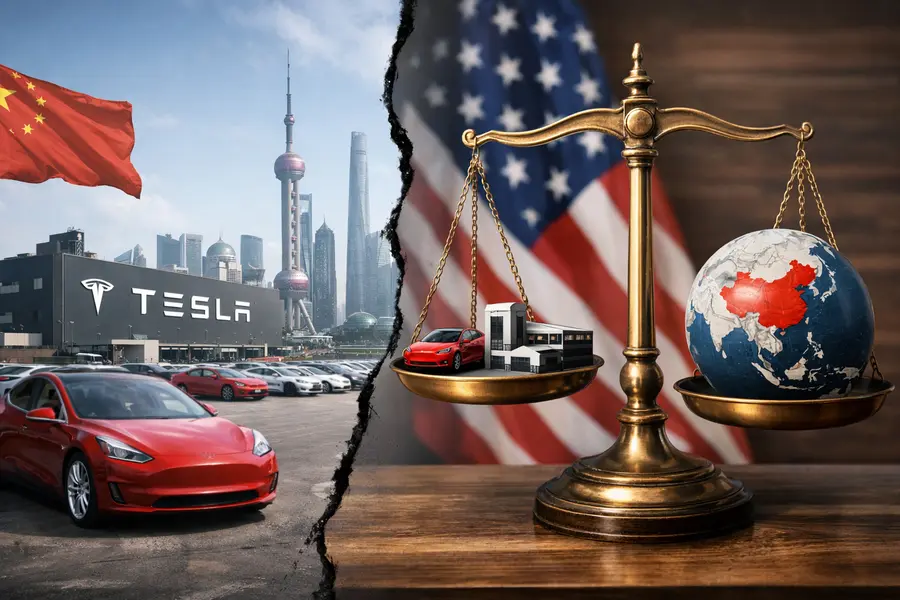
Tesla is exploring a potential sale or spin-off of its Shanghai operations amid intensifying U.S.-China trade tensions and rising domestic competition that have pressured margins and volume in its most important overseas market.
- Tesla is evaluating structural options for its China business, including a full sale or partial spin-off of the tesla shanghai gigafactory unit.
- The Shanghai facility produces roughly half of Tesla's global vehicle output, making any divestiture one of the largest in EV industry history.
- Escalating U.S.-China trade friction and a domestic EV price war have eroded Tesla's market share and profitability in China.
Lead
Tesla (TSLA) is actively reviewing the future ownership structure of its Chinese operations, including the landmark tesla shanghai gigafactory, as executives weigh whether continuing full ownership serves the company's long-term strategic and financial interests. The review, which encompasses both a potential outright sale and a partial spin-off into a separately listed entity, reflects growing pressure from Washington's trade posture — symbolized by the increasingly prominent china flag in U.S.-China policy debates — and from domestic rivals that have undercut Tesla's pricing at nearly every vehicle tier.What Happened
Discussions about restructuring Tesla's China footprint have reached senior executive levels, with the company engaging advisers to model scenarios ranging from a minority stake sale to a full separation. The tesla shanghai gigafactory, which opened in late 2019, now produces approximately 950,000 vehicles annually, accounting for nearly half of Tesla's total global deliveries. A divestiture at fair market valuation would imply a transaction of significant scale given the facility's installed capacity and land-use agreements with the Shanghai municipal government.
The review was prompted by a confluence of factors: tariff escalation between Washington and Beijing, which has complicated parts sourcing and raised the geopolitical risk premium associated with China-manufactured goods entering third-country markets; a sustained domestic price war led by BYD and a cohort of state-backed EV startups; and growing shareholder scrutiny over the company's concentration risk in a single jurisdiction that now accounts for a disproportionate share of global production.
Strategic Context
Tesla's Shanghai facility was constructed under unusually favorable terms — a wholly foreign-owned structure that required no local joint-venture partner, a condition Beijing granted selectively. At the time, the arrangement represented a milestone in China's opening of its automotive sector. Today, that same independence creates complications: fully foreign-owned assets are more exposed to bilateral policy shifts, export licensing restrictions, and potential regulatory retaliation than joint ventures, which carry embedded local-partner protection.
A spin-off would address several concerns simultaneously. Listing a China-focused Tesla entity on the Hong Kong or Shanghai stock exchange would create a locally capitalized structure less vulnerable to U.S. export-control scrutiny, unlock access to Chinese institutional capital, and preserve Tesla's technological and branding influence through a retained minority stake and licensing arrangement. A full sale would generate substantial near-term capital but would sever the company from one of the world's largest and fastest-growing EV markets.
Geopolitical Dimension
The strategic review is inseparable from the deteriorating trade environment. Washington has steadily broadened export controls on advanced semiconductor technology, battery intellectual property, and automotive software systems with links to Chinese supply chains. Beijing, in turn, has signaled readiness to deploy its own toolkit — including restrictions on critical mineral exports and enhanced scrutiny of foreign firms' data-handling practices — in response to further U.S. escalation.
For Tesla, the china flag represents both commercial opportunity and systemic risk. The company sells roughly 600,000 vehicles annually in China, a market it cannot easily replicate elsewhere at equivalent margin. Yet operating a flagship gigafactory inside China increasingly requires threading a needle between Washington's tightening national-security posture and Beijing's industrial policy, which openly favors domestic automakers through subsidies, preferential procurement, and infrastructure investment. Any structural separation would require approval from Chinese regulators, whose consent cannot be assumed given the symbolic importance of the tesla shanghai gigafactory to China's EV export narrative.
Market Reaction
Tesla shares responded with elevated volatility on the initial reports, reflecting the dual-edged nature of the news. Bulls view a spin-off as value-unlocking — separating a capital-intensive, geopolitically encumbered asset from Tesla's core technology and energy business. Bears argue that ceding operational control of Shanghai would structurally reduce Tesla's volume base and negotiating leverage with global suppliers who price contracts against total throughput.
China-focused EV names and Hong Kong-listed domestic automakers saw modest gains on speculation that a Tesla China divestiture could shift market share toward local players and reduce competitive intensity at the premium end of the market.
What Comes Next
Any formal transaction would require Chinese government approval, a process that could extend twelve to eighteen months given the strategic sensitivity of the asset. Regulatory filings in the U.S. would also be required if a spin-off involves distribution of shares to existing Tesla stockholders. The company has not made a public announcement, and the scope of any deal remains subject to change based on macroeconomic conditions and the trajectory of U.S.-China negotiations.
Analysts expect Tesla's next earnings call to draw pointed questions about the China review, capital allocation priorities, and the company's posture toward its largest single manufacturing asset.
Outlook
Tesla's examination of its China unit marks a potential inflection point for the global EV industry and for U.S.-China commercial relations in the technology sector. Whether the outcome is a spin-off, a partial sale, or a decision to retain full ownership, the review underscores how profoundly the geopolitical environment has shifted since the tesla shanghai gigafactory was celebrated as a symbol of globalization's promise. The resolution will set a precedent for how other multinational manufacturers manage dual-jurisdiction exposure in an era of strategic decoupling.
Mentioned tickers: TSLA, BYD