Pomegra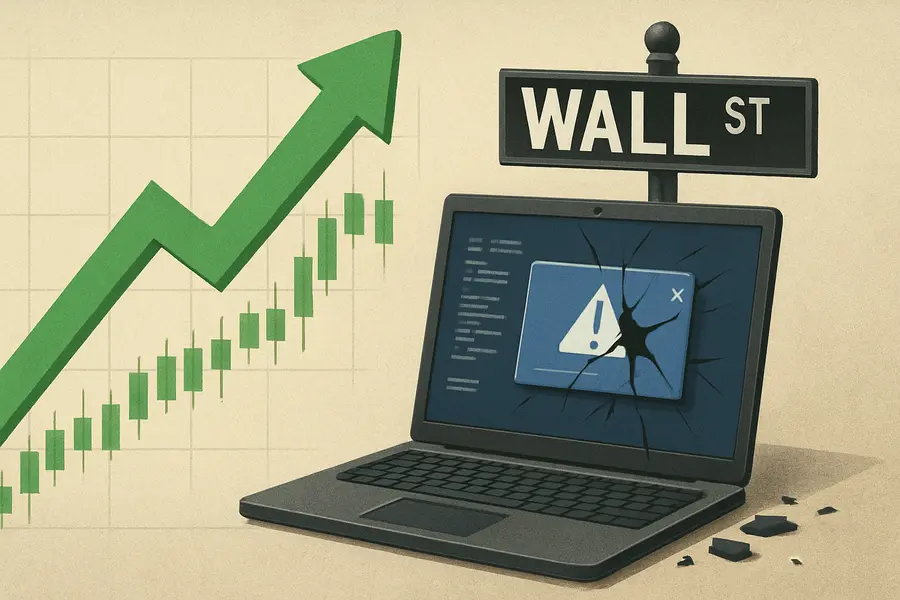
Wall Street split on July 2 as tech weakness dragged the Nasdaq-100 down 1.61% while financial sector gains lifted the Dow Jones to a record close of 52,900.
- The Nasdaq-100 fell 1.61% while the Dow Jones set a record at 52,900.07, reflecting divergence across market sectors as investors rotated.
- XLF gained 2.18% as JPMorgan unveiled a $50B buyback and Goldman Sachs raised its dividend 11% after all 32 major banks cleared the Fed's annual stress tests.
- June nonfarm payrolls rose just 57,000 — well below the 115,000 consensus — adding pressure to growth stocks while reinforcing bank net-interest-margin tailwinds.
Lead
Wall Street closed sharply divided on Wednesday, July 2, 2026, as tech weakness pulled the Nasdaq-100 down 1.61% and financial sector gains drove the Dow Jones Industrial Average to a record close of 52,900.07, a rise of 1.14% on the session. The S&P 500 finished nearly flat, a surface calm that masked deep rotation beneath the headline number as investors shed expensive semiconductor and AI-infrastructure positions and moved into capital-returning bank stocks. The catalyst was a weaker-than-expected June employment report that recalibrated expectations across every major asset class ahead of the July 4 holiday weekend.
What Happened
The Technology Select Sector SPDR Fund (XLK) declined 2.57%, paced by a rout in chipmakers. Micron Technology tumbled 13%, Qualcomm fell 8%, and Marvell Technology dropped 9.4%. Applied Materials lost 7.4% and SanDisk declined 14%. The Philadelphia Semiconductor Index shed more than 7% — its steepest single-session drop in weeks. Meta Platforms and Netflix bucked the trend, registering gains on the strength of new AI monetization and advertising-technology initiatives, but they were insufficient to contain the sector-wide damage.
The sell-off reflects compounding concerns. Questions have mounted over whether large cloud providers can continue their pace of AI infrastructure spending without demonstrable returns for investors. A separate report that Meta has begun offering excess compute capacity for commercial use sparked fears of capital-spending overcapacity, a signal the market interpreted as a leading indicator of demand softening at the infrastructure level. Valuation pressure compounds the risk: chipmakers and AI-adjacent hardware names absorbed multiple expansion throughout 2024 and 2025, leaving them with little margin for disappointment.
Financial Sector Gains
The Financial Select Sector SPDR ETF (XLF) advanced 2.18%, its strongest single-session gain in more than a month. The driver was the Federal Reserve's annual bank stress test results, released in late June, which showed all 32 of the nation's largest financial institutions absorbing more than $708 billion in hypothetical losses — including steep declines in commercial real estate values, sharply lower home prices, and a modeled unemployment spike to 10% — while maintaining minimum capital requirements.
JPMorgan Chase moved swiftly on the results, authorizing a $50 billion stock repurchase program effective July 1 and lifting its quarterly dividend 10% to $1.65 per share beginning in the third quarter. Goldman Sachs raised its quarterly payout 11% to $5.00 per share, a 25% increase year-on-year. Morgan Stanley announced complementary capital-return enhancements.For the financial sector, a prolonged period of elevated interest rates — long cast as an economic headwind — has become a structural earnings tailwind. Banks with large loan books and deposit franchises continue to benefit from wider net interest margins, and with credit quality holding at historically resilient levels, the combination of yield income and capital discipline is drawing investors who have grown wary of multiple-expansion-dependent technology names.
Consumer Stocks Mixed on Confidence and Labor Data
Consumer stocks delivered a differentiated picture. Consumer discretionary names underperformed broadly, weighed by softer revenue and free-cash-flow trends that have emerged in recent weeks. The June payroll data amplified those concerns: nonfarm employment rose by just 57,000 for the month, below the downwardly revised 129,000 added in May and well short of the 115,000 consensus forecast. The unemployment rate dipped to 4.2%, but the decline reflected a falling labor force participation rate — which dropped 0.3 percentage points to 61.5%, its lowest level since March 2021 — rather than genuine tightening. Prior-month revisions subtracted a combined 74,000 from April and May figures.Leisure and hospitality employment fell 61,000 in June, one of the sharper single-month contractions in the sector and a direct drag on consumer-facing businesses. Average hourly earnings rose 0.3% month-on-month to $37.64, providing some offset but insufficient to reignite confidence in discretionary spending at the lower end of the income distribution.
Consumer staples held up better. Agricultural processing and food-commodity names outperformed as pricing power and stable demand offset macro headwinds.
Market Sectors: Broadening Rotation
The session consolidates a rotation story that has been reshaping market sectors since early 2026. Energy stocks are up 21.5% year-to-date, materials have gained 17.6%, and industrials have advanced 12.3% — each outpacing the Nasdaq Composite. Financials are now tracking alongside those leaders.
The S&P 500's flat close while the Nasdaq fell more than 1.6% is itself a signal. When the index can absorb heavy losses in its largest-weighted sector without breaking down, it reflects genuine breadth — participation from areas of the market that were largely bystanders during the 2024–2025 AI rally.
Outlook
Tech weakness today appears structural rather than transient for the most interest-rate-sensitive, valuation-stretched chipmakers. Financial sector gains carry near-term momentum as long as credit conditions remain stable and the Fed holds its current posture. Consumer stocks remain contested ground until either labor market readings stabilize or consumer confidence recovers from historically low levels.With markets closed Thursday for Independence Day, the next significant data point is June's consumer price index release. A firmer inflation print would extend the rotation into financials and value; a cooler reading would reopen debate about the pace of Fed easing and potentially offer relief to growth-oriented technology names.
Mentioned tickers: XLF, XLK, SPY, JPM, GS, MS, MU, AMAT, MRVL, QCOM, SNDK, META, NFLX, AMD, INTC