Pomegra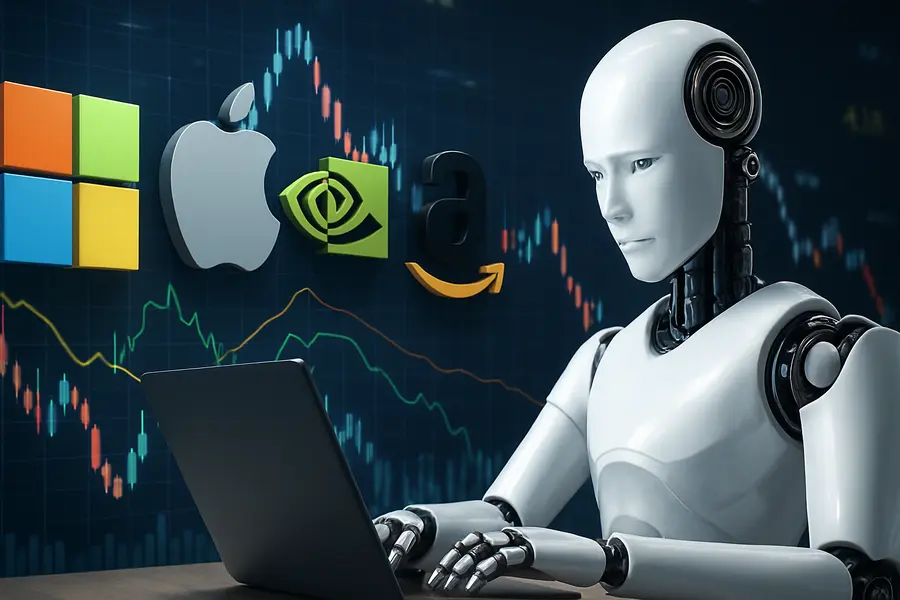
Strategists are pushing clients to rotate out of mega-cap tech into financials, industrials, and small caps as an AI-driven Nasdaq selloff exposes deep valuation risk across the sector.
- Nasdaq dropped 4.18% on June 5 — its worst single session since April 2025 — as AI infrastructure costs rattled mega-cap tech earnings.
- Alphabet Q1 2026 free cash flow collapsed 47% year-on-year; Amazon's trailing FCF is down 95%, strengthening the rotation thesis.
- Financials, industrials, and small-cap names are absorbing institutional flows as the earnings gap between the Magnificent Seven and the broader S&P 500 narrows.
Lead
The tech rotation that strategists had been forecasting for months arrived with force in June 2026. The Nasdaq Composite fell 4.18% on June 5 — its worst day in more than a year — and shed a further 2.21% on June 24, closing at 25,587 as a two-session losing streak underscored widening cracks in the AI-driven bull market. Wall Street's most influential allocators are now steering institutional capital away from the Magnificent Seven and into cyclicals, value names, and small caps that were largely left behind during the AI-era run-up.
What Happened
The immediate catalyst was a series of crushing free-cash-flow disclosures from the largest tech spenders. Alphabet's (GOOGL) Q1 2026 free cash flow dropped 47% year-on-year to $10.12 billion as data-center buildout consumed capital at a pace that alarmed even bullish investors. Amazon (AMZN) reported an even starker figure: trailing twelve-month free cash flow had fallen 95% to $1.2 billion, a near-complete erosion of a metric long treated as the bedrock of its valuation.
The figures crystallized a concern that had circulated among institutional investors since late 2025 — that the tech sector's unprecedented AI capital expenditure cycle was eroding the earnings quality that had justified premium multiples. With roughly 95% of businesses that invested in AI still failing to generate measurable profit from the technology, the patience trade that sustained mega-cap prices through two years of capex expansion showed clear signs of exhaustion.
Market Rotation in Motion
The shift out of concentrated tech positions and into broader market names gathered momentum well before the June selloff. Research from Yardeni Research described a migration from the Magnificent Seven — Apple (AAPL), Microsoft (MSFT), Nvidia (NVDA), Meta (META), Alphabet (GOOGL), Amazon (AMZN), and Tesla (TSLA) — toward what strategists have labeled the "Impressive 493," the remaining S&P 500 members that spent two years trading in the shadow of AI-era leadership.
The earnings gap underpinning that rotation is narrowing. The Magnificent Seven's collective earnings growth premium over the broader index has compressed materially from its 2024 peak, removing the fundamental justification for holding seven stocks that collectively represented more than 30% of S&P 500 market capitalization. As that premium contracts, the rotation math favors rebalancing.
Institutional fund managers surveyed in mid-2025 — when the trend was still early — had already flagged tech as the most crowded trade globally. Twelve months on, that crowding is unwinding in real-time. The tech sector's average weight of 61% in the Nasdaq-100, which drove 88% of the index's 2025 total return, is now the source of its vulnerability.
The AI Capex Overhang
The structural issue is straightforward: the five largest U.S. tech companies have committed a combined $300 billion or more in AI infrastructure spending for 2026, a figure that would have seemed implausible three years ago. The return on that capital remains largely invisible to outside investors, and the timelines for monetization keep extending.
Free cash flow — the cleanest measure of a company's ability to fund dividends, buybacks, and organic growth — is the first casualty. When Alphabet and Amazon report numbers that look more like pre-profitability growth companies than the cash machines they became through the 2010s, the repricing dynamic is immediate. Equity risk premiums for the tech sector adjust upward; the rotation into assets with near-term visible cash flows accelerates.
Geopolitical headwinds compound the pressure. Elevated energy costs tied to Middle East tensions are feeding into data-center operating expenses, squeezing margins on the infrastructure side even as revenue from AI services remains uncertain.
Sectors in Focus
The beneficiaries of the rotation are concentrated in economically sensitive segments of the market that offer valuation support and, in several cases, direct leverage to the same AI buildout driving tech's pain. Financials are absorbing significant inflows: rising rates benefit net interest margins, and the sector trades at a fraction of tech multiples. Industrials — particularly those supplying electrical infrastructure, cooling systems, and power generation equipment for data centers — represent a second-order AI play without the software-valuation risk.
Healthcare and energy are also attracting capital, with healthcare offering defensive earnings and energy benefiting from the grid-demand surge that AI compute clusters are creating. Small-cap indices, long laggard relative to mega-cap tech, are seeing renewed institutional interest as investors seek names with lower valuations and greater sensitivity to a domestic economic cycle that remains broadly positive.The S&P 500 equal-weight index has outperformed its cap-weighted counterpart in the weeks since the June 5 selloff, a market-structure signal that broad-based participation is replacing narrow leadership.
Outlook
The rotation out of mega-cap tech into broader market names reflects a fundamental reassessment of AI's near-term earnings impact rather than a wholesale rejection of the technology's long-run potential. As free cash flow at the largest tech companies deteriorates under AI infrastructure costs, capital is migrating toward financials, industrials, and small caps where valuations are lower and earnings visibility is higher. The durability of the rotation hinges on whether AI monetization timelines accelerate or continue to slip — and on whether the macroeconomic backdrop remains supportive enough to sustain cyclical earnings in the sectors absorbing the inflows. Near-term, the bias is toward broader market participation at the expense of concentrated tech exposure.
Mentioned tickers: GOOGL, AAPL, MSFT, NVDA, META, AMZN, TSLA, QQQ, SPY