Pomegra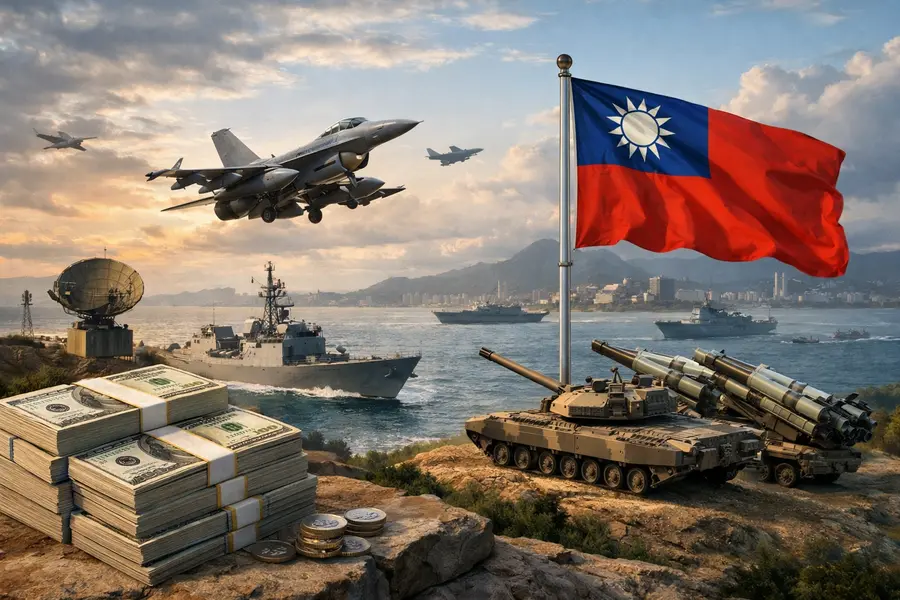
Taiwan's new Littoral Combat Command and $40 billion defense package signal a decisive strategic shift as China rehearses blockades and presses toward its 2027 military readiness target.
- Taiwan commissioned a new Littoral Combat Command on July 1 to unify coastal missile, radar, and unmanned surface vessel defenses under a single chain of command.
- Taiwan's supplementary defense budget, passed in May 2026, lifts military outlays to 3.32% of GDP — crossing the 3% threshold for the first time since 2009.
- Land-based anti-ship missile stocks are set to exceed 1,400 units, the world's densest coastal deployment, combining indigenous Hsiung Feng missiles with U.S.-supplied Harpoon systems.
Lead
Taiwan launched its new Littoral Combat Command (LCC) on July 1, 2026, establishing a unified coastal defense structure that integrates land-based anti-ship missiles, mobile and fixed radar networks, and a newly formed unmanned surface vessel unit. The activation comes as Taipei advances a sweeping eight-year defense modernization program worth $40 billion — and as Beijing rehearses maritime blockade scenarios at a pace and scale analysts describe as unprecedented.
What Happened
The LCC, commanded by Vice Admiral Chien Shih-yuan — promoted personally by President Lai Ching-te on June 24 — consolidates all of Taiwan's coastal maritime defenses, including those protecting its outlying islands, into a single operational command. The unit will integrate domestically produced and American missile systems alongside a new unmanned surface vessel squadron, with operational responsibility extending 24 nautical miles from Taiwan's shoreline.
The command's formation reflects a broader structural shift in Taiwan military doctrine toward layered area-denial: creating overlapping kill zones that would complicate any amphibious assault or maritime quarantine attempt by the People's Liberation Army (PLA).
Six days earlier, on June 25, Taiwan's National Security Council, Ministry of National Defense, Coast Guard Authority, and other agencies conducted a joint tabletop exercise simulating a PRC maritime quarantine. The drill modeled scenarios in which Chinese Coast Guard vessels board, inspect, and detain commercial shipping bound to or from Taiwanese ports — and practiced coordinated civil, military, and diplomatic responses.
The Defense Budget
The financial architecture undergirding Taiwan's Taiwan defense preparations comes from a special supplementary budget approved by the legislature in May 2026 — a pared-back version of the $40 billion package President Lai Ching-te first proposed in November 2025. Spread across 2026 to 2033, the program funds three flagship capabilities.
First, the T-Dome system: a multi-layered island-wide air and missile defense shield modeled on Israel's Iron Dome, designed to intercept ballistic missiles, cruise missiles, drones, and aircraft simultaneously. Second, a massive expansion of coastal area-denial, including 208,200 attack drones of four types and 1,320 suicide drone boats with a 40-kilometer engagement range. Third, accelerated indigenous production of Hsiung Feng anti-ship missiles alongside continued receipt of U.S.-supplied Harpoon Coastal Defense System batteries, bringing Taiwan's projected land-based anti-ship missile inventory above 1,400 rounds — the densest such deployment anywhere in the world.
Total military outlays for fiscal 2026 stand at TWD 949.5 billion, equivalent to approximately 3.32% of GDP.
China-Taiwan Tensions: The Threat Driving the Response
China Taiwan tensions have escalated sharply over the past eight months. In late December 2025, the PLA conducted Justice Mission 2025 drills, the most expansive Taiwan strait exercises on record: PLA Navy, Air Force, Rocket Force, and Coast Guard vessels jointly simulated a full maritime blockade, establishing air and sea control rings, targeting key port infrastructure, and rehearsing deterrence of external naval forces. Eleven PLA Navy vessels and eight China Coast Guard ships entered Taiwan's contiguous zone — a first.In January 2026, a Chinese surveillance drone penetrated the airspace of Pratas Island, a Taiwan-controlled outpost in the South China Sea, marking what defense analysts describe as the first confirmed Chinese aircraft intrusion into Taiwanese-administered airspace in many years.
The PLA's stated planning horizon is 2027 — the year Chinese Communist Party leadership directed the military to achieve the capability to seize Taiwan by force if ordered. Western defense establishments treat that date as an operational benchmark, not a trigger.
Indo-Pacific Security: The Regional Frame
Indo-Pacific security dynamics are shifting in parallel. The United States Air Force is deploying 36 Boeing F-15EX Eagle II fighter jets to Kadena Air Base in Japan, strengthening the forward posture of the alliance architecture underpinning Taiwan's deterrence. Washington has also designated Taiwan arms deliveries as a top priority: the U.S. Defense Security Cooperation Agency director issued a directive placing Taiwan above other buyers, and the first of 66 Lockheed Martin F-16V Block 70 jets — an $8 billion contract — is expected to arrive in Taiwan as early as September 2026.Outlook
Taiwan's defense posture is undergoing the most substantial structural transformation in decades. The Littoral Combat Command fuses capabilities that were previously distributed across separate service branches, improving response speed and command coherence in contested maritime scenarios. The combination of record spending at 3.32% of GDP, a proliferating drone and missile arsenal, an air defense shield modeled on proven Israeli architecture, and tightening U.S. operational support in the wider Indo-Pacific is designed to raise the cost of any PLA military action well above what Chinese planners can confidently absorb. Whether that calculus holds through 2027 and beyond will define the security landscape of the western Pacific.
Mentioned tickers: LMT, BA