Pomegra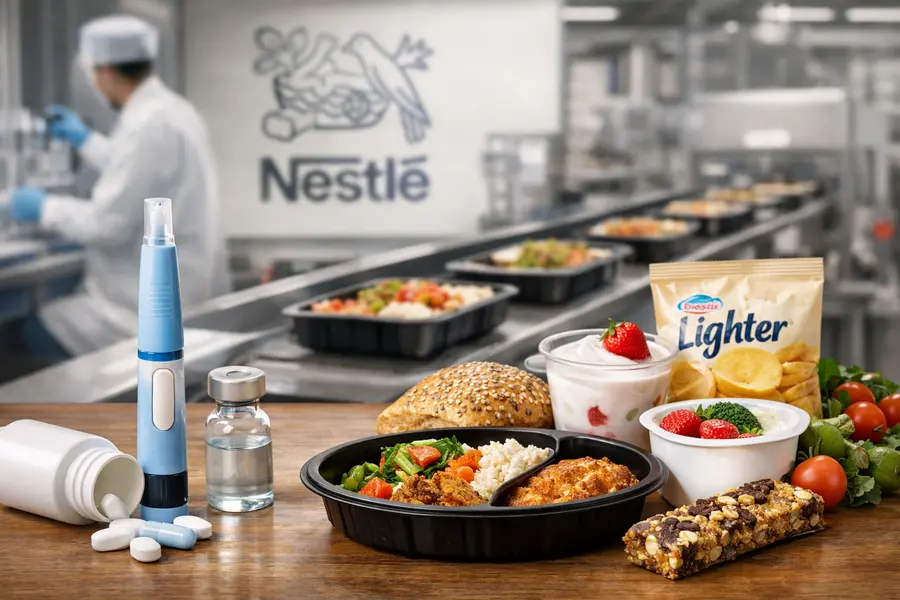
Lead
Nestlé (NESN; NSRGY) is reformulating key food products to serve consumers on GLP-1 weight-loss drugs, adjusting flavour profiles, macronutrient ratios, and portion sizes to address the physiological changes these medications produce. The move, accelerating in mid-2026, spans its frozen meal, beverages, and snack categories — and marks one of the most significant product-strategy realignments at the Swiss food giant in a generation.What Happened
Nestlé is running structured consumer trials to measure how GLP-1 weight loss drug use alters flavour perception. A study published in Physiology & Behavior confirmed that GLP-1 receptor agonists depress perception across all five basic taste qualities, compelling the company to rethink product formulations built around previous consumer palates.In response, Nestlé is bringing GLP-1 food product users directly into recipe development as co-creators — an approach that breaks from standard R&D practice. Planned adjustments include increased use of pepper and expanded spice profiles to compensate for blunted taste sensitivity. Protein and fibre content are being elevated across multiple mainstream product lines, with the high-protein variant of Milo chocolate malt drink cited as an early example.
- Nestlé GLP-1 food products now span frozen meals, protein drinks, and reformulated mainstream lines targeting users of drugs like Ozempic and Wegovy.
- The number of packaged-food SKUs carrying "GLP-1 Friendly" labels rose approximately 37% from 2024 as the food industry races to capture a companion-nutrition market valued at $3.88 billion in 2026.
- Nestlé business strategy centers on flavour recalibration, higher protein density, and consumer co-development with GLP-1 users — a structural pivot away from legacy mass-market formulations.
The company has also launched a proprietary line of protein-based drinks built on whey protein microgel technology, engineered to regulate appetite, stabilise blood sugar, and preserve muscle mass — a clinical priority for GLP-1 users, who face accelerated muscle loss alongside fat reduction.
Vital Pursuit and New Brand Architecture
The flagship vehicle for Nestlé's GLP-1 food products is Vital Pursuit, a U.S. frozen-food brand unveiled in 2024 and now expanding to 12 stock-keeping units. The line includes protein pasta bowls, sandwich melts, and cauliflower-crust pizzas engineered at portion sizes aligned with the reduced appetite typical of GLP-1 drug users. The brand marks Nestlé's first major U.S. consumer launch in nearly three decades, signalling the company's confidence in the market's durability.
Food Industry Context
Nestlé is not acting alone. Across the food industry, companies are explicitly labelling products as "GLP-1 Friendly," with that category growing 37% year-on-year. The global GLP-1 companion-nutrition market is expanding at a 12.35% compound annual rate and is projected to reach $6.94 billion by 2031. A parallel GLP-1 meal-replacement segment, valued at $2.4 billion in 2026, is forecast to hit $10.9 billion by 2036.The weight loss drug impact on food consumption volumes presents a countervailing pressure. GLP-1 users eat measurably less, and industry forecasters have warned that aggregate caloric volume declines could weigh on traditional packaged-food revenues for years. Nestlé, with trailing twelve-month revenue of $113.53 billion and a market capitalisation of $268 billion, faces the dual imperative of protecting legacy volumes while positioning in higher-margin functional categories.
Strategic Context
Nestlé's business strategy in response to GLP-1 weight loss drug adoption rests on three pillars: flavour recalibration for changed sensory profiles, nutrient densification to address muscle-preservation needs, and explicit brand positioning around GLP-1 compatibility. The company is also investing in start-up partnerships to accelerate GLP-1 innovation beyond what its internal R&D pipeline can deliver, signalling that organic development alone is insufficient to match the pace of the market.The approach reflects a broader repositioning of Nestlé Health Science as a strategic growth vehicle, moving the unit closer to the intersection of clinical nutrition and consumer food — a space previously served primarily by pharmaceutical and medical-nutrition companies.