Pomegra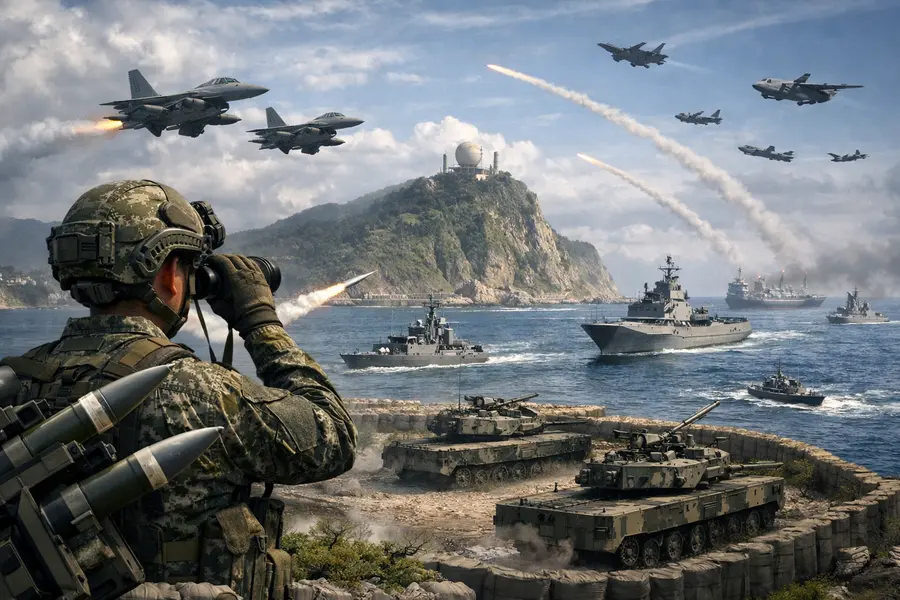
Taiwan has approved a landmark NT$780 billion arms budget and deployed first-of-kind suicide drones as Beijing's military incursions hit record frequency, reshaping Indo-Pacific security calculations.
- Taiwan's legislature passed a NT$780 billion ($26B USD) special defense budget in May 2026, running through 2033.
- PLA incursions into Taiwan's air defense identification zone now average over 300 per month, doubling prior rates.
- The U.S. allocated $2 billion in direct Taiwan security assistance in fiscal year 2026, bypassing standard arms-sale procedures.
Lead
Taipei — Taiwan has approved a historic eight-year special defense budget of NT$780 billion ($26 billion) and deployed domestically produced suicide drones for the first time, as the island accelerates Taiwan defense preparations against a backdrop of intensifying China Taiwan tensions and near-daily incursions by the People's Liberation Army. The legislative vote in May 2026, passed 59-0, marked one of the most consequential defense authorizations in Taiwan's modern history, even as opposition parties trimmed the original NT$1.25 trillion proposal put forward by President Lai Ching-te's administration.What Happened
Taiwan's legislature, controlled by the opposition Kuomintang and Taiwan People's Party, passed the pared-back supplementary budget in late May with 48 lawmakers from Lai's Democratic Progressive Party abstaining in protest over cuts to domestic defense programs. Despite the political friction, the approved package still authorizes NT$300 billion for two U.S. arms packages already cleared by Washington and NT$480 billion for a future procurement tranche yet to be formally announced.
Separately, the Taiwan military conducted its first live deployment of domestically produced loitering munitions — suicide drones modeled on U.S. Switchblade-class systems — during naval repulsion drills on January 29. The exercise simulated a Chinese amphibious assault and marked a visible shift toward asymmetric capabilities designed to complicate any cross-strait invasion scenario.
On June 25, President Lai's administration convened tabletop exercises simulating Beijing's imposition of a maritime quarantine — a scenario in which China would compel foreign and domestic vessels to declare customs through Chinese authorities, effectively strangling Taiwan's seaborne trade without firing a shot. All three major political parties participated, presenting a rare display of bipartisan consensus on the island's vulnerability.
China's Escalating Military Posture
The urgency behind Taiwan's defense moves is rooted in a sustained escalation by the PLA. Since President Lai assumed office in May 2024, average monthly incursions into Taiwan's air defense identification zone have exceeded 300, more than double the rate of the prior two years. China Taiwan tensions reached a new threshold in late December 2025, when PLA forces fired 27 rockets during large-scale exercises — named Justice Mission 2025 — with 10 landing within Taiwan's 24-nautical-mile contiguous zone, the closest live-fire incident on record.
Beyond aircraft, China has normalized carrier strike group transits through the Taiwan Strait and expanded China Coast Guard operations, with one CCG vessel reportedly entering Taiwan's contiguous zone during the 2025 Strait Thunder exercise. Surveillance balloon incursions into Taiwan's ADIZ were also recorded on multiple dates across December 2025. The PLA's 71st Group Army — the largest ground formation in the Eastern Theater Command and the unit most likely to lead any invasion ground effort — is being outfitted with advanced anti-armor protection systems on main battle tanks.
U.S. Support and Indo-Pacific Security Architecture
Washington has responded with direct financial and institutional backing. In fiscal year 2026, the U.S. allocated $2 billion for Taiwan — $1 billion through the expanded Taiwan Security Cooperation Initiative and $1 billion to replenish American military stocks — bypassing the slower Foreign Military Sales process to accelerate delivery. A bipartisan congressional bill introduced in April 2026 proposed joint U.S.-Taiwan Coast Guard patrols to protect undersea internet cables, a critical vulnerability that Beijing has shown interest in exploiting.
Indo-Pacific security spending dynamics have shifted sharply. Regional defense budgets rose a collective 8.1 percent, while Washington committed to a $1.5 trillion defense spending envelope. Taiwan itself has raised its defense budget to 3.3 percent of GDP — a 17-year high — with an official target of 5 percent by 2030. A $14 billion U.S. arms package for Taiwan, approved by Congress, remains under review following a pause ordered by the Trump administration.Strategic Context
Taiwan's accelerated Taiwan defense preparations reflect a broader doctrinal evolution: moving away from platform-heavy, symmetric force structures toward layered denial capabilities — drones, coastal missiles, undersea infrastructure protection, and civilian resilience. The tabletop quarantine exercises signal that Taipei is war-gaming not just an outright invasion but the more immediately plausible scenario of economic strangulation without direct military engagement.
The political challenge remains acute. Taiwan's opposition-controlled legislature trimmed the special budget significantly, cutting funding for the domestically developed Chiang Kung anti-ballistic missile — the planned centerpiece of Taiwan's new T-Dome air defense architecture — exposing a tension between U.S. arms procurement and building indigenous industrial capacity.
For the Indo-Pacific security architecture more broadly, Taiwan's defense trajectory is becoming a bellwether. Regional allies, defense contractors, and logistics networks are recalibrating around a potential strait crisis with a compressed timeline that intelligence and military communities now place between 2027 and 2030.
Outlook
Taiwan has signaled it will push to restore full funding for the T-Dome program and the Chiang Kung missile in future budget cycles. The Lai administration is also expected to deepen civil-military integration, including civilian logistics reserves and emergency port protocols, following the June quarantine simulations. How quickly Washington resolves the status of the paused $14 billion arms package will be a key variable determining whether Taiwan's Taiwan military modernization stays on schedule heading into 2027 — a date that defense planners on both sides of the Pacific are treating as a planning threshold.
Mentioned tickers: LMT, RTX, NOC, GD, BA