Pomegra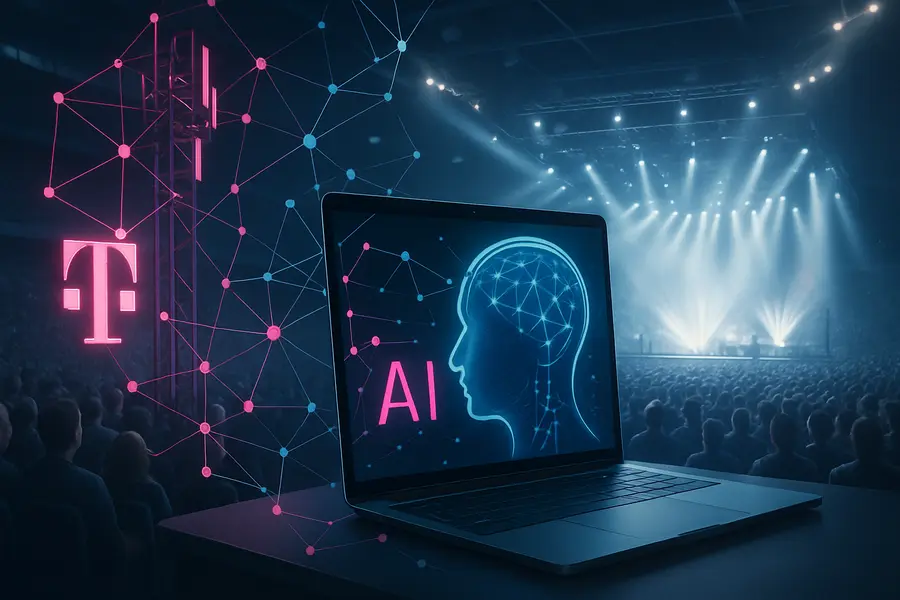
T-Mobile debuts Dynamic CX, an AI tool that pre-positions and adapts network capacity in real time at high-density live events, launching ahead of the 2026 FIFA World Cup across 11 U.S. cities.
- Dynamic CX layers AI atop T-Mobile's Self-Organizing Network to pre-position bandwidth and reallocate it in near real time as crowds shift during events.
- Opensignal recorded T-Mobile earning 19 outright wins and 19 joint wins across 11 U.S. World Cup host cities from February through May 2026.
- The platform serves messaging, video streaming, and rideshare apps at stadiums, fan zones, airports, and transit hubs throughout the summer season.
Lead
T-Mobile US (NASDAQ: TMUS) unveiled Dynamic CX on June 3, 2026—an AI-powered network optimization capability that automatically prepares and adapts the carrier's infrastructure in near real time during large-scale live events. The launch arrives as the United States hosts the 2026 FIFA World Cup across 11 markets this summer, representing the most concentrated multi-city connectivity test the company has faced in a single season, with tens of millions of visitors expected over several weeks.What Dynamic CX Does
Dynamic CX builds on T-Mobile's existing Self-Organizing Network (SON) technology, which has long handled routine performance tuning. The new platform adds a predictive intelligence layer: the system analyzes publicly available event information, venue schedules, and online activity to anticipate where crowds will form and when. That forecast allows the network to pre-position resources before stadiums open their gates.
Once an event begins, the system shifts from prediction to continuous adaptation. As attendees flow through venues, fan zones, and transit corridors, AI-driven automation reallocates bandwidth in near real time—prioritizing video uploads, live streaming, messaging, and rideshare requests without requiring manual intervention from network engineers.
The operational difference from conventional capacity planning is material. Traditional approaches pre-provision based on historical averages and fixed schedules. Dynamic CX reacts to actual crowd behavior as it emerges, reducing the lag between demand and network response from minutes to seconds.
World Cup Deployment
The 2026 FIFA World Cup spans host cities including Atlanta, Boston, Dallas, Houston, Kansas City, Los Angeles, Miami, the New York/New Jersey region, Philadelphia, the San Francisco Bay Area, and Seattle—11 markets, each with distinct stadium footprints, transit systems, and fan zone configurations.
T-Mobile's network teams have expanded capacity and operational support across all 11 locations, covering stadiums, airports, and public transit hubs. Operational planning also incorporates seasonal risk factors: hurricane preparedness in coastal markets, wildfire contingencies for western cities, and extreme heat protocols across Sun Belt venues.
An independent analysis by Opensignal, covering February through May 2026, found T-Mobile leading across key mobile experience metrics in those host cities—recording 19 outright wins and 19 joint wins across all 11 markets. That dataset serves as a pre-tournament benchmark against which Dynamic CX performance will be tested during peak event weeks.
Strategic and Competitive Dimension
High-density event connectivity has historically been a reputational liability for carriers. Overloaded cells, failed video uploads, and dropped calls tend to happen at precisely the moments of highest public visibility—championship weekends, concert nights, large travel surges. A system that demonstrably reduces those failures at a global tournament carries significant brand value that extends well beyond the event itself.
Dynamic CX also fits within T-Mobile's stated roadmap toward AI-native 5G Advanced and 6G network architectures. Outlined at Mobile World Congress 2026, that strategy calls for software-defined, self-managing networks capable of adapting to demand without human-in-the-loop intervention. Dynamic CX is a production deployment of that concept, not a pilot.
The company is also among the first U.S. carriers to implement NVIDIA's AI-RAN infrastructure, working with Nokia's anyRAN software to enable cell sites and mobile switching offices to support distributed edge AI workloads alongside conventional 5G delivery. Dynamic CX operates within that broader infrastructure shift.
T-Mobile's Dual-Track AI Deployment
Dynamic CX runs in parallel with IntentCX, T-Mobile's customer service AI platform developed with OpenAI. IntentCX applies intent-driven decisioning to support interactions—using real-time sentiment analysis and customer data to route and resolve issues proactively. T-Mobile has set an internal target of reducing inbound customer service calls by 75% through that system.
The two platforms reflect distinct but complementary tracks: IntentCX targets the customer experience layer, while Dynamic CX targets the physical network layer. Both are built around real-time data processing and automated action, and both reduce the dependence on human judgment at the moment of peak demand.
Outlook
T-Mobile enters the summer events season with documented network leadership in the 11 World Cup host cities and a deployed AI tool designed to sustain that performance under maximum load. The practical validation of Dynamic CX will unfold over the coming weeks as stadium crowds peak and mobile demand spikes simultaneously across multiple markets. Should the platform perform as designed, expansion to other high-density event categories—concert tours, NFL opening weekends, holiday travel periods—becomes a logical next step. TMUS shares traded in the $177–$184 range around the announcement date, with a market capitalization of approximately $196 billion.
Technology