Pomegra
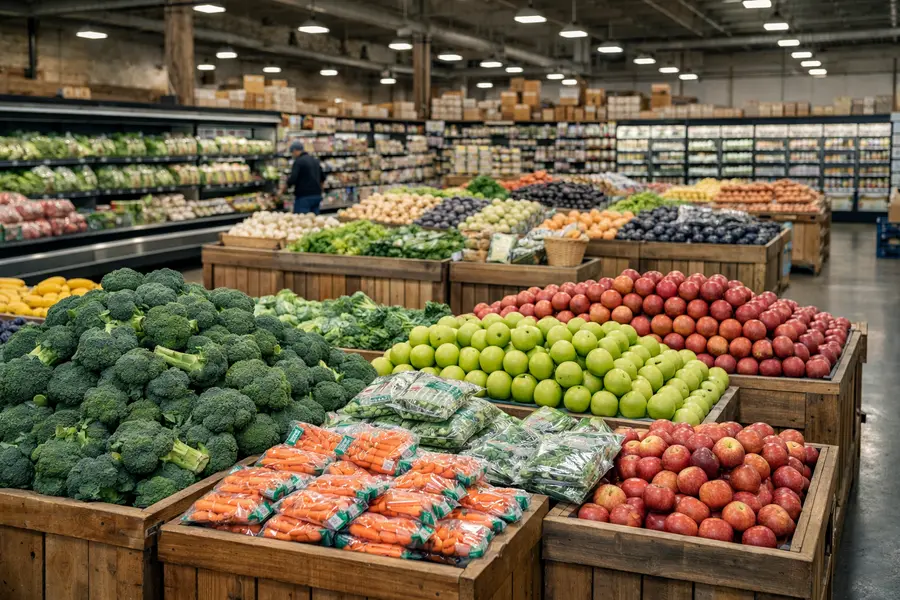
Sprouts Farmers Market shares fell 23% after a Q3 earnings miss and a fourth-quarter comparable sales forecast of down 2% to 4%, as store traffic weakened.
- Sprouts (NASDAQ: SFM) fell 23% on Oct. 29 after Q3 EPS of $1.21 missed the $1.23 consensus.
- Q3 comparable sales fell 0.9% as transactions dropped 3.3%; Q4 comps are guided down 2% to 4%.
- The cyclospora disruption cut about 0.6 points from Q3 comparable sales.
Lead
Sprouts Farmers Market (SFM) shares fell about 23% on Thursday, Oct. 29, 2026, after the specialty grocer missed third-quarter estimates and said comparable store sales would decline 2% to 4% in the fourth quarter. Adjusted earnings per share were $1.21 against a consensus of $1.23. Net sales rose 5% to $2.3 billion, below the $2.34 billion expected. The drop erased a large share of the company's market value in a single session.What Happened in Sprouts' Third Quarter?
Sprouts grew sales 5% to $2.3 billion in Q3, but the growth came from new stores rather than existing ones. Comparable store sales fell 0.9%. Comparable transactions fell 3.3%, and a 2.5% rise in average basket size only partly offset that.
Net income was $113 million. Gross margin fell 50 basis points to 38.2%, from 38.7% a year earlier. The company attributed the decline mainly to higher shrink, meaning product lost to spoilage or markdowns, tied to weaker sales and the cyclospora disruption. Higher fuel costs also weighed on margin.
Sprouts opened a record 15 new stores in the quarter. That expansion lifted total sales but did not offset the slowdown at mature locations.
Why Did Sprouts' Outlook Hit the Stock So Hard?
The fourth-quarter comparable sales guidance of down 2% to 4% is a steeper decline than the third quarter's 0.9%, and it came with a weaker full-year outlook. For fiscal 2026 on a 52-week basis, Sprouts now expects net sales growth of about 4.3%, comparable sales of roughly negative 1.7%, EBIT of about $605 million and diluted EPS of about $4.80.
Comparable sales had improved through July before softening in August and September, and that slowdown carried into the fourth quarter. The shares had traded at about 11 times forward earnings, a five-year low, before the drop. The decline took the multiple to roughly 8 times. Two brokerages downgraded the stock after the report.
CEO Jack Sinclair pointed to "a challenging consumer environment and the cyclospora disruption" and said the company needs to "improve our performance."
How Much Did the Cyclospora Disruption Matter?
The cyclospora disruption cost Sprouts about 60 basis points of comparable sales in Q3, which is less than the 3.3% fall in transactions. Cyclospora is an intestinal parasite linked to contaminated produce, and the disruption affected fresh-produce supply and demand at a chain where produce is a central draw.
The remaining traffic loss points to causes beyond the outbreak. Sprouts is responding with more spending on affordability, including a pricing reset scheduled for January. A price cut could win back shoppers, but it would likely weigh on gross margin when the company has just reported margin pressure.
How Do Peers Compare?
Sprouts' weakness is specific to the company and not a sector-wide slump. Walmart (WMT) reported comparable sales growth of 2.6%, driven by more transactions. Costco (COST) has posted quarterly comparable growth above 6.4%. Kroger (KR) reported identical sales excluding fuel of only 0.2%, which is closer to the Sprouts result.
Value-focused and scale operators are taking traffic from a niche natural and organic grocer at a time when consumers are watching their budgets. The comparison puts Sprouts' premium positioning under scrutiny after years of strong growth.
Leadership Transition
The results arrive during a change at the top. Nick Konat, president and chief operating officer, becomes CEO effective Jan. 4, 2027. Sinclair, CEO since 2019, will move to executive chairman. The January pricing reset will fall in Konat's first weeks in the job.
Outlook
Sprouts enters its fourth quarter with negative comparable sales guided, margins under pressure and a CEO handover due in early January. The January pricing reset and the pace of the record store expansion are the main variables. Whether transactions recover will show if the Q3 traffic drop was cyclical or a sign of lasting share loss to larger grocers. Results for the fourth quarter will provide the next test.
Mentioned tickers: SFM, WMT, COST, KR