Pomegra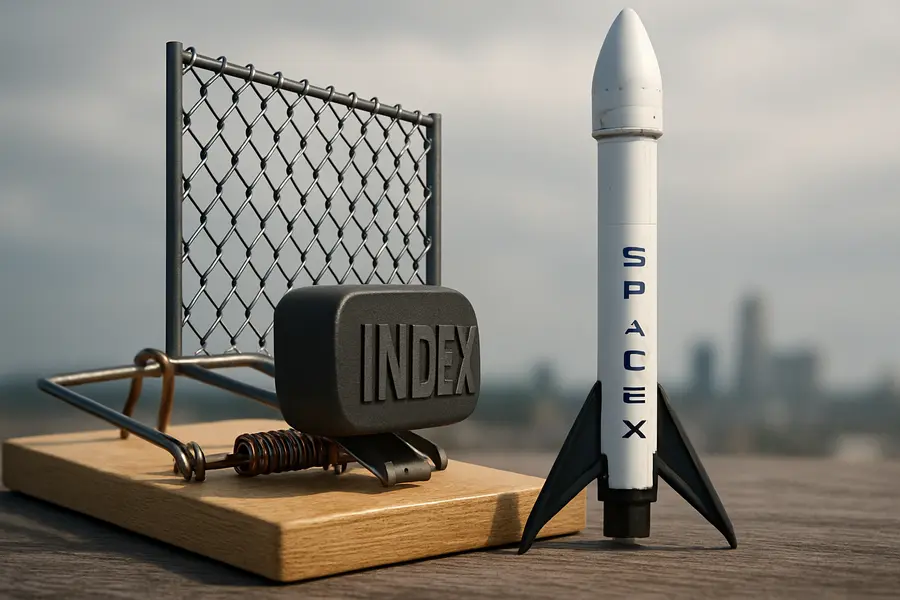
SpaceX's 4.3% public float and Nasdaq's fast-track rules are forcing passive investors into the market's most volatile trillion-dollar listed stock, SPCX.
- SpaceX (SPCX) debuted June 12 at $135, closing up 19% at $160.95; implied volatility reached ~120 — three times that of the iShares Bitcoin ETF.
- Passive funds are on course to absorb roughly 30% of SpaceX's constrained public float within 15 trading days of its Nasdaq listing.
- S&P 500 blocked fast-track entry; Nasdaq-100 revised inclusion rules in May 2026, exposing QQQ and total-market holders immediately.
Lead
SpaceX (SPCX) completed history's largest IPO on June 12, 2026, raising $75 billion at $135 per share and closing its debut session at $160.95 — a 19% first-day gain that pushed the company's market capitalization above $2 trillion. For millions of Americans invested in broad index funds, the listing was not a choice. Automatic inclusion mechanics tied to the Nasdaq-100 are now channeling passive capital into a stock whose implied volatility stood near 120 as of June 17 — roughly three times the reading on the iShares Bitcoin ETF (IBIT) — making SPCX the most volatile name among all trillion-dollar companies in U.S. equity benchmarks.A Float Too Small for the Demand
The structural tension at the center of the SpaceX passive investing story is supply. Insiders and early private investors retain the vast majority of equity, leaving the public float at an estimated 4.3% of total shares outstanding — an exceptionally constrained level for a company of this scale. When index-tracking funds are obligated to purchase shares to mirror their benchmarks, that mechanical demand crashes into limited supply.
Estimates suggest passive investors will accumulate approximately 30% of the available float within just 15 trading days of listing. Bloomberg has flagged this as a potential feedback loop: as SPCX appreciates on forced buying, its index weight rises, compelling further purchases. The dynamic is self-reinforcing in a way that has no analogue among large-cap incumbents.
Nasdaq Fast-Tracks; S&P Holds the Line
Not all index families responded the same way. Nasdaq revised its benchmark methodology — effective May 1, 2026 — to allow any newly listed company ranking among the top 40 by market capitalization to join the Nasdaq-100 after just 15 trading days, with prior free-float seasoning requirements eliminated. Under those rules, SPCX is on course for near-immediate inclusion in the QQQ and related trackers. Analysis from SpotGamma estimates Nasdaq-100 tracking funds will absorb roughly 5.5% of the public float on rebalance day alone.
What Index Fund Exposure Actually Means
Index funds SpaceX exposure is arriving through multiple channels. ETFs tracking the Nasdaq-100 — led by the $300-billion-plus QQQ — must hold SPCX proportional to its benchmark weight. Russell 1000 trackers face parallel obligations. Total-market and broad U.S. equity funds carry Nasdaq-100 components by construction. The result: any investor with a standard 401(k), target-date fund, or diversified passive allocation now holds SpaceX without having made an active decision.This is the defining concern at the heart of the current wave of SpaceX stock news: volatility that investors associate with speculative assets is entering portfolios explicitly designed to minimize single-stock risk. SPCX is uniquely the only company above $1 trillion in market capitalization currently unprofitable inside either major U.S. benchmark.
The Elon Musk IPO Premium
The Elon Musk IPO carries a valuation premium that compounds the risk-concentration question. At its first-day close, SpaceX surpassed Tesla's market capitalization of roughly $1.6 trillion, ranking it seventh among all U.S.-listed companies. The listing followed SpaceX's February 2026 merger with xAI, the artificial intelligence venture Musk founded in 2023, in a deal valuing the combined entity at $1.25 trillion. Investors are therefore pricing launch services, Starlink satellite broadband — which together drove the 33% revenue surge in 2025 — and a speculative AI premium stacked on an already capital-intensive space business.
Options markets reflect that complexity. Implied volatility near 120 prices in the possibility of dramatic daily price swings. The iShares Bitcoin ETF — widely regarded as a high-risk instrument — carried an implied volatility roughly one-third of SPCX's level at the same time.
Outlook
The forced-ownership dynamic around SpaceX exposes a structural feature of passive investing that large, sudden listings can exploit: any company clearing the index inclusion threshold compels buying regardless of price or the holder's risk tolerance. With the Nasdaq-100 fast-track now active, SPCX's index weight — and its presence in millions of retirement accounts — will expand in parallel with whatever valuation the market assigns. S&P 500 entry remains gated on profitability; if SpaceX reaches breakeven, a second and potentially larger wave of passive demand would follow. Until then, the collision between a tightly held float, extreme implied volatility, and mechanical buying defines the market environment around the world's newest $2 trillion company.