Pomegra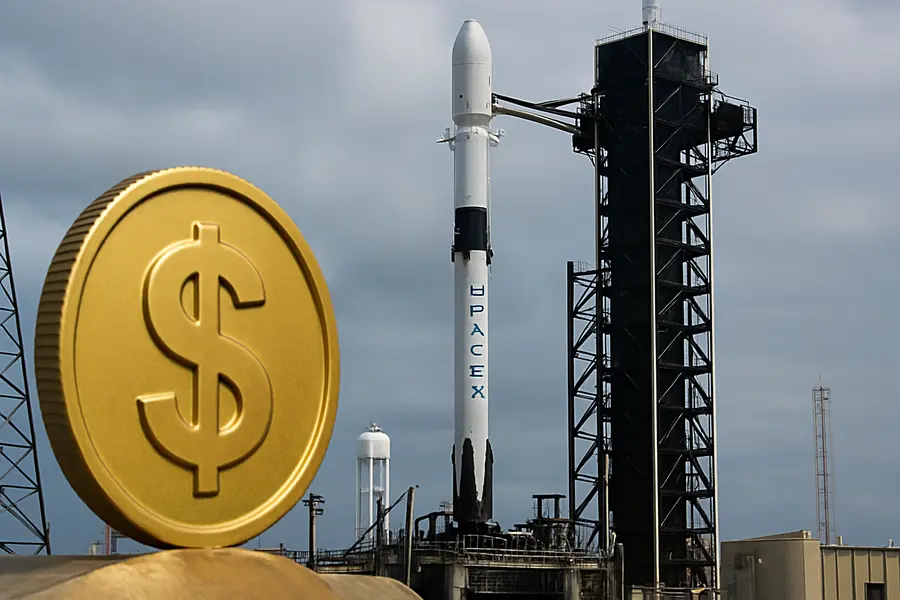
SpaceX's June 2026 IPO — the largest in history at $1.75 trillion — has since surged past $2 trillion, but a 94x price-to-sales ratio signals mounting execution risk.
- SpaceX raised $75 billion in the largest IPO in U.S. history, pricing at $135/share for a $1.75 trillion valuation on June 12, 2026.
- The stock surged 19.2% on debut to $160.95 and hit $225.64 by June 16, briefly pushing the SpaceX valuation past $2 trillion.
- With 2025 revenue of $18.67 billion and a price-to-sales ratio near 94x, the company must execute flawlessly on Starship and Starlink to justify its market cap.
Lead
What Happened
The SPCX IPO priced above the range initially flagged in a May 2026 S-1 filing and drew the widest institutional roadshow in recent memory. Shares debuted at $160.95, a 19.2% first-day gain, before extending the rally through mid-June. The $75 billion raise eclipsed Saudi Aramco's $67.4 billion in 2019, which had previously held the record. The implied SpaceX valuation at peak June trading carried a price-to-sales multiple near 94 times 2025 revenue — a structure that has historically rewarded a small number of platform-technology holders and punished far more.
Revenue Reality
SpaceX generated $18.67 billion in revenue in 2025, a 33% year-over-year increase. Starlink, the broadband satellite constellation, accounted for $11.4 billion — roughly 61% of total company revenue. Commercial and government launch contracts added $4.1 billion, up just 8% from the prior year, reflecting the maturity of the Falcon 9 platform after more than 350 cumulative flights. The remainder came from Starshield national-security agreements and emerging services.Despite strong top-line growth, the company posted a net loss as multi-billion-dollar annual investment in the Starship heavy-lift vehicle, new satellite production lines, and orbital data-center infrastructure consumed the operating cash generated by Falcon 9. Those expenditures are not discretionary: Starship is the machine upon which the entire long-term thesis rests.
The Starship Wager
At the center of every large-number SpaceX valuation projection sits a single assumption — that Starship works reliably and profitably at scale. The vehicle's Version 3 configuration, tested in March 2026, targets a per-kilogram launch cost below $100 and a payload capacity exceeding 200 metric tons to orbit, roughly ten Falcon 9 missions in a single flight. If those numbers materialize in commercial service, the economics of the space economy 2026 and beyond shift entirely in SpaceX's favor. If Starship development slips by one to two years or falls short of cost targets, the market holds a $2 trillion valuation for a company whose next-generation product remains unproven.
Aerospace Industry Trends and Rising Competition
The aerospace industry trends shaping 2026 complicate the SpaceX monopoly narrative. Blue Origin's New Glenn completed its first commercial missions earlier this year and secured a NASA lunar cargo contract worth up to $468 million — concrete evidence that a second orbital-class reusable rocket now exists. Rocket Lab has logged 85 cumulative launches and holds a backlog that more than doubled year-over-year, with the reusable Neutron medium-lift rocket approaching its debut in the same payload class Falcon 9 has dominated. United Launch Alliance, Arianespace, and several national launch providers round out a competitive field that was largely non-existent five years ago.
The overall space economy 2026 stands at approximately $613 billion annually, with nearly 80% driven by commercial operators. Industry forecasts project that figure rising toward $1.8 trillion by 2035 at a compound annual growth rate above 11%. The structural expansion is real. The question for investors is how much flows to SpaceX versus an increasingly capable cohort of challengers.
Tech Bubble Warning Signs
Comparisons to prior tech bubble episodes are available in quantity. A price-to-sales ratio near 94x is not inherently disqualifying for a category-defining platform company — early Amazon and early Salesforce traded on similar multiples — but those cases required years of compounding that left little margin for operational missteps, capital-market disruptions, or competitive entry. SpaceX faces all three simultaneously.
Starlink subscriber growth, which underpins the revenue story, is encountering the first signs of deceleration in mature markets where competing low-Earth-orbit broadband services are arriving. Government contracts provide cash-flow stability but carry cost-plus structures that cap margin expansion. And the $60 billion all-stock acquisition of AI coding platform Cursor, announced alongside the IPO, signals ambitions far beyond launch vehicles, adding integration risk to an already complex execution agenda.
Outlook
SpaceX enters public life as the most valuable aerospace company in history, backed by genuine technological achievements that reshaped the economics of space access over a decade. The SpaceX valuation now embedded in the stock prices in not only those achievements but a sustained period of new-market creation: Starship commercial viability, Starlink dominance in low-Earth-orbit broadband, and successful diversification into AI infrastructure. Each assumption is plausible individually. Taken together, on the timeline implied by a 94x revenue multiple in a broadening space economy 2026, they represent a concentration of expectation that has been rare in market history. The $2 trillion mark may prove to be the point at which the weight of those expectations begins to constrain, rather than amplify, SpaceX's strategic freedom.