Pomegra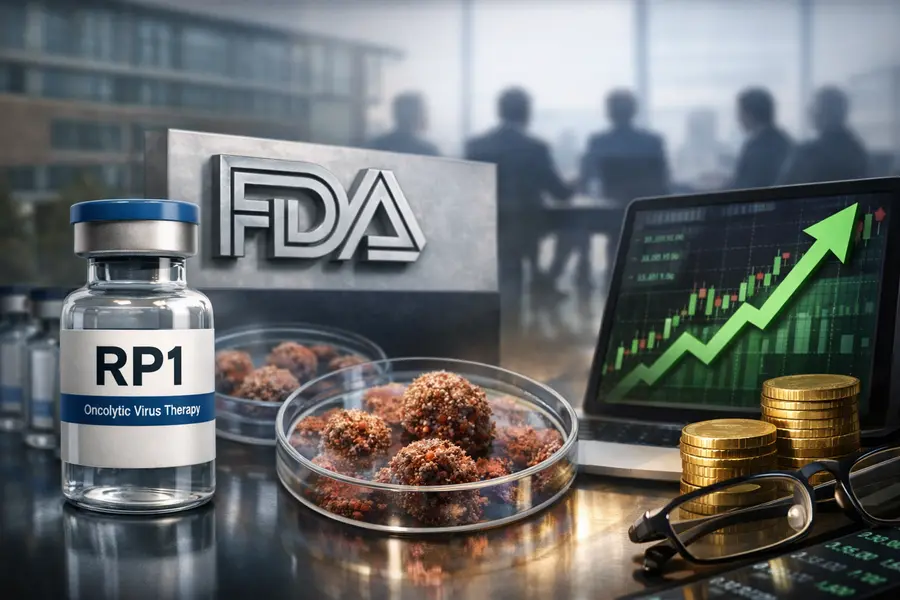
Replimune shares vaulted more than 127% after an FDA advisory committee voted 10-3 to endorse the efficacy of its combination melanoma therapy, adding nearly $600 million in market value ahead of a final agency decision on August 2.
- The FDA's Cellular, Tissue, and Gene Therapies Advisory Committee voted 10-3 on July 30, 2026, that RP1's efficacy data are evaluable and clinically meaningful for anti-PD-1-refractory advanced melanoma.
- REPL shares surged more than 127% on July 31, gaining nearly $600 million in equity value, as investors priced in a significantly higher probability of FDA approval.
- RP1 combined with nivolumab produced a 33.6% objective response rate and median overall survival of 32.9 months in patients with limited remaining treatment options.
Lead
Replimune Group (NASDAQ: REPL) shares surged more than 127% on July 31, 2026, one day after the U.S. Food and Drug Administration's Cellular, Tissue, and Gene Therapies Advisory Committee voted 10 to 3 that efficacy results from the IGNYTE trial were evaluable and clinically meaningful for RP1 — the company's oncolytic immunotherapy — combined with nivolumab in patients with advanced melanoma that had progressed on prior anti-PD-1 therapy. The FDA's final Prescription Drug User Fee Act decision is due August 2, 2026.
What Happened
The advisory panel convened on July 30 at the FDA's Silver Spring, Maryland campus to evaluate whether a single-arm study, without a nivolumab-only control, could support a Biologics License Application for vusolimogene oderparepvec (RP1). The deliberations unfolded against a difficult regulatory backdrop: the FDA had twice rejected the application via complete response letters — first in July 2025, when the agency determined the IGNYTE study did not constitute "an adequate and well-controlled clinical investigation," and again in April 2026, when reviewers stated they "would not recommend" approval based on a trial lacking a randomized comparator arm. The core objection centered on an inability to attribute systemic benefit specifically to RP1 rather than to Bristol-Myers Squibb's nivolumab (Opdivo) alone.
Despite those standing objections, the committee voted 10-3 in favor of the data's interpretability and clinical significance — a result that Replimune's management described internally as validating a third BLA resubmission accepted by the FDA in June 2026.
Trial Data
Three-year follow-up data from the IGNYTE melanoma research program, presented at the 2026 American Society of Clinical Oncology Annual Meeting, formed the centerpiece of the company's regulatory argument. RP1 plus nivolumab achieved a 33.6% objective response rate and a 15% complete response rate by modified RECIST criteria in a population of heavily pretreated patients. Median overall survival reached 32.9 months. At the three-year landmark, 47.8% of all treated patients remained alive — a figure that rose to 83.5% among responders — and 44.8% of responding patients maintained durable responses at that point. The safety profile was predominantly Grade 1–2, with no Grade 5 events.
The patient population — individuals with advanced melanoma refractory to anti-PD-1 therapy — has few approved salvage regimens, a clinical reality that weighed significantly in panel deliberations.
Market Reaction
REPL shares were already trading up more than 112% in pre-market action on July 31 before extending gains during the regular session. Total equity value added approached $600 million in a single trading day. Volume ran well above the stock's 30-day average, reflecting both short covering and renewed institutional interest following what was widely characterized as an "overwhelmingly positive" panel outcome.
Strategic Context
Replimune engineered RP1 as a modified herpes simplex virus designed to replicate selectively in tumor cells, lysing them and triggering a systemic immune cascade. The therapy is delivered intratumorally into accessible lesions, raising the central regulatory question of whether observed responses in non-injected tumors reflect genuine systemic activity rather than a local effect. The absence of a parallel nivolumab monotherapy arm in IGNYTE made it impossible to disentangle the two mechanisms — an argument the FDA's own reviewers pressed in its briefing documents ahead of the meeting.The favorable 10-3 advisory vote represents a material inflection point following two years of regulatory setbacks. An FDA approval would make vusolimogene oderparepvec the first oncolytic immunotherapy licensed in the United States since Amgen's talimogene laherparepvec (T-VEC) was approved for melanoma in 2015. The decision also carries broader implications for the oncolytic virus drug class, as regulators weigh what evidentiary standards are appropriate for single-arm trials in oncology indications with high unmet need.
Outlook
With the FDA decision window closing August 2, the agency will either approve the therapy — following the direction set by its advisory committee — or issue a third complete response letter requiring a randomized confirmatory study. Historically, the FDA aligns with advisory panel recommendations in the majority of cases, making the 10-3 vote a meaningful signal rather than a guarantee. Approval would open a commercial pathway in an underserved melanoma segment and lend credibility to Replimune's broader oncolytic platform. A rejection would likely require the company to design and fund a randomized, controlled trial, resetting the clinical timeline by several years.