Pomegra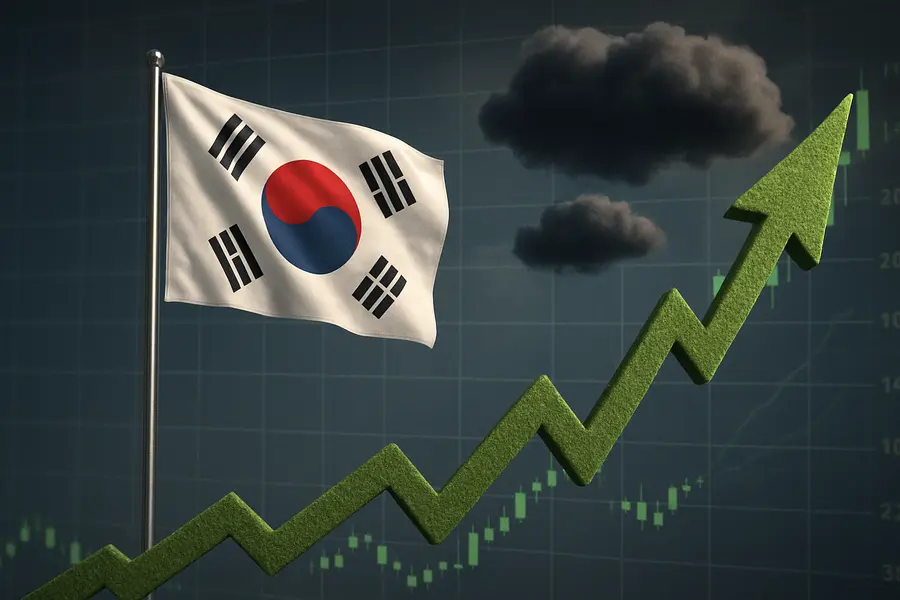
https://upload.wikimedia.org/wikipedia/commons/thumb/4/45/Yeouido2025.jpg/1280px-Yeouido2025.jpg
- KOSPI neared 9,000 by June 2026, up roughly 96% year-to-date, with Samsung and SK Hynix exceeding 50% of total index market cap for the first time.
- SK Hynix controls approximately 57% of global high-bandwidth memory revenue, locked into Nvidia and Microsoft supply agreements through 2026 and beyond.
- Risks include AI spending cyclicality, US tariff threats, Middle East energy dependence, and accelerating Chinese chip competition.
South Korea's KOSPI index soared 96% in 2026 on Samsung and SK Hynix's AI memory dominance, but concentration risk, US tariffs, and geopolitical pressure cloud the rally.
Lead
South Korea's benchmark KOSPI index reached a record 8,801 on June 4, 2026, capping the most dramatic equity re-rating in emerging markets this decade. The iShares MSCI South Korea ETF has gained approximately 87% year-to-date and roughly 219% over the trailing twelve months, outpacing every major Asia-Pacific benchmark. The rally traces directly to a single structural thesis: South Korea controls the memory architecture that every artificial intelligence data center on earth requires.
The HBM Engine
The driver is high-bandwidth memory (HBM), the stacked DRAM that sits atop AI accelerators and acts as a throughput bottleneck for every large-scale model inference and training workload. SK Hynix held approximately 57% of global HBM revenue in the third quarter of 2025, according to Counterpoint Research, with Samsung Electronics at 22% and US-based Micron at 21%.
Demand from hyperscalers has proven durable. Nvidia is expected to allocate roughly two-thirds of its HBM4 orders for the upcoming Vera Rubin AI platform to SK Hynix, with industry sources placing that share as high as 70%. Microsoft signed an exclusive HBM3E supply agreement with SK Hynix in January 2026 for its next-generation Maia 200 AI chip. Projections presented at Computex 2026 in early June placed the global HBM supply shortage as locked in through at least 2030.
The earnings consequences have been extreme. Goldman Sachs forecast KOSPI earnings growth of 300% for full-year 2026—the strongest annual profit expansion in any Asian market since the 1999 recovery from the Asian financial crisis—while the index trades at approximately seven times forward earnings, historically inexpensive relative to its profitability profile.
Concentration Risk
Samsung Electronics and SK Hynix together exceeded 50.44% of total KOSPI market capitalization by late May 2026, a record concentration for any two companies in a major emerging-markets index. Samsung share prices have nearly quadrupled since the start of 2025; SK Hynix has risen approximately six-fold.That concentration created dramatic downside exposure on June 5, 2026, when Broadcom projected third-quarter AI chip revenue of $16 billion—roughly 7% below the $17.2 billion consensus estimate. Samsung tumbled more than 7% and SK Hynix dropped more than 9% intraday, triggering circuit breakers and erasing billions in market value within a single session. The episode confirmed that a modest revision in AI infrastructure spending by a handful of US hyperscalers is sufficient to move the entire Korean index by multiple percentage points.
Geopolitical and Trade Pressures
South Korea tech sits at the center of the US-China technology competition, and the position is both lucrative and precarious. Korean chipmakers depend on US-origin equipment, Dutch lithography systems, and Japanese specialty chemicals for production. Export controls imposed by Washington and allied governments have tightened restrictions on sales to Chinese customers, while Chinese competitors—Yangtze Memory Technologies and ChangXin Memory Technologies—are expanding aggressively in commodity DRAM and NAND, eroding pricing power in mid-range memory.Trade friction with Washington adds a second layer of risk. South Korea shipped $132 billion in goods to the United States in 2024, with semiconductors and electronics among the top categories. President Trump threatened tariff increases in January 2026, citing Seoul's pace on the bilateral trade agreement ratification, and elevated baseline tariffs on Korean imports remain in place.
Energy vulnerability represents a third structural threat. South Korea imports approximately 70% of its crude oil from the Middle East, virtually all of it transiting the Strait of Hormuz. Elevated energy prices from Middle East uncertainty contributed to South Korean inflation accelerating to 3.1% in May 2026—the highest reading in more than two years—adding pressure on the Bank of Korea's rate path and compressing domestic consumption.
Samsung's Internal Challenges
While SK Hynix has extended its lead in HBM, Samsung faces mounting internal pressures that risk widening the gap at a critical moment. Labor disputes over performance-based bonuses escalated in April 2026, disrupting production schedules at key fabs and drawing scrutiny from customers evaluating HBM4 qualification timelines. South Korea's 52-hour workweek regulation creates structural tension with the continuous-shift demands of advanced semiconductor fabrication.
Environmental approvals, land acquisition delays, and infrastructure coordination have slowed expansion of Samsung's planned semiconductor cluster near Seoul, pushing back capacity targets precisely as the HBM shortage reaches its most acute phase and rival Micron invests aggressively in next-generation DRAM capacity in the United States and Japan.
Outlook
South Korea's control of HBM production has delivered a multi-year earnings windfall and a valuation re-rating that analysts at Macquarie project could carry the KOSPI index toward 6,000 on a normalized basis—well below current levels, reflecting the magnitude of the 2026 surge. The structural demand case for AI memory remains intact, and the supply shortage is unlikely to resolve before the end of the decade.
The counterweights are equally structural. Two stocks now constitute a majority of one of Asia's most liquid emerging markets benchmarks. US-China technology decoupling forces Seoul to navigate export controls on both sides of the divide. Middle East energy exposure injects an inflationary variable that Korean policymakers cannot control. And Samsung's internal execution challenges arrive precisely when the global AI buildout tolerates no production delays.
The KOSPI's near-century gain in a single year reflects a real and durable competitive advantage. Whether that advantage justifies the concentration, cyclicality, and geopolitical risk embedded in current pricing is the central question Korean equities will answer in the second half of 2026.
Mentioned tickers: 005930.KS, 000660.KS, EWY, NVDA, AVGOAnalysis