Pomegra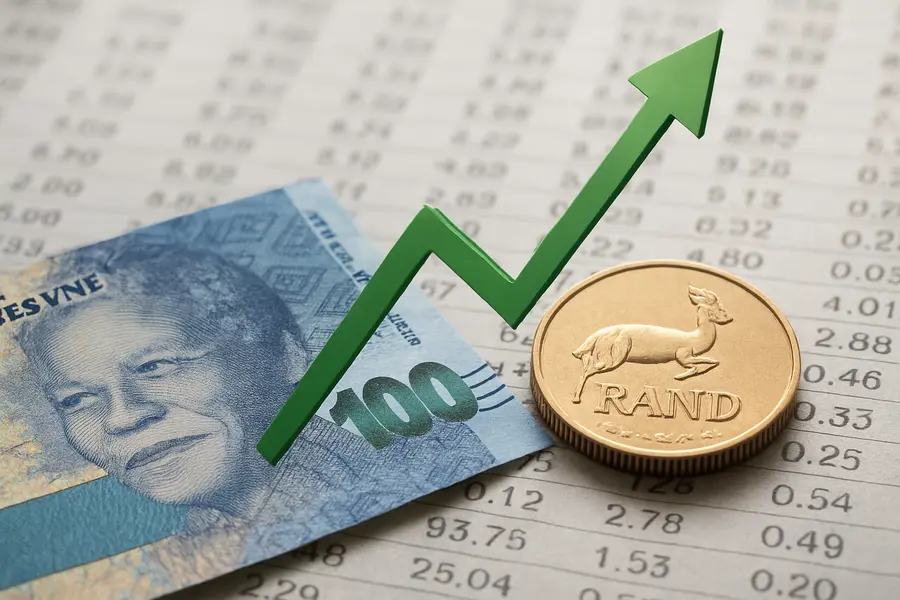
The South African rand gained ground against the dollar on June 30 as investors positioned cautiously ahead of a cluster of key domestic releases, with the ZAR exchange rate at 16.42 per dollar — roughly 0.2% firmer than the prior session — as the currency posted its second consecutive day of modest gains.
- The rand traded at 16.42/USD on June 30, up 0.2%, and has strengthened 7.57% against the dollar over the past 12 months.
- Investors await money supply, private sector credit, trade balance, and budget balance data due as part of June's month-end release schedule.
- South Africa's Q1 2026 GDP grew 0.5% quarter-on-quarter, beating the 0.3% consensus, adding a supportive backdrop to the currency's recent stability.
Lead
The South African rand opened firmer on Monday, June 30, trading at 16.42 per dollar at 0653 GMT — approximately 0.2% stronger than Friday's close — as currency markets in Africa's largest economy treaded water in anticipation of a round of closely watched domestic economic data. The session marked the final trading day of the quarter, a period often characterized by elevated volatility driven by portfolio rebalancing and positioning flows in emerging markets.
What Happened
The rand's modest advance came after a week marked by intraday swings, with the USD/ZAR pair ranging between a low of 16.3855 on June 22 and a high of 16.6625 on June 24 before settling into a tighter band heading into month-end. Despite a 0.57% depreciation over the past 30 days, the rand has posted a 7.57% gain against the dollar on a 12-month basis — outperforming a number of its emerging market peers and reflecting improved macro fundamentals and risk appetite toward South Africa economy assets.
The daily print of 16.42 sits near the bottom end of the currency's 2026 forecast range of 15.05–16.43, a level some market participants regard as a near-term technical floor amid stabilizing global risk conditions.
Awaited Data
The focus of Tuesday's session remains firmly on a batch of month-end releases from South Africa. Investors are tracking money supply figures, private sector credit expansion data, the South African Reserve Bank's inflation expectations survey, and the closely monitored trade balance and budget balance statistics. Together, these releases are expected to sharpen the market's read on domestic demand conditions and fiscal trajectory heading into the second half of 2026.
Credit and money supply metrics carry particular weight given the SARB's decision in May to raise its benchmark repo rate by 25 basis points to 7% — the central bank's first rate hike since 2023. The move was driven by a renewed inflation uptick, with headline consumer prices rising to 4.5% in May from 4.0% in April, though the print still landed below economist forecasts of 4.7%. Core inflation edged up to 3.8% from 3.6%, suggesting underlying price pressures remain contained.
The SARB's next monetary policy committee meeting is scheduled for July 23, and the incoming data set on June 30 will play directly into market expectations for whether the central bank holds or continues its tightening path.
Market Reaction and Strategic Context
Currency traders responded with measured optimism to the latest run of South Africa macro data. An upside surprise on first-quarter GDP — the economy expanded 0.5% quarter-on-quarter against a consensus estimate of 0.3% — helped underpin sentiment and reinforced the view that the recovery, while gradual, is on track. Real GDP growth is projected to average 1.8% from 2026 through 2028, an improvement from the 1.4% recorded in 2025.
Supporting the rand's relative resilience is a convergence of structural tailwinds. South Africa's removal from the Financial Action Task Force grey list, a sovereign credit rating upgrade from S&P Global, and progress on structural reforms have collectively bolstered foreign investor confidence in domestic assets. The ZAR benefits from its strong inverse correlation with gold prices — South Africa is a major gold and platinum group metals exporter — and commodity price stabilization since early 2026 has provided a partial cushion against dollar strength.
Emerging Markets Dimension
The rand's performance on June 30 reflects broader dynamics across emerging markets. Commodity-linked currencies — including the Brazilian real, Chilean peso, and Mexican peso — strengthened in early 2026 as the dollar softened from elevated levels and metals prices recovered. South Africa was among the strongest performers in that cohort, benefiting from both the commodity tailwind and improved domestic credit conditions.
However, structural constraints remain a headwind. Near-collapse conditions on South Africa's freight rail network and persistent inefficiencies in port operations continue to suppress the country's export throughput capacity. Rising criminal activity and inadequate municipal infrastructure add to the medium-term cost base for domestic businesses, effectively capping how quickly growth can translate into rand appreciation.
Inflation dynamics also present a complicating factor for ZAR exchange rate watchers. While headline inflation at 4.5% remains above the SARB's 3% target, it is trending within a manageable range. The central bank has raised its 2026 inflation forecast to 4.4% from an earlier 3.7%, with 2027 projected at 3.7% — narrowing the path for early rate cuts.
Outlook
The South African rand today reflects a currency caught between improving fundamentals and persistent structural headwinds. The 16.42 level against the dollar represents relative stability rather than directional momentum, with month-end data set to serve as the near-term catalyst. A stronger-than-expected trade balance or a downside surprise in private sector credit growth could push the rand through recent support levels. Conversely, data in line with or above expectations may allow the currency to consolidate near current levels into the second half of 2026. The SARB's July 23 meeting will be the next major policy anchor for market pricing.