Pomegra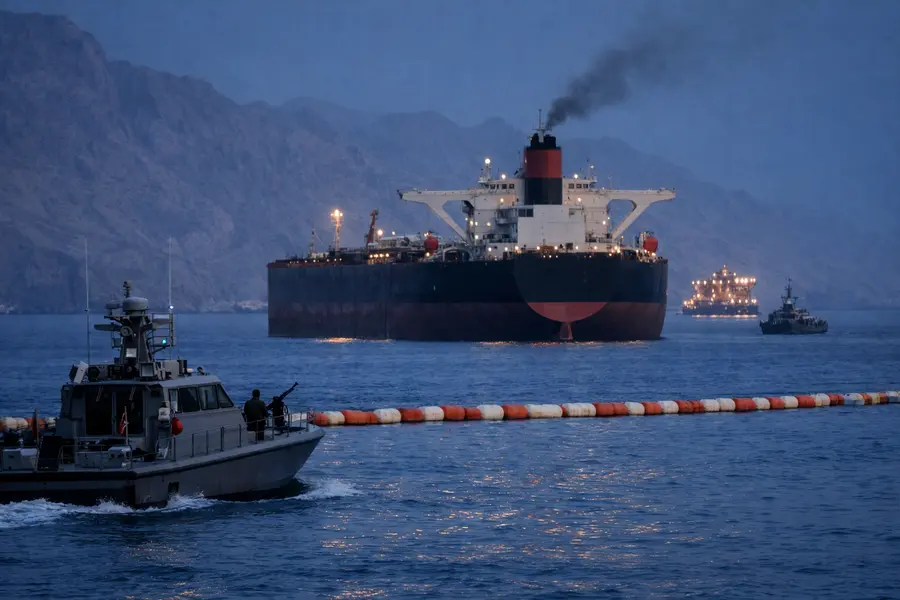
Iran's Supreme National Security Council insists the Strait of Hormuz will not reopen for commercial shipping until Washington lifts its naval blockade, withdraws military forces, and pays war reparations — directly contradicting President Trump's claim that the United States holds "total control" over the waterway.
- Iran's conditions for reopening the Hormuz strait include lifting sanctions, withdrawing U.S. forces, and paying war reparations — demands Washington has rejected.
- Only 14 vessels crossed the strait on Tuesday, down from roughly 120 oil tanker and cargo crossings daily before the conflict began in February 2026.
- Brent crude trades near $90 a barrel, sustained by the ongoing closure of a chokepoint that carried roughly 20% of global oil supply before the war.
Lead
DUBAI — August 14, 2026 — Iran's Supreme National Security Council said the Hormuz strait will remain closed to all foreign commercial shipping until the United States accepts Tehran's full list of conditions, a declaration that came hours after President Donald Trump repeated his assertion — made twice this week via Truth Social — that Washington exercises "total control" over the 21-mile-wide passage and might "keep it." The standoff, now in its sixth month, has reduced daily transit through the world's most critical oil chokepoint to approximately 14 vessels, a fraction of the 120 that transited pre-war, with no diplomatic framework in place to bridge the gap.What Happened
The war that shuttered the Hormuz strait began February 28, 2026, when U.S. and Israeli airstrikes on Iranian nuclear and military infrastructure prompted Tehran to order the Islamic Revolutionary Guard Corps to close the waterway to all foreign shipping. Within 48 hours, IRGC patrol vessels were broadcasting VHF warnings — "no ship is allowed to pass the Strait of Hormuz" — boarding commercial vessels, and laying sea mines across navigational channels. Oil tanker traffic collapsed within days.
A U.S.-brokered ceasefire on April 7, 2026 briefly stabilized the situation, and a follow-on agreement in June produced a two-week reopening. That arrangement collapsed in early July after IRGC units attacked merchant vessels, and Washington reimposed a full naval blockade of Iranian ports on July 30. Effective commercial traffic has not recovered since.
Iranian Foreign Minister Seyed Abbas Araghchi on Wednesday called Trump's "total control" claim a product of "long-term intelligence failures," adding that no negotiations between Tehran and Washington are currently underway. The Persian Strait Gulf Authority issued a parallel statement: "The Strait of Hormuz remains blocked and will not be reopened until Iran's conditions are accepted."
Iran's Conditions
Tehran's list, articulated by Security Council Secretary Mohammad Bagher Zolghadr, runs to six points: a permanent lifting of the U.S. naval blockade and all reimposed sanctions; withdrawal of American military forces from the broader region; payment of war reparations; release of frozen Iranian assets; formal recognition that the conflict is ended; and a guarantee of non-aggression against Iran's regional allied networks. Foreign Ministry spokesman Esmail Baghaei added that the naval blockade must be lifted as a precondition before any other element of the list is addressed.
Trump, responding via Axios on Tuesday, rejected reparations outright and demanded compensation from Iran instead, citing "all of the people they have killed and gravely wounded with their roadside bombs and many conflicts." He characterized U.S. negotiating posture as "only semi-negotiating," signaling reliance on the naval blockade to apply economic pressure rather than returning to airstrikes.
Market Reaction
Brent crude trades near $90 a barrel, having briefly topped $102 following the July breakdown and subsequent reimposition of the blockade. The international benchmark has shed roughly 12% from that peak as traders price in demand-side deterioration against persistent supply disruption. WTI tracks Brent within a $2–$3 discount.The effective closure of the Hormuz strait has cascades far beyond crude. Liquefied natural gas shipments from Qatar — which accounts for roughly a fifth of global LNG supply — remain at minimal levels, and petrochemical feedstocks, aluminum, and manufactured goods transiting the Persian Gulf to Asian markets face substantial delays and rerouting costs. Shipping insurance premiums for the region have reached multi-decade highs, making oil tanker operations in adjacent waters economically unviable without government-backed cover.
Strategic Context
The Hormuz strait, at its narrowest point, separates Iran's Qeshm Island from the Musandam Peninsula of Oman. Roughly 20% of global petroleum liquids transited the passage daily in 2025, including substantial volumes from Saudi Arabia, Iraq, Kuwait, and the UAE. The U.S. naval blockade — which bars ships from calling at any Iranian port, inside or outside the strait — has strangled Iran's own export revenues, but the combination of IRGC mine-laying, drone threats, and vessel seizures has made commercial operators unwilling to transit even when the U.S. Navy offers escort.
The convoy system introduced in late June successfully shepherded a limited number of oil tankers through the strait, but the July attacks demonstrated that escort operations cannot guarantee safety against asymmetric threats at scale.
What Comes Next
Diplomatic channels remain officially closed. Iran has conditioned any return to talks on a prior U.S. concession — lifting the naval blockade — while Washington insists Iranian demands for reparations and a full military withdrawal are non-starters before a ceasefire framework is restored.
The Oman backchannel, which facilitated the April ceasefire, has not produced a new round of substantive engagement. A UN Security Council session is scheduled for late August at the request of non-permanent members, though veto dynamics limit its coercive potential.
Absent a breakthrough, energy markets are pricing for an extended closure through at least the end of the third quarter of 2026, with analysts modeling Brent in an $85–$105 range contingent on whether additional oil tanker convoys can be organized or alternative routing through the Suez Canal and Cape of Good Hope absorbs more volume.
Outlook
The Hormuz strait standoff has entered a phase of entrenched positional bargaining, with neither side offering the concessions required to unblock negotiations. Iran's six-point demand list and Washington's counter-demands on reparations leave the gap wide. The oil tanker paralysis shows no near-term resolution, keeping energy markets elevated, LNG supply constrained, and regional trade disrupted. The next inflection point will most likely come from either a shift in Iran's domestic political calculus or a deterioration in U.S. naval posture — neither of which appears imminent.
Mentioned tickers: USO, BNO, XOM, CVX, BP, SHEL, TTE, QIA