Pomegra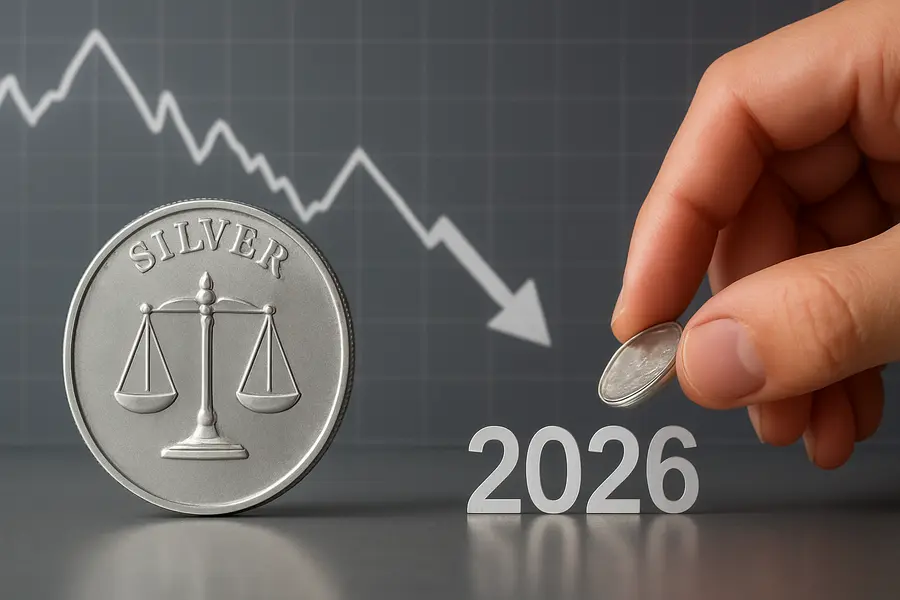
Silver has surrendered more than half its January all-time high, splitting institutional opinion between those who see the silver price correction 2026 as a buying opportunity and those forecasting further losses.
- XAG/USD has fallen more than 51% from its January 2026 all-time high near $121.62, trading near $59 in mid-June.
- The Silver Institute projects a sixth consecutive year of structural supply deficit, anchoring the long-term bull case.
- Institutional year-end targets range from $56 to $96 per ounce, reflecting deep disagreement on direction.
Lead
Silver (XAG/USD) traded near $59.18 per ounce in mid-June 2026, more than 51% below the January all-time high of approximately $121.62 — a collapse that has erased the bulk of the metal's historic 2025 rally and reignited a fierce institutional debate over whether to buy silver dip or position for renewed weakness in the months ahead.What Happened
Silver's fall is the inverse of its ascent. The metal surged roughly 147% through 2025, propelled by industrial demand optimism, a weakening dollar, and speculative inflows that lifted prices to a fresh record early this year. The reversal accelerated after the CME Group raised margin requirements on silver futures, forcing leveraged traders to reduce positions. The Federal Reserve's June dot plot returned rate-hike scenarios to the table, strengthening the U.S. dollar and removing a key commodity tailwind. Concentrated profit-taking across the precious metals complex compounded the decline.
The depth of the correction has been exceptional even by silver's historically volatile standards. From peak to trough, the metal shed more than five decades of accumulated price gains within months, with each attempted recovery stalling beneath major moving-average clusters.
Technical Picture
The near-term technical structure of the silver market outlook remains bearish. XAG/USD has broken below its 20-day, 100-day, and 200-day simple moving averages, all of which have converged near $69–$70 per ounce — converting that zone from support to resistance. The immediate battleground is the $60 psychological threshold; a sustained failure there reopens the path toward $54.60, the December 2025 swing low. Indicator composites currently classify the pair as a strong sell across multiple timeframes.
A meaningful recovery requires a daily close above the 200-day SMA at $69.33, with the 100-day SMA at $76.71 serving as the next significant cap for any sustained rebound.
The Bull Case: Buy Silver Dip
For structurally oriented investors, the silver price correction 2026 reads less like a breakdown and more like a reset within a multi-year bull market. The Silver Institute's World Silver Survey 2026 projects the sixth consecutive year of global supply deficit, reflecting a market where industrial consumption has persistently outrun mine output. Primary demand pillars include photovoltaic solar manufacturing, electric vehicles, artificial intelligence data-center infrastructure, and semiconductor fabrication — collectively accounting for more than half of annual global silver consumption.
The gold-to-silver ratio has widened to approximately 61.7:1. Historical precedent shows that during sustained precious metals bull cycles, the ratio compresses toward 40–50:1 as silver outpaces gold once macro headwinds recede. The current reading implies significant relative underperformance that long-term buyers have historically used as an entry signal.
The Bear Case: Stretched Valuations and Substitution Risk
Not all institutional views are constructive. BMO Capital Markets projects a full-year 2026 average of $56.3 per ounce, placing year-end prices only modestly above current levels. Commerzbank and HSBC project a more moderate recovery toward $70 by December, contingent on easing oil and inflation pressures.
J.P. Morgan analysts have specifically noted that silver does not benefit from the structural central-bank accumulation that has cushioned gold during corrections — a distinction that limits conviction among institutional dip-buyers. Without sovereign demand as a price floor, XAG/USD remains more exposed to momentum reversals and margin-driven liquidation than its yellow-metal counterpart.
On the supply side, solar panel manufacturers are actively reducing silver content per unit. Longi Green Energy Technology, a major global photovoltaic producer, announced plans to substitute silver with copper in back-contact cells, with mass production targeted for the second quarter of 2026. If substitution accelerates sector-wide, it erodes one of the structural demand arguments most frequently cited by silver bulls in their precious metals forecast models.
What Comes Next
The trajectory for the remainder of 2026 hinges on two variables: the Federal Reserve's rate path and the pace of industrial substitution in the solar sector. A pivot toward easing would weaken the dollar, lift real-asset demand, and likely provide the macro catalyst needed to close the gap between current spot prices and institutional year-end targets. Absent that catalyst, silver faces a range-bound or declining trajectory against a backdrop of stretched prior positioning and dollar resilience.
The structural deficit case remains intact. However, persistent supply shortfalls do not guarantee near-term price support when macro forces dominate sentiment — a dynamic the first half of 2026 has illustrated in full.