 Pomegra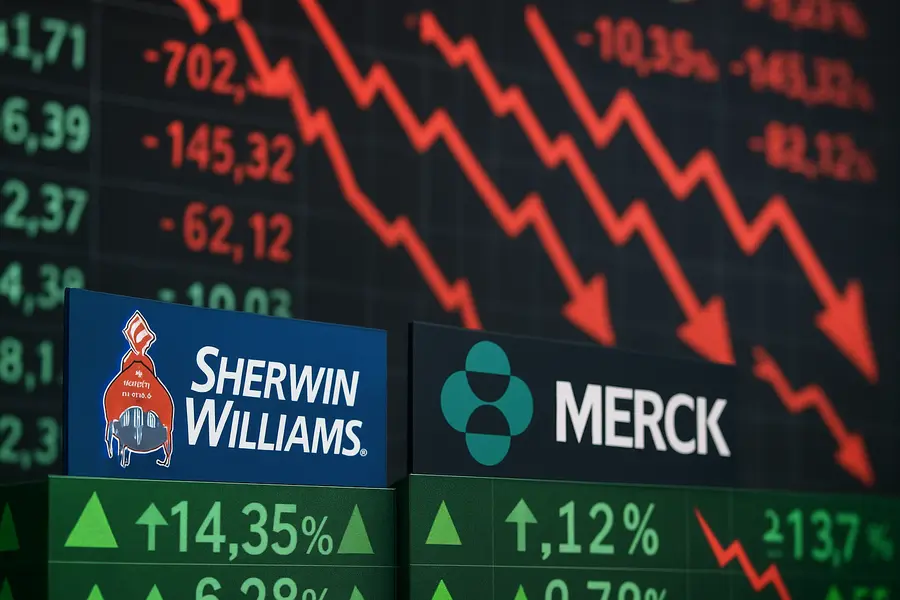
I now have sufficient data to write the article. Here it is.
- The Nasdaq slid 2.21% to 25,587 and the S&P 500 fell 1.44% to 7,365, as Micron collapsed 13.2% and Qualcomm shed 8% on AI-return concerns.
- SHW traded in a $319–$330 intraday band, supported by 47 consecutive years of dividend growth and a Q1 2026 earnings beat across all three segments.
- MRK reached an intraday high of $116.47, backed by a cluster of June FDA approvals and a Buy consensus rating from 18 analysts.
---
Sherwin-Williams and Merck rose June 23 as a chip-driven selloff erased more than $1 trillion in Nasdaq market value and sent institutional capital into defensive and value plays.
Lead
New York, June 23 — Sherwin-Williams (SHW) and Merck & Co. (MRK) moved higher as a cascading selloff across the semiconductor complex drove the Nasdaq Composite down 2.21% to 25,587 and the S&P 500 down 1.44% to 7,365, triggering a broad rotation into defensive and value-oriented names. The two companies, drawing on resilient fundamentals and reliable dividend profiles, joined a cohort of consumer staples and healthcare stocks absorbing capital that had fled the battered AI infrastructure trade.
What Happened
The session's decline originated in Asian markets overnight, where memory chip shares tumbled following a Bank of America note flagging rate risk and raising investor doubts about hyperscaler returns on artificial intelligence infrastructure spending. By the New York open, the damage had spread across the U.S. semiconductor complex. Micron Technology (MU) fell 13.2%, its steepest single-day drop in more than a year; SandDisk declined 11.2%. Qualcomm (QCOM) shed 8%, Advanced Micro Devices (AMD) lost 5.8%, Nvidia (NVDA) dropped 4.2%, and Broadcom (AVGO) fell 3.1%. Across two consecutive sessions, the Nasdaq 100 erased more than $1 trillion in market capitalization.
Market Reaction
As technology shares dragged on the indexes, institutional positioning shifted toward names insulated from the AI capital expenditure cycle. Walmart (WMT) advanced roughly 2%, Johnson & Johnson (JNJ) gained close to 3%, and SHW and MRK joined that defensive cohort.
Sherwin-Williams held an intraday band of $319.38 to $329.88. The stock's appeal during the session rested on a straightforward value proposition: 47 consecutive years of dividend growth — one of the longest streaks across the materials sector — combined with a first-quarter 2026 report that beat consolidated guidance and demonstrated market share gains across all three reporting segments despite a persistently soft housing environment.
Merck reached an intraday high of $116.47 before settling near $115.49. The pharmaceutical major has accumulated a string of pipeline milestones in June 2026, including FDA approvals for KEYTRUDA in combination with WELIREG, clearance for the vaccine CAPVAXIVE, and positive Phase 3 data for tulisokibart in ulcerative colitis. Eighteen analysts carry a Buy rating on the stock, with consensus price targets implying roughly 12.7% upside from recent levels.
Strategic Context
The session reinforced a sector rotation that has gathered momentum throughout 2026. Industrial, energy, and consumer defensive names have led U.S. equity markets year-to-date as the AI trade — dominant across 2024 and 2025 — faces its first sustained valuation stress test. Energy stocks have gained more than 22% since January 1; industrials have posted comparable returns.
Sherwin-Williams occupies a structurally distinct position in this rotation. As a paint and coatings manufacturer, its revenue tracks residential and commercial construction activity rather than technology capital expenditure cycles, rendering it largely uncorrelated to AI infrastructure drawdowns. Its dividend continuity elevates it further within risk-off frameworks where income predictability commands a premium.
Merck's defensive classification stems from the relatively inelastic demand for pharmaceutical products. Its oncology franchise, anchored by KEYTRUDA, contributes a substantial share of annual revenue and maintains a multi-year growth runway as label expansions accumulate. Healthcare equities have historically outperformed during dislocations driven by growth-factor repricing, a pattern that reasserted itself on June 23.
What Comes Next
The central question entering subsequent sessions is whether the tech rout represents a durable repricing of AI-adjacent equities or a tactical correction within a longer bull cycle. Nasdaq futures edged higher on June 24 as some investors returned to technology shares, suggesting the selloff may have been partly technical. However, two consecutive sessions of losses exceeding $1 trillion in Nasdaq market value signal elevated caution heading into second-quarter earnings season.
For SHW, the near-term thesis depends on a housing recovery that has moved slower than consensus anticipated. A renewed decline in mortgage rates could provide a material demand catalyst for paint volumes and lift analyst sentiment above its currently mixed reading. For MRK, the clinical pipeline ranks among the most active in large-cap biopharma, with multiple data readouts anticipated before year-end that could expand KEYTRUDA's addressable indications and further validate the company's oncology-centered strategy.
Outlook
The June 23 session demonstrated how rapidly institutional capital redirects when confidence in a dominant market theme fractures. Sherwin-Williams and MRK offered two distinct rationales for defensive shelter — one grounded in dividend durability and construction-cycle exposure, the other in pharmaceutical pipeline momentum — and both attracted buyers as the tech rout deepened. Whether the rotation proves durable will depend largely on whether AI-linked corporate earnings disappoint materially when second-quarter results begin to arrive in July.