Pomegra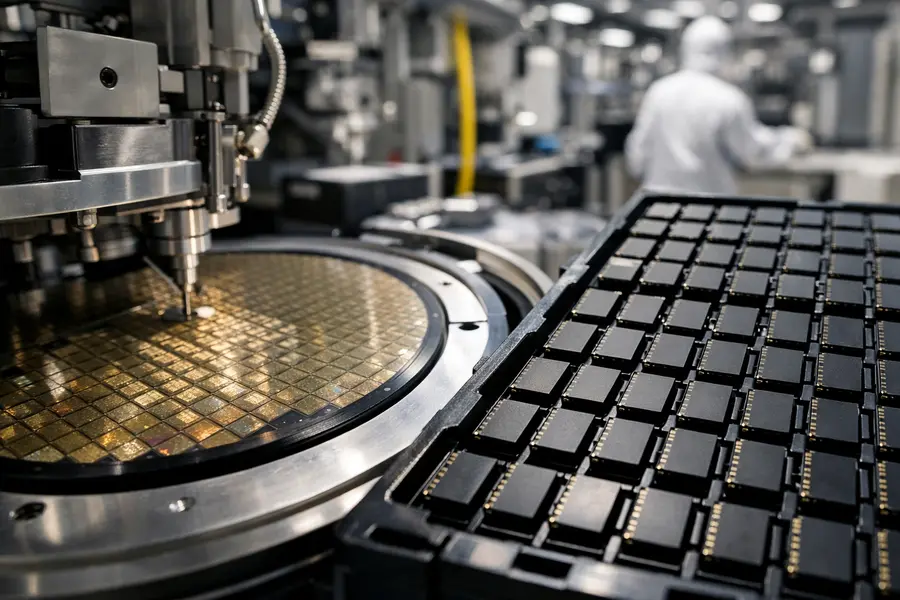
SanDisk jumped 13.6% and Micron gained 5% as SanDisk's Investor Day confirmed AI infrastructure spending has overwhelmed global NAND flash chip and memory wafer supply.
- SanDisk surged 13.6% on August 14 after its Investor Day; JPMorgan upgraded SNDK to Overweight with a $2,250 price target implying ~47% additional upside.
- NAND flash chip contract prices rose 70–75% quarter-over-quarter in Q2 2026 as AI data centers absorbed an estimated 70% of global memory output.
- SanDisk signed eight multi-year volume agreements totaling ~$94 billion in contract value, locking in ~80% gross margins even at floor pricing.
Lead
SanDisk Corporation (SNDK) surged 13.6% on Thursday, August 14, 2026, and Micron Technology (MU) rose 5% as a sweeping Investor Day presentation by the flash-memory maker confirmed that artificial intelligence infrastructure buildouts have pushed global NAND flash chip and memory wafer supply to structural limits. JPMorgan lifted its rating on SanDisk from suspended to Overweight, setting a price target of $2,250 — representing roughly 47% additional upside from the prior close and arriving after a year-to-date advance already exceeding 500%.What Happened
SanDisk held its 2026 Investor Day on August 13 in New York, unveiling a multi-year financial framework and technology roadmap that materially reframe the company's risk profile. Management presented targets for mid-to-high double-digit annual revenue growth from fiscal 2028 through fiscal 2030, alongside non-GAAP gross margins of approximately 80% and adjusted free cash flow margins near 50%.
The company disclosed eight new business model agreements (NBMs) carrying roughly $94 billion in total contract value at floor pricing, with a weighted-average duration exceeding four years. Margin targets hold at floor-price levels, establishing a structural revenue floor that decouples SanDisk's financials from spot-market NAND flash chip cycles that historically devastated sector returns.
On the technology side, SanDisk announced it is sampling BiCS10 — its 10th-generation three-dimensional NAND architecture — and alongside joint-venture partner Kioxia revealed a high-performance QLC 3D flash platform engineered for AI inference and data-intensive workloads. The company also advanced its High Bandwidth Flash (HBF) architecture, positioning it as a low-latency storage layer suited to sit adjacent to GPU processing nodes inside AI data centers.
Market Reaction
SanDisk opened sharply higher on August 14 and held gains through the close on elevated volume. Micron, which controls approximately 12.8% of global NAND output and produces both DRAM and NAND flash chips, advanced 5% as investors recalibrated valuations across the entire memory complex. Both stocks have benefited from a broader repricing of memory from cyclical commodity to structural AI infrastructure input — a shift now visible in multi-year contract structures rather than spot pricing alone.
JPMorgan's upgrade described SanDisk as having potentially broken memory's historic boom-bust cycle through long-dated volume agreements and a margin architecture that remains intact at floor-price tiers. The $2,250 price target reflects confidence that AI procurement commitments will insulate revenues through the end of the decade.
Strategic Context
The session's moves reflect conditions that extend well beyond a single company. AI data centers now absorb an estimated 70% of all memory chips produced globally — a concentration that has inverted the traditional demand profile and created persistent shortfalls across both NAND flash chip production and memory wafer processing capacity.
Global NAND production is highly concentrated. Kioxia controls roughly 14% of output; SanDisk and Micron each hold approximately 12.8%. New clean-room construction and memory wafer fabrication expansion run 24–36 months from authorization to first yield, placing any meaningful capacity relief no earlier than 2027–2028. SK Hynix has stated that the shortage could extend past 2030 under sustained AI-scaling scenarios.
AI and Technology Angle
AI inference — applying trained models to real-world queries at scale — is the direct driver of rising storage intensity. Each query to a large language model or multimodal system triggers high-frequency reads across high-capacity flash storage. As token usage proliferates across enterprise and consumer applications, demand for fast, high-endurance NAND flash chips grows nonlinearly relative to compute additions.SanDisk's enterprise data center flash total addressable market projection reaches 1.2 zettabytes by 2030. HBF sits closer to GPU and CPU processing nodes than conventional flash, reducing latency and allowing AI systems to access larger active datasets without memory-hierarchy bottlenecks. The convergence of inference scaling, model proliferation, and hyperscaler buildouts has produced a supply-demand gap that no single memory wafer producer can close on a short timeline given the capital intensity and lead times inherent to semiconductor fabrication.
What Comes Next
Micron's next earnings cycle arrives in late September, and management commentary on NAND spot pricing and contract-renewal economics will function as the sector's primary forward indicator. Industry projections place the NAND flash chip supply-demand imbalance running through at least 2027, with pricing expected to remain elevated as long as AI capital expenditure from Microsoft, Amazon, Google, and Meta holds at current commitment levels — each having publicly announced record data center investment for 2026.
Outlook
The AI-driven memory upcycle is deepening rather than moderating. SanDisk's Investor Day established that a substantial portion of the company's forward revenue is already secured through long-dated volume agreements, partially insulating financial performance from spot-market volatility. SanDisk and Micron together represent close to 26% of global NAND production, a combined position that confers unusual pricing authority in a market where every major hyperscaler buyer faces structural undersupply. If memory wafer capacity additions arrive later than projected — a likely outcome given permitting and equipment-delivery timelines — the margin and revenue expansion outlined at Investor Day could prove conservative rather than ambitious.