Pomegra
Houthi missiles and drones set Saudi Arabia's Ras Tanura hub ablaze, keeping Brent near $116 as Saudi-Iran talks offer only partial relief to oil markets.
- Fire broke out near Ras Tanura early Tuesday; Aramco contained it within hours, and the extent of damage was not immediately clear.
- Brent rose 0.6% to $116.50 a barrel and WTI gained 0.7% to $102.50, putting Brent up about 13% in October.
- Saudi Arabia, Iran, Pakistan and Turkey agreed to continue talks, but the diplomacy has not lowered the crude oil price.
Lead
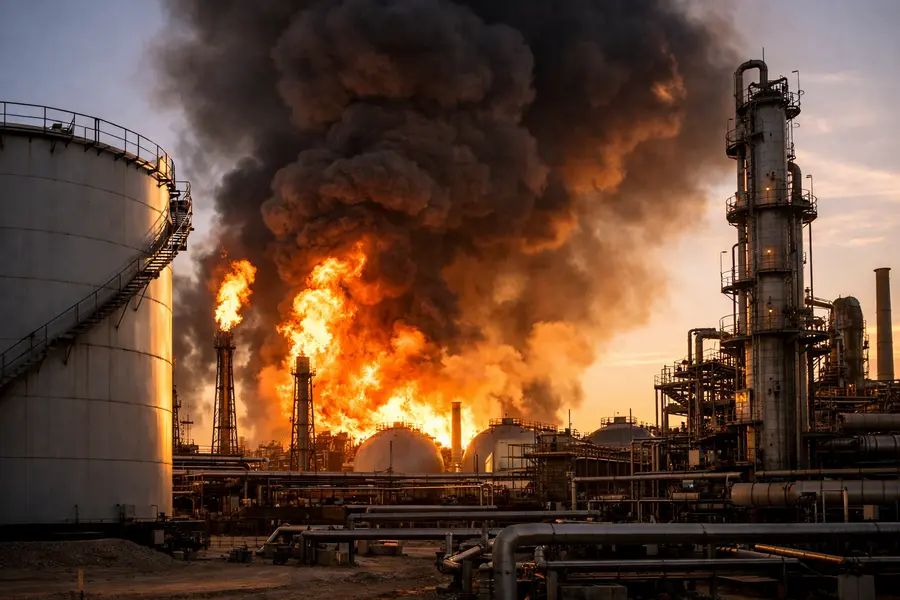
A fire broke out near Saudi Arabia's Ras Tanura oil hub in the early hours of Tuesday, October 27, after a fresh wave of Houthi missile and drone attacks. Brent crude settled near $116.50 a barrel, 0.6% higher, after reversing earlier losses. West Texas Intermediate rose 0.7% to $102.50. Saudi Arabia said its air defences intercepted and destroyed three ballistic missiles fired toward the Eastern Province. The Houthi group said it struck the Ras Tanura refinery with a ballistic missile that "struck its target accurately."
What Happened at Ras Tanura?
The fire erupted near facilities operated by state producer Saudi Aramco (2222.SR) on the kingdom's Persian Gulf coast. Neither Aramco nor the Energy Ministry gave an immediate assessment of damage. The fire was contained several hours later.
Ras Tanura is one of the world's largest oil export terminals, handling more than 5 million barrels a day before the current conflict. It also hosts the kingdom's largest domestic refinery, with capacity of about 550,000 barrels a day, plus extensive storage tanks. The site was hit once before this year: in March, an intercepted drone caused a fire and limited damage, and Aramco temporarily shut some units.
The latest strike follows repeated Houthi attacks in recent weeks on Aramco's headquarters, a major oil field and refineries in the western region. Saudi forces intercepted three ballistic missiles and four drones aimed at the Eastern Province and the south.
Why Is the Crude Oil Price Holding Near $116?
The crude oil price holds near $116 because the attacks hit a supply chain with little slack, even though no production loss has been confirmed. Brent closed Friday at $116.72, a six-month high, after a weekly gain of about 6.2% that marked a third straight weekly advance.
Three factors keep the market tight:
- Thin spare capacity. OPEC+ spare capacity is estimated at roughly 0.27 million barrels a day, a small buffer against any outage.
- Hormuz dependence. About one in five barrels of global oil consumption passes through the Strait of Hormuz, and overland routes cannot absorb that volume if shipping is restricted.
- Embedded risk premium. Goldman Sachs puts the Middle East risk premium at about $24 a barrel, while the International Energy Agency has warned that refined products may stay tight into 2027.
How Are Saudi Export Routes Affected?
Saudi Arabia has two main outlets, and both are now under threat. Before Hormuz traffic recovered, the kingdom rerouted about 4 million barrels a day through the 1,200-kilometre East-West pipeline to the Red Sea port of Yanbu. The line has a nameplate capacity near 5 million barrels a day. Yanbu, home to the Samref, Yasref and Yanbu refineries and a crude export terminal, has itself been attacked several times.
Aramco has since moved bulk shipments back from the Red Sea to the Persian Gulf as traffic through Hormuz neared pre-war levels. That shift puts more volume through Ras Tanura and Jubail, where the 465,000 barrel-a-day Satorp refinery sits, so Tuesday's strike lands on the route the kingdom now relies on most. It also leaves the Houthis able to threaten both coasts.
Does Saudi-Iran Diplomacy Ease the Pressure?
Saudi-Iran diplomacy offers some relief but has not changed the supply picture. Iran, Pakistan, Turkey and Saudi Arabia agreed to continue talks, which reduces the odds of a direct Gulf confrontation. The channel does not bind the Houthis, whose strikes on Saudi energy assets have continued while the talks proceed.
Prices reflect that gap. Brent traded lower earlier on the diplomatic signal and then reversed as news of the fire spread. Markets also weigh the prospect of a resumption of fighting between the United States and Iran, a main driver of the roughly 13% rise in Brent this month. Libyan supply disruptions add to the upward pressure.
Geopolitical Dimension
The pattern is one of asymmetric pressure on a state with the most spare infrastructure in the Gulf. Low-cost missiles and drones force Riyadh to spend interceptors and to hold exports in reserve against damage. That raises insurance, shipping and security costs even when air defences succeed. Saudi Arabia's main airport only partially resumed operations after earlier damage, a sign that the campaign reaches beyond oil.
For importers in Asia and Europe, the exposure is to refined products as much as crude. Damage to refining capacity at Ras Tanura, Yanbu or Jubail would tighten diesel and jet fuel markets before it moved crude benchmarks.
What Comes Next for Oil Prices?
Over the next three to twelve months, three outcomes matter most. If Saudi defences keep intercepting attacks and the four-party talks produce a wider understanding, Brent could drift lower as part of the risk premium unwinds. If a strike disables export or refining units for more than a few days, the thin OPEC+ buffer would push prices toward the upper end of the recent range. If US-Iran fighting resumes, Hormuz flows would again be at risk and the East-West pipeline could not replace them.
The most immediate marker is the damage assessment at Ras Tanura. A quick return to normal loadings would confirm that the market is pricing risk rather than lost barrels.
Outlook
Ras Tanura's fire was contained, and no barrels are confirmed lost, yet Brent remains near $116 because the Houthi campaign now threatens both Saudi export corridors with almost no spare capacity to absorb a failure. Saudi-Iran diplomacy lowers the risk of a wider war but does not stop the strikes. Prices will track Aramco's damage updates, the pace of Hormuz traffic and the course of US-Iran tensions.
Mentioned tickers: 2222.SR