Pomegra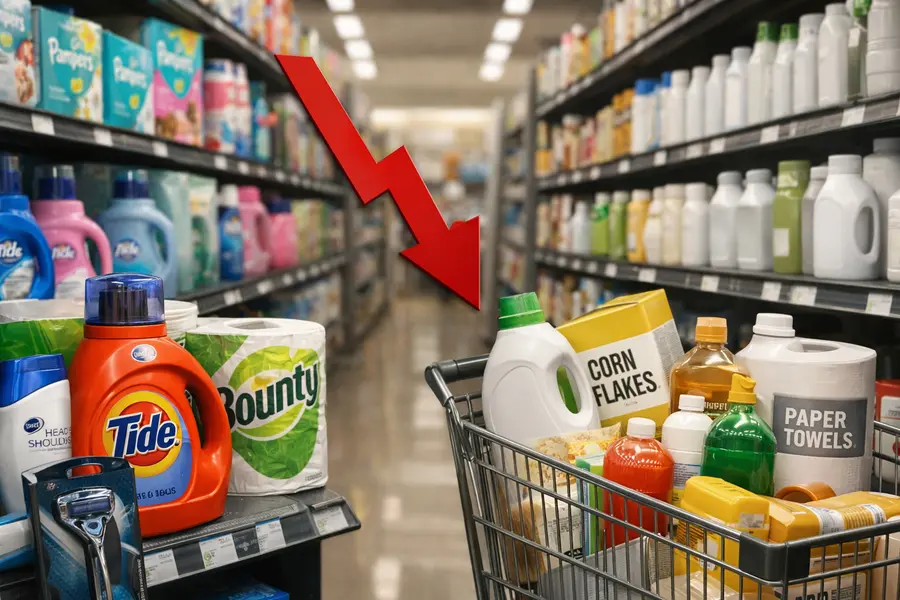
P&G posted volume growth in just one fiscal quarter as price-conscious shoppers traded down to store brand shampoo and stretched every last drop of product further.
- U.S. private label retail sales reached a record $282.8 billion in 2025, growing nearly three times faster than national brands.
- Store brand personal care and beauty posted dollar growth of 10.4%, the strongest gain of any private label department tracked by Circana.
- P&G's FY2025 net sales held at $84.3 billion, but full-year all-in volume was unchanged as pricing carried all organic growth.
Lead
NEW YORK — Procter & Gamble Co. closed its fiscal year 2025 with net sales of $84.3 billion and organic growth of 2 percent, yet volume — the measure of actual units sold — was flat for the full year and positive in only one quarter, as price-conscious shoppers reached for store brand shampoo and other private-label alternatives or quietly stretched their existing products to last longer between purchases.
The pattern marks a structural shift in consumer behavior that is pressuring the world's largest household-goods company even as private label market share climbs to levels not seen in the modern era of consumer packaged goods.
What Happened
P&G's volume story played out in quarters. The company recorded a positive organic volume contribution in the first half of the fiscal year before momentum stalled as macroeconomic pressure intensified. By the third quarter ended March 2025, organic sales grew just 1 percent, driven entirely by pricing; volume and mix contributed nothing. Net sales for the period came in at $19.8 billion, down 2 percent on a reported basis as foreign-exchange headwinds eroded results.
Chief Financial Officer Andre Schulten acknowledged the deceleration explicitly: U.S. value consumption, running near 3 percent for the prior twelve months, slowed to roughly 1 percent through February and March 2025. The company trimmed its full-year guidance at that quarterly report.
For the full fiscal year, organic sales grew 2 percent — split between pricing and mix. All-in volume was unchanged. Pricing, the lever P&G pulled aggressively during the post-pandemic inflation cycle, had become the sole engine of growth.
Trading Down and Stretching Products
The headwind is not limited to shoppers switching brands. Schulten described a subtler behavioral shift: shoppers "choosing to be a little bit more diligent in terms of using pantry inventory, maybe dosing the product a little bit more carefully." The result is fewer purchase occasions — a structural drag on volume regardless of brand loyalty or preference.
Beyond stretching, price-conscious shoppers are actively switching. Industry data from Circana and the Private Label Manufacturers Association shows U.S. private-label retail sales reached $282.8 billion in 2025, a record. Store brands grew dollar sales 3.3 percent against just 1.2 percent for national brands — nearly three times the pace. Unit share for private label hit 23.5 percent, also a record, up from 21.6 percent in 2021.
Consumer sentiment reinforces the numbers. A July 2025 survey found that 71 percent of U.S. shoppers believed they could identify store brands on the shelf — yet when shown products side by side, 72 percent could not. Quality perception, long the principal barrier to private-label adoption in categories like shampoo and skin care, is eroding. Globally, 68 percent of consumers now view store brands as good alternatives to national brands, a threshold materially higher than five years ago.
P&G's Competitive Position
Procter & Gamble executives have pushed back against the most alarming interpretation of the data. CEO Jon Moeller and CFO Schulten have both cited the ratio of private-label volume to P&G brand volume as their preferred internal benchmark. By that measure, Schulten stated that U.S. private label share in P&G's specific categories had actually declined, falling below 16 percent — even as overall industry private label share rose to records.The company's argument: consumers are not abandoning its brands at the category level, and premium positioning through product innovation remains viable. P&G continued to invest in advertising, reformulations, and packaging improvements to justify price premiums across its portfolio of household staples.
That argument is harder to sustain in the volume data. Across the back half of FY2025 and the opening quarters of FY2026, P&G reported effectively no unit growth, relying instead on residual pricing power built during the 2022–2024 inflation cycle.
Market Context
P&G shares fell following the Q3 FY2025 earnings report when the company trimmed guidance. The stock trades at a premium to consumer staples peers, a valuation that presupposes a return to volume-led growth — one that has remained elusive.
Private label's five-year trajectory adds urgency. Store brands have added $64.8 billion in annual U.S. sales since 2021, a 30 percent increase driven by a combination of retailer investment in product quality, improved shelf placement, and a generation of shoppers whose inflation-era habits have hardened into permanent preferences.
Outlook
The central question for P&G and the broader consumer staples sector is whether the shift toward store brand shampoo and private-label personal care reflects a cyclical response to elevated prices or a permanent recalibration of shopper expectations. The five-year private label trajectory suggests the latter. Re-establishing volume growth will require either price adjustments that compress margins or product innovation compelling enough to pull price-conscious shoppers back to national brands — a test P&G has yet to pass at scale.