Pomegra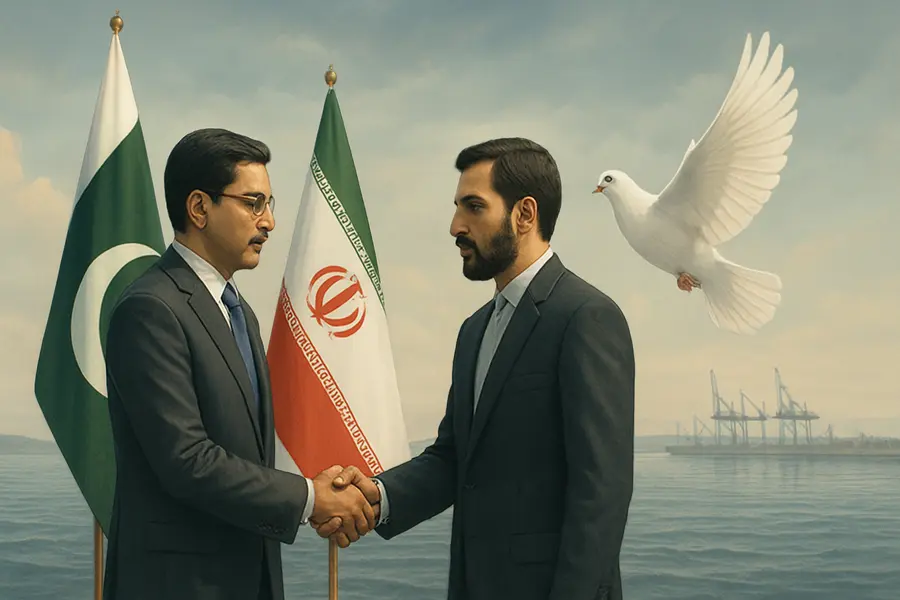
Pakistan's Islamabad Memorandum, signed June 17, halted more than 100 days of US-Israeli strikes on Iran and reopened the Strait of Hormuz after Brent crude peaked at $126 a barrel.
- The June 17 Islamabad Memorandum mandates immediate Strait of Hormuz reopening and lifting of the US naval blockade on Iranian ports.
- Brent crude fell from a $126/barrel wartime peak to approximately $72 as Hormuz transit volumes recovered toward 75% of prewar levels.
- A 60-day window now opens for Iran's nuclear program and sanctions relief talks, with Pakistan, Qatar, Saudi Arabia, Turkey, and Egypt as co-facilitators.
Lead
On June 17, 2026, US President Donald Trump and Iranian President Masoud Pezeshkian signed — remotely — a memorandum of understanding drafted in Islamabad, formally halting more than 100 days of US-Israeli military strikes on Iran and anchoring a Gulf security framework that markets and GCC governments had urgently sought. The deal triggered the first full day of commercial traffic through the Strait of Hormuz, with 25 vessel transits recorded — the highest in two months — as global energy supply chains began to normalize.
From Strikes to Islamabad
When the first US-Israeli airstrikes hit Tehran, Pakistan's Deputy Prime Minister and Foreign Minister Ishaq Dar was in Saudi Arabia attending an Organisation of Islamic Cooperation session. Within hours, Islamabad issued a statement and Dar called Iranian Foreign Minister Abbas Araghchi directly. That call opened a channel that no other actor in the region could credibly hold: an immediate neighbor of Iran with intact diplomatic ties to Washington.
Pakistan's April 8 proposal produced the war's first formal pause. The Islamabad Peace Talks followed on April 11–12, 2026 — a 21-hour session that ended without a final deal, the principal sticking points being Iran's nuclear stockpile and control of the Strait of Hormuz. A second ceasefire, extending the pause for 60 days, was agreed on June 12. Five days later, the Islamabad Memorandum was signed.
The Pakistani mediating team was led by Prime Minister Shehbaz Sharif, Field Marshal Asim Munir, and Ishaq Dar. Qatar, Saudi Arabia, Turkey, and Egypt each provided supporting facilitation, but Islamabad held the central chair throughout — a configuration that reflected Pakistan's unique dual access to both parties.
Gulf States: Major Losers, Urgent Stakeholders
Gulf Cooperation Council members ranked among the war's largest economic casualties. Iranian missile and drone strikes hit GCC territory. The double blockade of the Strait of Hormuz — Iran's closure compounded by a US naval cordon — disrupted energy exports, eroded tourism flows, reduced expatriate worker confidence, and caused infrastructure damage, including at Qatar's Ras Laffan liquefied natural gas complex. Economic growth projections across the bloc were revised downward; inflation edged higher.For GCC governments, the Islamabad Memorandum offered the relief they had sought since the conflict's opening days. The agreement mandates the lifting of the US naval blockade on Iranian ports alongside the Strait of Hormuz reopening, restoring the energy export corridors on which the Gulf's fiscal model depends. A proposed $300 billion reconstruction fund for Iran, contingent on Tehran's compliance with MOU terms, is expected to be sourced substantially from Gulf nations — converting the region's wartime losses into a stake in the deal's durability.
Energy Markets Absorb the Shift
Brent crude's arc through the conflict illustrated the disruption's scale. Prices crossed $100 per barrel for the first time in four years on March 8, peaked at $126 per barrel at the height of hostilities, and retreated to approximately $72 by June 17 — the lowest level since late February — as the MOU signing accelerated expectations of Iranian oil returning to global markets.
Persian Gulf exports recovered to roughly 75% of prewar volumes within days of signing, led by Chinese-affiliated tonnage resuming transit. Major Western shipping lines and elevated war-risk insurance premiums kept some carriers sidelined, making full market normalization a near-term rather than immediate outcome.
Pakistan's Strategic Calculus
Islamabad's motivation combined urgency and opportunity. Pakistan shares a 909-kilometer border with Iran in the Balochistan region, making any conflict spillover or refugee flow an immediate domestic security problem. Elevated energy import costs through the war's duration added further pressure to an already strained economy.
The Iran war diplomacy gains run deeper than economics. Pakistan's role in producing the Islamabad Memorandum positioned it as a credible interlocutor with both Washington and Tehran simultaneously — a dual-access credential that no other regional actor could match. The outcome represents a landmark expansion of Pakistan's Middle East footprint, establishing Islamabad as a consequential actor in great-power conflict mediation for the first time.
What Comes Next
The MOU establishes a 60-day negotiating window. Iran's nuclear program — specifically, the downgrading of weapons-grade uranium to reactor-grade following a final agreement — remains the central unresolved issue. Sanctions relief timelines are yet to be defined. A simultaneous Israeli-Hezbollah ceasefire brokered on June 19, facilitated by the US, Qatar, and Iran, added a second fragile truce layer to an already complex regional architecture.
The Strait of Hormuz remains technically open but operationally cautious. Full shipping normalization — including the return of major Western carriers and the correction of war-risk premiums — is contingent on the 60-day talks producing durable outcomes on the nuclear file.