Pomegra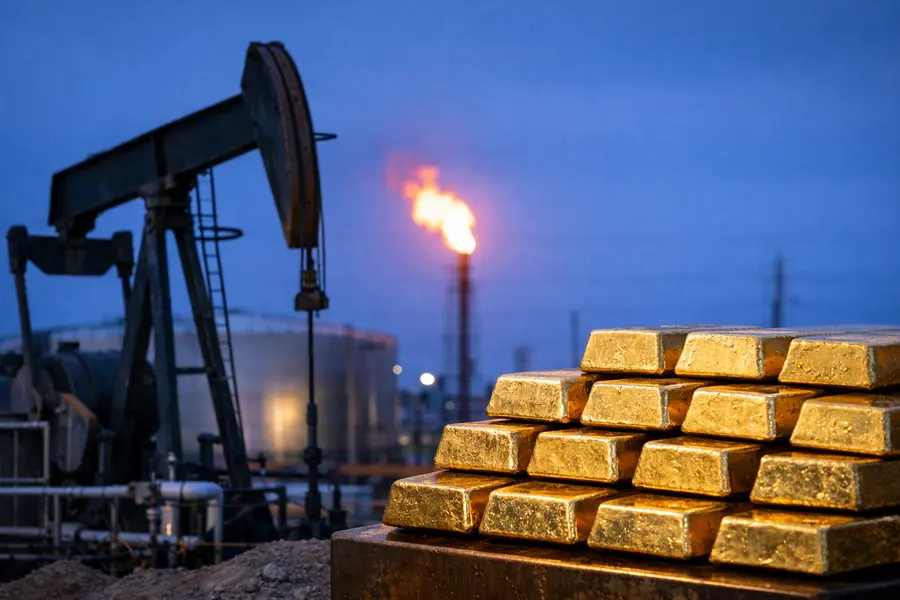
Lead
Crude oil fell sharply on Wednesday, August 13, with West Texas Intermediate losing $1.30 to settle near $81.97 per barrel and Brent crude declining $1.29 to $87.69, as a combination of swelling U.S. stockpiles and downgraded global demand forecasts pushed prices lower despite persistent tensions around the Strait of Hormuz. Simultaneously, gold pulled back from elevated levels as dollar strength curbed appetite for the non-yielding metal — a broad commodity retreat that illustrated the deepening divergence between geopolitical headline risk and underlying macroeconomic reality.
- WTI crude dropped 1.4% to $81.97/bbl after a 17.4-million-barrel U.S. stockpile build, the largest in months.
- OPEC and the IEA cut their 2026 global oil demand outlooks for the third consecutive month, removing floor support.
- Gold retreated from recent highs as the U.S. dollar strengthened, sending gold bars lower alongside broader commodity pressure.
What Happened
The dominant force in energy markets was a U.S. Energy Information Administration report showing crude inventories rose by 17.4 million barrels in the week ending August 7 — a build of unusual magnitude that caught traders off guard and immediately weighed on the crude oil chart across all major benchmarks. Supply normalization through the Strait of Hormuz, which had been disrupted for much of early 2026, also allowed more barrels to reach global markets, gradually eroding the risk premium that had supported prices.
On the demand side, OPEC trimmed its 2026 demand growth estimate for the third consecutive month in its July report — a cumulative downward revision of roughly 20% — while the International Energy Agency issued a parallel cut. The sequential nature of those revisions has increasingly convinced markets that elevated consumption assumptions earlier in the year were overstated, and that the fundamental balance is looser than previously believed.
OPEC+ compounded the bearish picture by approving a 188,000 barrel-per-day output increase for August, its fifth straight monthly addition as the group gradually unwinds voluntary production cuts. With supply rising and demand forecasts falling, the directional pressure on prices was unambiguous.Gold and the Dollar
Gold bars — which had rallied aggressively through early 2026, hitting a record $5,597.23 per ounce in January — pulled back Wednesday in sympathy with the broader commodity complex and under direct pressure from a firmer U.S. dollar. The metal traded near $4,374 per ounce, retreating from the two-month high touched earlier in the session as currency markets absorbed relatively hawkish signals from Federal Reserve communications.The Fed funds rate remains at 3.50–3.75%, and while no near-term hike is the consensus expectation, three policymakers supported a rate increase at the July meeting — a minority position that nonetheless injected uncertainty into the outlook. For gold, which carries no yield, even a modest repricing of rate expectations tightens the opportunity cost calculus for holders, amplifying the drag from dollar appreciation.
Strategic and Geopolitical Context
The session underscored a key tension that has defined commodity markets for much of 2026: geopolitical risk — centered on the Strait of Hormuz, through which roughly 20% of globally traded oil passes — has been insufficient to offset deteriorating demand fundamentals. As Hormuz shipping gradually normalizes, the supply disruption premium that padded crude prices earlier in the year is deflating.
The EIA's short-term energy outlook projects WTI to fall toward $78 per barrel by the fourth quarter of 2026 and to $69 per barrel in 2027, a trajectory consistent with a market moving from deficit toward balance as both OPEC+ supply and non-OPEC production expand.
For gold, the structural case — central bank accumulation, de-dollarization flows, and safe-haven demand linked to geopolitical fragmentation — remains intact, even as tactical positioning adjusts to dollar movements. The metal's swift retreat from record territory earlier this year has been characterized broadly as a mean-reversion from an overstretched run rather than a reversal of the underlying trend.
Outlook
The near-term outlook for crude oil is weighted to the downside. Consecutive demand forecast reductions from both OPEC and the IEA, rising U.S. inventories, and stepped-up OPEC+ supply all point toward a softer price environment through year-end, with the EIA's $78 fourth-quarter target appearing increasingly credible. Persistent Hormuz uncertainty provides a floor, but absent a material escalation, that support is limited. Gold faces continued volatility tied to dollar direction and Fed rate expectations, though the medium-term trajectory hinges on whether inflation data pushes policymakers toward action or restraint. Upcoming CPI and PPI releases are the next catalysts for both metals and energy markets.
Mentioned tickers: USO, GLD, BNO, WTIC, IAU, SLV