Pomegra
Reports that Nvidia may guarantee $250 billion in OpenAI data center debt rattled AI hardware markets, sending NVDA shares down nearly 5% and triggering sector-wide losses on circular financing fears.
- Nvidia fell nearly 5% to $197 after the Wall Street Journal reported talks to backstop $250B in OpenAI data center financing.
- AMD dropped 8%, Dell tumbled 14%, and Marvell fell 7% as circular financing concerns swept the AI hardware sector.
- Critics warn Nvidia may be inflating GPU demand by financing the very customer buying its data center servers and chips.
Lead
Reports that Nvidia is in talks to backstop up to $250 billion in debt financing for OpenAI's planned 10-gigawatt data center campus in Pike County, Ohio, sent shockwaves through AI hardware markets on July 27. Nvidia shares fell 4.9% to $197, breaching the psychologically significant $200 level, while the broader semiconductor sector recorded one of its steepest single-session losses in months. The selloff reflected growing unease over what analysts described as an unprecedented vendor-financing arrangement in the AI infrastructure buildout.
What Happened
The Wall Street Journal reported that Nvidia is considering providing a financial backstop that would allow OpenAI to raise debt at more favorable terms than the unprofitable company could secure independently. A separate but related agreement would cover up to $350 billion in chip purchases, with the combined structure tied to SoftBank's SB Energy subsidiary developing the Ohio campus.
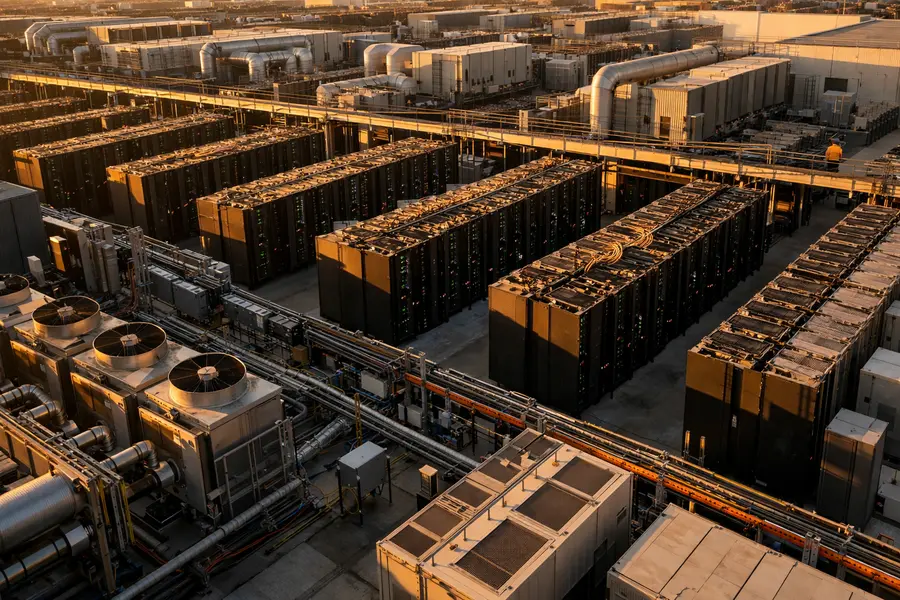
The backstop functions as a credit guarantee: Nvidia's balance sheet underwrites OpenAI's borrowing, enabling the data center buildout to proceed at a scale that OpenAI's standalone credit profile could not support. The Ohio campus, estimated to cost more than $500 billion in total, represents one of the largest single infrastructure projects in U.S. corporate history.
OpenAI CEO Sam Altman pushed back on the report, posting on X that the company "neither has nor wants guarantees for its data centers," while also saying the company "loves working with NVIDIA and they make the best AI chips in the world." OpenAI raised $122 billion in March at an $852 billion valuation, with Nvidia contributing $30 billion as one of the round's largest investors.Market Reaction
The selloff rippled across the entire AI hardware supply chain. AMD shed approximately 8%. Dell Technologies, a major seller of AI-configured data center servers, fell 14% over the reporting period. Marvell Technology dropped more than 7%, while Broadcom and HPE also declined. Apple surpassed Nvidia as the largest U.S. company by market capitalization for the first time since April 2025 as Nvidia's valuation eroded.
The Philadelphia Semiconductor Index posted outsized losses relative to the broader market, underscoring how concentrated the damage was in AI-exposed names. Volume in Nvidia options surged, with put activity accelerating through the session.
The Circular Financing Problem
The core investor concern centers on what market participants are calling circular financing: Nvidia guarantees OpenAI's debt, OpenAI uses the proceeds to purchase Nvidia GPUs, and those GPUs fill data center servers that generate the revenue OpenAI needs to service the debt. Critics argue the arrangement manufactures GPU demand rather than reflecting organic end-market pull.
Investor Michael Burry, who bet against the U.S. housing market ahead of the 2008 financial crisis, disclosed increased short positions in Nvidia, Micron, and the iShares Semiconductor ETF, posting "Around and Around We Go" on social media in reference to the structure. The concern is not that any individual transaction is fraudulent, but that the arrangement can mask a mismatch between AI infrastructure investment and actual monetizable AI workloads.
The criticism echoes longer-running debates about whether AI capex has outpaced the revenue it is generating. OpenAI reports approximately $2 billion per month in revenue — strong by software standards, but far below what would be required to service hundreds of billions in infrastructure debt without continued equity injections.
Strategic Context
The backstop news lands against an already-fragile backdrop for AI hardware. In early June, Broadcom's AI revenue guidance disappointed expectations, erasing more than $1.3 trillion in combined semiconductor market value in a single session. Marvell fell nearly 20% over two days during the same period. The Nvidia-OpenAI report has reopened those wounds, reviving questions about whether the AI spending supercycle is self-sustaining or structurally dependent on a closed loop of tech giants financing one another's buildouts.
For Nvidia, the strategic logic of supporting OpenAI's data center expansion is straightforward: OpenAI is among its largest customers, and ensuring OpenAI can fund its infrastructure needs protects a critical revenue stream. But investors now face the question of whether Nvidia's balance sheet is being stretched to prop up demand for its own products — a risk that, if it materialized, would hit both revenue and credit metrics simultaneously.
OpenAI's path to profitability also matters here. The company is preparing for an IPO by end of 2026. A debt-financed data center buildout underpinned by Nvidia's credit would give OpenAI access to large-scale compute without immediate equity dilution, but it also encumbers the balance sheet heading into a public listing.
Outlook
The immediate selloff may stabilize if Nvidia formally denies the backstop terms or if OpenAI provides clarity on its data center financing strategy. However, the episode has surfaced a structural concern that will not disappear with a denial: the AI infrastructure buildout relies heavily on a small number of companies guaranteeing one another's spending, and any disruption to that loop — a slowdown in AI revenue, a tightening of credit conditions, or a shift in hyperscaler capex plans — could cascade quickly through the data center servers and chip supply chain. Near-term, Nvidia's next earnings report and any update on OpenAI's debt financing plans will be closely watched for signs of whether the circular financing concerns are being addressed or are deepening.
Mentioned tickers: NVDA, AMD, DELL, MRVL, AVGO, HPE, MU